

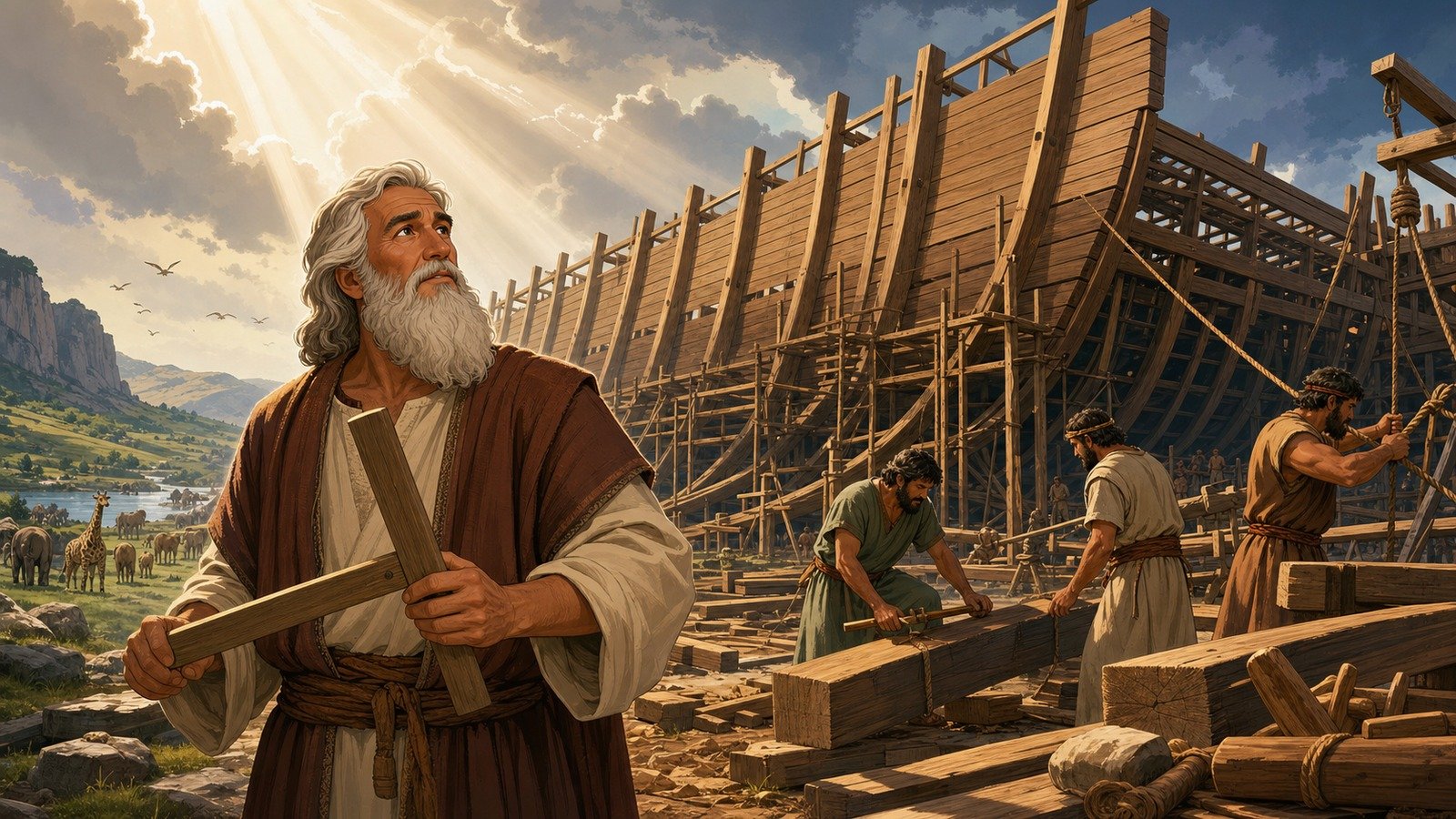
God gives Noah detailed instructions for the ark's construction and announces both the coming Flood and the covenant he will establish with Noah's family and the animals brought aboard.
Further context
2 min readThree terms are used of Noah: righteous, blameless among the people of his time, and one who walked faithfully with God. The last of those has been used once before, of Enoch, and reusing it marks him out from the generation just described.
The building instructions are specific enough to test. The vessel is three hundred cubits long, fifty wide and thirty high, with three decks, a door in the side and an opening near the top. A cubit was never standardised and the usual range runs from about forty-four to fifty-two centimetres, which puts it somewhere near a hundred and thirty-five metres by twenty-two by thirteen.
The proportions matter more than the absolute size. A length-to-beam ratio of six to one is close to what large wooden hulls actually use. But the thing described is a floating box rather than a ship: no sail, no rudder, no oars, no keel and no means of steering appear anywhere. It is built to stay afloat and be carried, not to go anywhere.
That is where this boat differs most sharply from the vessels in the Mesopotamian flood stories it is usually set beside. In the version preserved in the epic of Gilgamesh, found on tablets in the library at Nineveh, the boat is a cube of a hundred and twenty cubits on each side with seven decks. In an older Babylonian version the vessel appears to be round, and a tablet published in 2014 describes a large circular coracle built of coiled rope. A cube and a coracle would both behave very badly in water at that scale. These dimensions are the only ones in the group that a shipwright would recognise.
The material is named with a Hebrew word (gopher) that occurs nowhere else in the Bible, and its meaning is unknown. "Cypress" in most modern versions is an educated guess based on timber used for boatbuilding in the region, and the older "gopher wood" simply reproduces the Hebrew without translating it.
Two things here are worth separating from the popular version of the story. The first is that a covenant is announced before the Flood begins, using a word that will carry enormous weight through everything that follows and meaning a binding commitment with stated terms. This is its first appearance anywhere in the Bible, and it makes the rescue the keeping of an undertaking rather than a rescue alone.
The second concerns the animals. Here they are two of every kind, male and female. A few paragraphs later the instruction is seven pairs of every clean animal and one pair of every unclean one. Some scholars treat the difference as evidence of two combined sources. Others read the first as a general instruction and the second as a refinement, noting that the extra clean animals are needed for the sacrifice offered after the Flood, which would otherwise wipe out a species at the moment of thanksgiving.
Noah does everything exactly as he was commanded, and that is the whole of his response. He asks no questions, raises no objection and is given no dialogue at all. Abraham will argue about Sodom, Moses will list five reasons why he is the wrong man, Gideon will demand a sign twice. Noah builds the boat.