

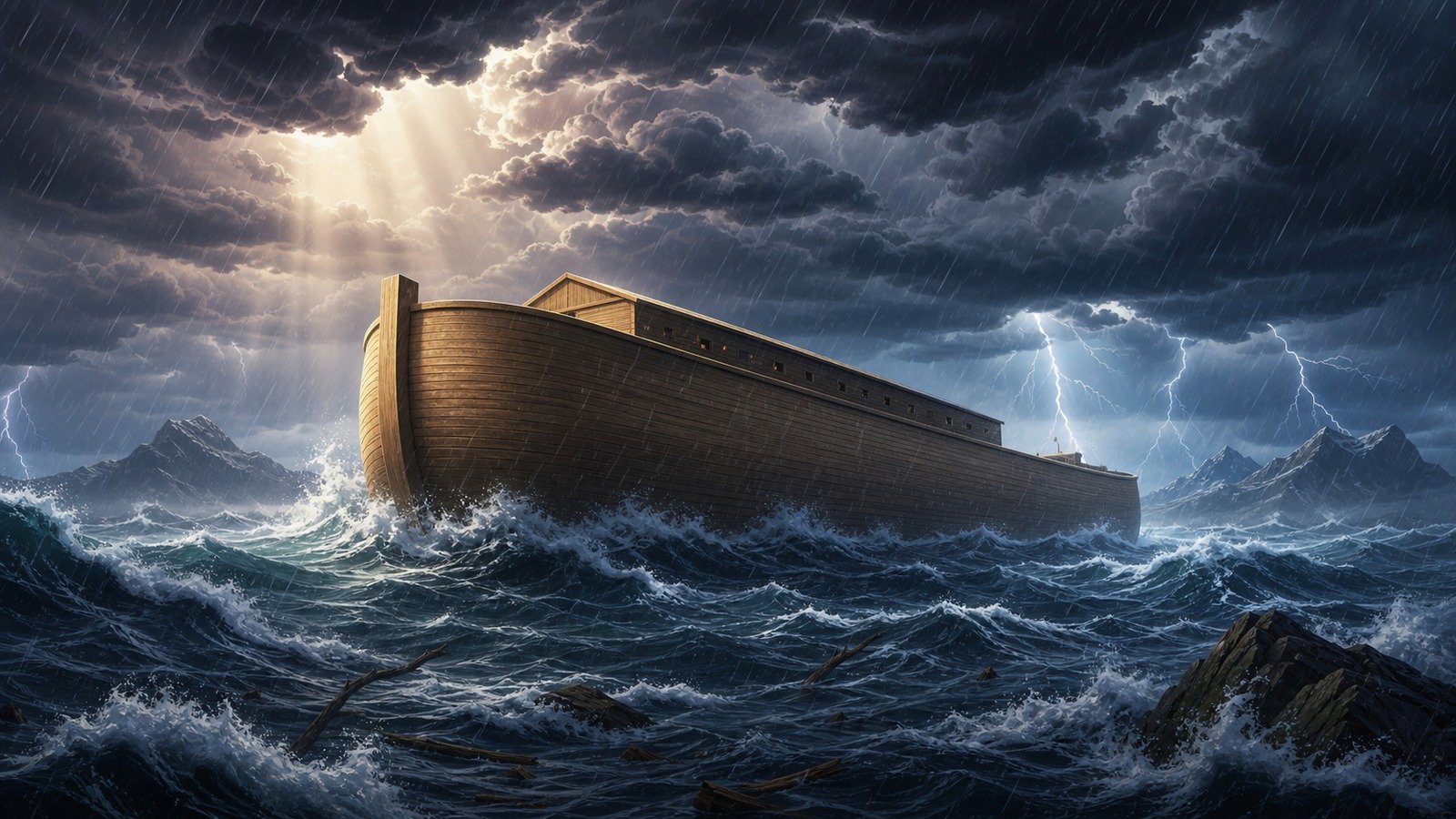
The Flood covers the earth for forty days of rain and a total of 150 days before the waters begin to recede, destroying all land-dwelling life outside the ark. Noah's family and the animals with them survive as the sole continuation of terrestrial life.
Further context
3 min readWater came from below as well as from above. The springs of the great deep burst open at the same moment the floodgates of the heavens were thrown wide, which undoes in one sentence the separation of the waters made on the second day of creation. Rain fell for forty days and forty nights, and the water held its height for a hundred and fifty more.
The dating is unusually exact for this part of the story: the seventeenth day of the second month of Noah's six hundredth year. The high mountains were covered to a depth of fifteen cubits, roughly seven metres.
How far the water reached is disputed among Christians who accept that the event happened, and the disagreement turns on evidence rather than on commitment. The Hebrew noun rendered "earth" (erets) means either the whole world or a particular land, and the phrase "all the earth" is used elsewhere for something plainly bounded, as when all the world is said to have come to Egypt to buy grain during a famine. On that basis some read a catastrophic regional flood described from the standpoint of the people living through it. Against that stands the language of the flood itself, which reports every living thing on dry land perishing and the mountains submerged, and reads naturally as universal.
Physical evidence does not settle it. No globally synchronous flood deposit is recognised anywhere in the geological record. Regional flood layers in Mesopotamia are well attested and were being excavated within living memory: Leonard Woolley cut through a sterile silt band more than two metres thick at Ur in 1929, and comparable layers have been found at Kish, Shuruppak and Nineveh. They are not contemporaneous with one another, which rules them out as traces of one event and confirms that severe, memorable inundations happened in that region repeatedly.
The figure of 2348 BC circulates widely and comes from the same seventeenth-century arithmetic that produced 4004 BC for the creation. It has no independent support of any kind, and it sits awkwardly against the continuous occupation of Egyptian and Mesopotamian sites straight through that period.
Flood stories from the same region survive in copies older than any surviving copy of Genesis, and the similarities are close enough to require comment. Both the Atrahasis epic, known from Old Babylonian tablets of the seventeenth century BC, and the eleventh tablet of the Gilgamesh epic describe a flood sent by the gods, a survivor warned in advance, a large vessel, animals taken aboard and birds released to test for dry land.
The differences run to motive and character. In Gilgamesh the gods send the flood because human noise is disturbing their sleep, the decision is taken in secret, one god leaks it to his favourite, and the gods themselves cower like dogs against a wall when the storm arrives. Here the cause is moral and stated, the judgement and the rescue are announced together, and there is no fear, no deception and no divided council anywhere.
Jesus used these days as an image, and what he picked out was not the water. People were eating and drinking, marrying and giving in marriage, right up to the day Noah entered the boat, and knew nothing about it until the flood came. The point being made was about ordinary life carrying on undisturbed, not about the scale of the catastrophe.