

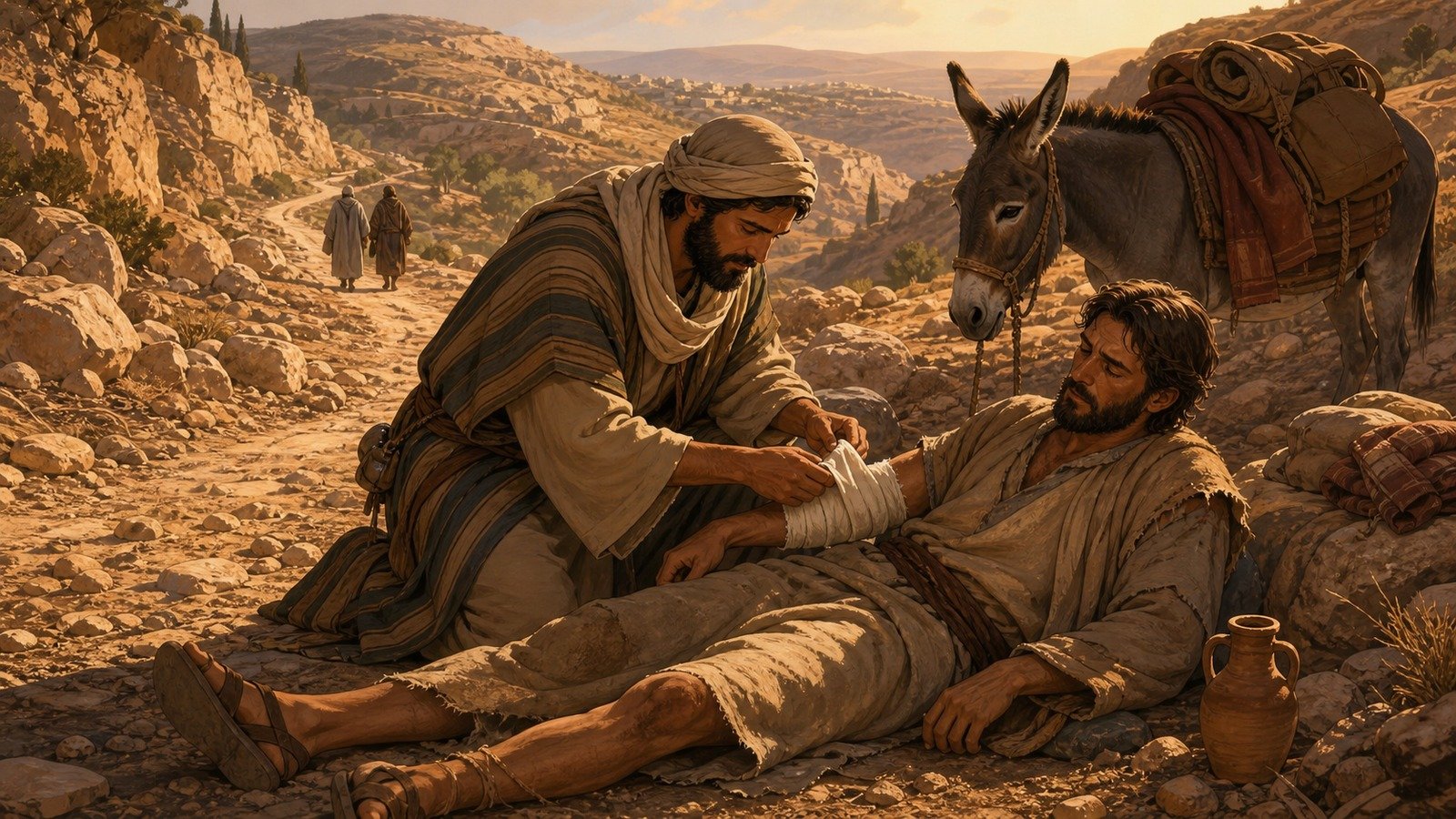
Asked by an expert in the law who counts as a "neighbour," Jesus tells of a Samaritan, a despised outsider by Jewish standards, who helps a beaten traveller after a priest and a Levite pass by, redefining neighbourly obligation around compassionate action rather than ethnic or religious identity.
Further context
3 min readAn expert in the law stands up to test Jesus and asks what he must do to inherit eternal life. Sent back to the law, he quotes the command to love God with all his heart, soul, strength and mind, and to love his neighbour as himself.
Told he has answered correctly, he wants to justify himself and asks the question that produces the story: and who is my neighbour?
It was a serious legal question, not a dodge. The command about loving a neighbour sits in a chapter dealing with fellow Israelites, and the boundary of the obligation was genuinely debated. The Qumran community held that outsiders were owed hatred.
The road from Jerusalem down to Jericho drops about a thousand metres in twenty-seven kilometres through bare limestone hills with ravines on both sides, and it was notorious for robbery for centuries afterwards. A stretch of it was later called the Red Ascent.
A man going down that road is stripped, beaten and left half dead.
A priest goes down the same road, sees him, and passes by on the other side. Then a Levite does the same. Both belonged to the temple establishment, and both would have had a strong reason in mind: contact with a corpse made a man ritually unclean for seven days, and the man on the ground looked dead. It is a defensible calculation and the story lets it stand without comment, which is more damaging than an argument.
Then a Samaritan, and the audience would have expected a third figure completing the sequence of priest, Levite and ordinary Israelite. What they get instead is a member of the group they despised most, and the point lands in that gap.
What he does is itemised. He takes pity, goes to him, bandages his wounds, pours on oil and wine, puts him on his own donkey, brings him to an inn and looks after him. Oil soothed and wine, being alcoholic, disinfected, and both were standard first-century treatment. Putting the man on the animal means the Samaritan walked.
The next day he gives the innkeeper two denarii, two days' wages for a labourer, enough for perhaps a fortnight's lodging, and undertakes to reimburse any extra on his return. A beaten Jewish traveller left in a Jewish inn under the credit of a Samaritan was in a position where the innkeeper had every incentive not to detain him for debt.
The closing question inverts the original one. The lawyer asked who qualified as his neighbour. He is asked instead which of the three was a neighbour to the man who fell into the hands of robbers.
He cannot bring himself to say the word Samaritan. The one who had mercy on him, he answers.
The lawyer's opening question assumes that eternal life is something inherited by doing, and the answer he is given never disputes it. He is sent to the law, quotes it correctly, and is told to go and do likewise.
Christians have found that exchange awkward for a long time, since it appears to make a good life the condition of everything. The more careful readings note who is asking and why: a man testing a teacher, then trying to justify himself, is being shown the full extent of what the command he has just quoted actually requires, and the story he is told makes it impossible for him to draw a boundary anywhere.