

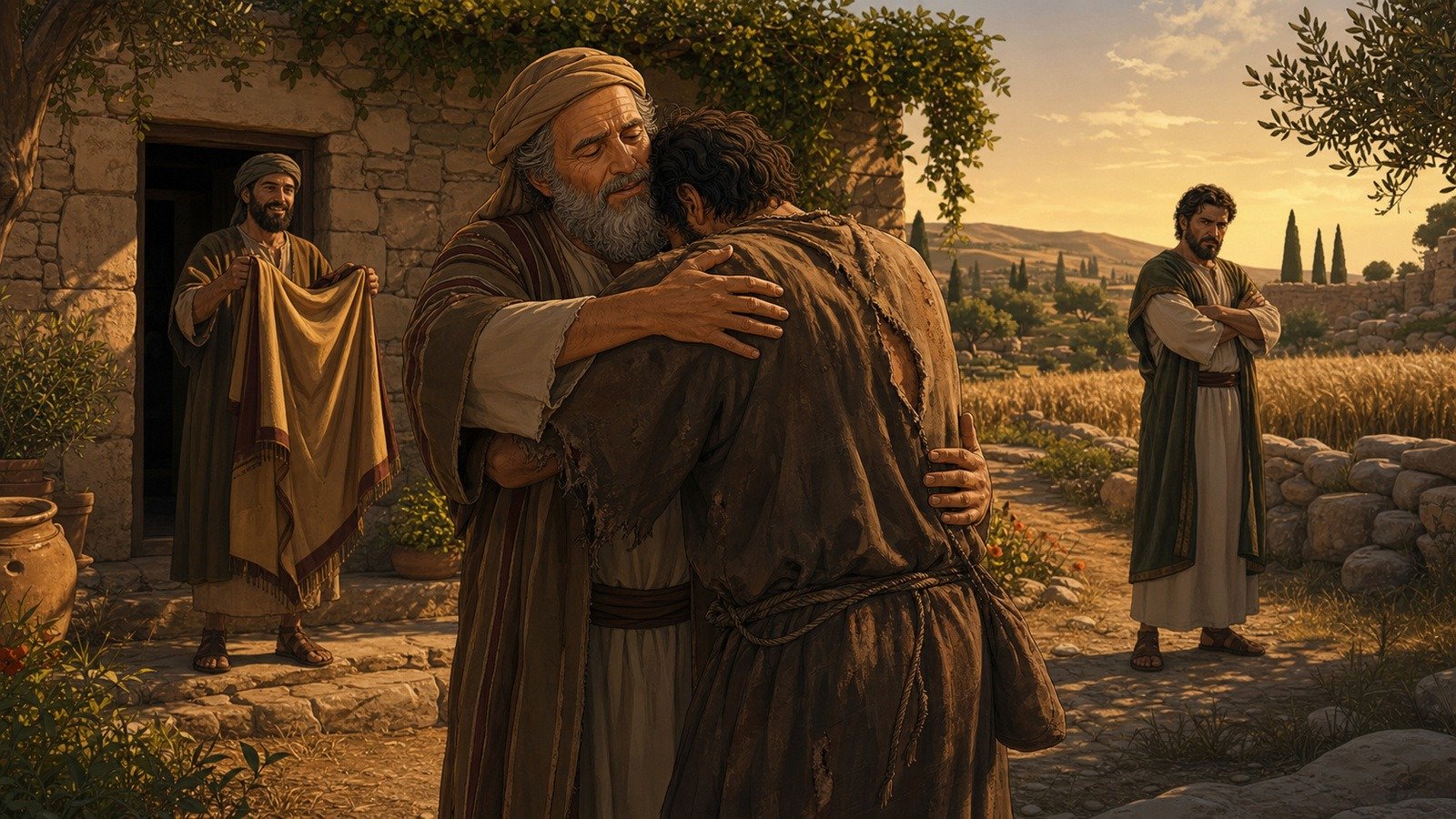
A younger son squanders his inheritance and returns home in desperation, only to be welcomed by his father with open celebration, while an older brother resents the mercy shown; the parable closes the sequence in Luke 15 as its fullest statement of God's pursuing grace.
Further context
2 min readThe third story Jesus tells in the same conversation, and the longest of any of them.
A man has two sons. The younger says: father, give me my share of the estate.
What that meant in a village where everyone watched everyone has to be understood, because English translations make it sound like an awkward request rather than what it was. Inheritance passed at death. Asking for it early amounts to treating the father as though he were already dead, and doing it publicly humiliates him. A father in that culture had every social right to refuse and to strike the boy. This one divides his property between them, and the word used is the one for a life or a livelihood.
The younger son converts his share to cash, which means selling land that had been in the family for generations to neighbours who would see him do it, and leaves for a distant country.
He squanders it in wild living. Then a severe famine, and he hires himself out to a citizen of that country who sends him to feed pigs, an animal no Jew would keep, and he longs to fill his stomach with the pods the pigs are eating. Carob pods were fodder, and eating them was a byword for destitution.
When he comes to his senses, his plan is a job application. He rehearses a speech about being no longer worthy to be called a son, and asks to be made a hired servant, which is the lowest category, a day labourer rather than a member of the household.
The father sees him while he is still a long way off, which means he had been watching the road. Then he runs. An elderly man in that society did not run; it required gathering up his robe and exposing his legs, and it was undignified. Some have suggested the running also gets him to his son before the village does, since a young man who had sold family land and lost the money in Gentile territory would have faced a rough reception at the gate.
The speech is interrupted before the request for a job. The robe, the ring and the sandals are all restoration of standing: the best robe is the father's own, a ring signifies authority, and slaves went barefoot.
The fattened calf means the whole village is invited, because an animal that size had to be eaten in a day.
Then the older brother, who has been in the fields, hears music and dancing and will not go in. His complaint is that he has slaved for years and never even had a young goat, while this son of yours, not this brother of mine, gets a calf.
The father goes out to him too, which is the second time he leaves a party to meet a son outside, and says: my son, you are always with me, and everything I have is yours.
The story stops there. Whether the elder brother went in is left open, and the men who had been muttering about the company he kept were the ones being asked.