

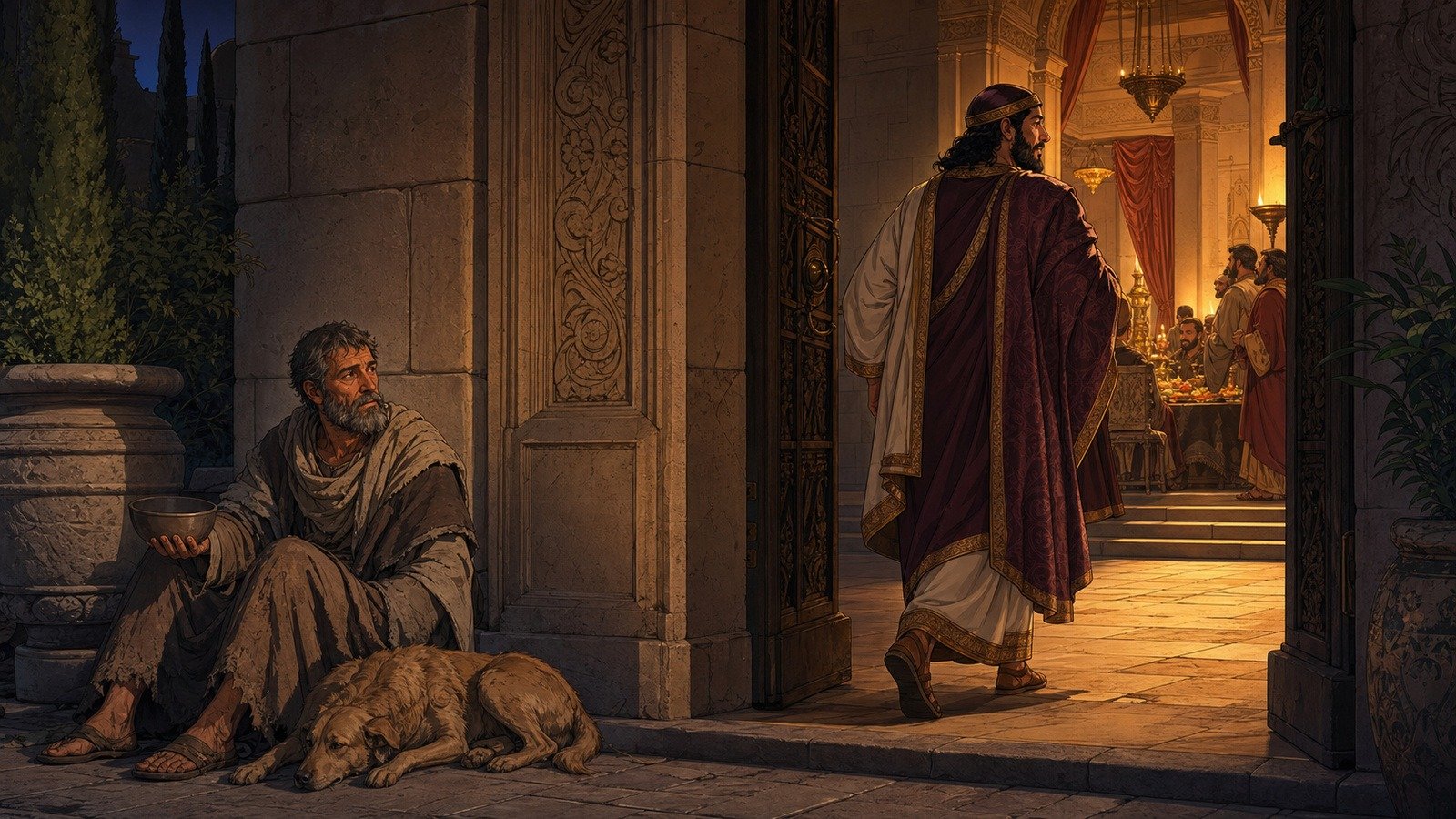
Jesus tells of a wealthy man who ignores a poor beggar, Lazarus, at his gate; after death their situations reverse, and the rich man's request to warn his living brothers is refused, since "they will not be convinced even if someone rises from the dead."
Further context
3 min readA rich man dressed in purple and fine linen and living in luxury every day. At his gate a beggar named Lazarus, covered with sores, longing to eat what fell from the rich man's table, with dogs coming and licking his sores.
Purple dye came from a shellfish gathered on the Phoenician coast, and it took thousands of them to produce enough for one garment, which is why purple meant wealth. Fine linen from Egypt was the other half of the display. Feasting every day, rather than at festivals, is the third detail.
The gate is a large ornamental one, so this is a substantial house, and Lazarus has been placed at it, presumably carried there by someone. The dogs are scavengers, not pets.
Lazarus is the only character in any of the parables given a name, and it is a shortened form of Eleazar, meaning God has helped.
Both die. The beggar is carried by the angels to Abraham's side, and the rich man is buried, which is mentioned because Lazarus almost certainly was not.
What follows is a conversation across a chasm, and it needs a caution. The imagery is drawn from popular Jewish pictures of the afterlife current at the time, with the righteous and the wicked separated but within sight of one another, and stories with a similar shape circulated in Egypt and in Jewish tradition. It is a parable working with familiar furniture, not a survey of the geography of the next world.
The rich man's first words show that nothing has changed in him. He asks Abraham to send Lazarus to dip his finger in water and cool his tongue. He knows the beggar's name, which means he knew it all along, and he is still treating him as staff.
Told that a great chasm has been fixed, he asks for Lazarus to be sent to his five brothers to warn them. They have Moses and the Prophets, he is told; let them listen to them.
No, father Abraham, but if someone from the dead goes to them, they will repent.
The answer closes the story: if they do not listen to Moses and the Prophets, they will not be convinced even if someone rises from the dead.
Within a few months a man called Lazarus would come out of a tomb near Jerusalem, and the response of the authorities was to plan his death as well.
The five brothers are a detail nobody has ever satisfactorily explained, and attempts to identify them with the household of Caiaphas, who had five brothers-in-law, are ingenious and unprovable.
What the story is doing has been argued about at length. Read as a warning about wealth, it fits the surrounding material, which is full of money. Read as a warning about evidence, it belongs with everything else in that section: a man who will not be persuaded by what he already has will not be persuaded by anything, and spectacular proof changes nothing in a person who has decided in advance.
The rich man is not accused of cruelty. He is never described as driving Lazarus away or refusing him. He simply walked past a man at his own gate every day for years and did nothing at all, and the indictment is entirely in the omission.