

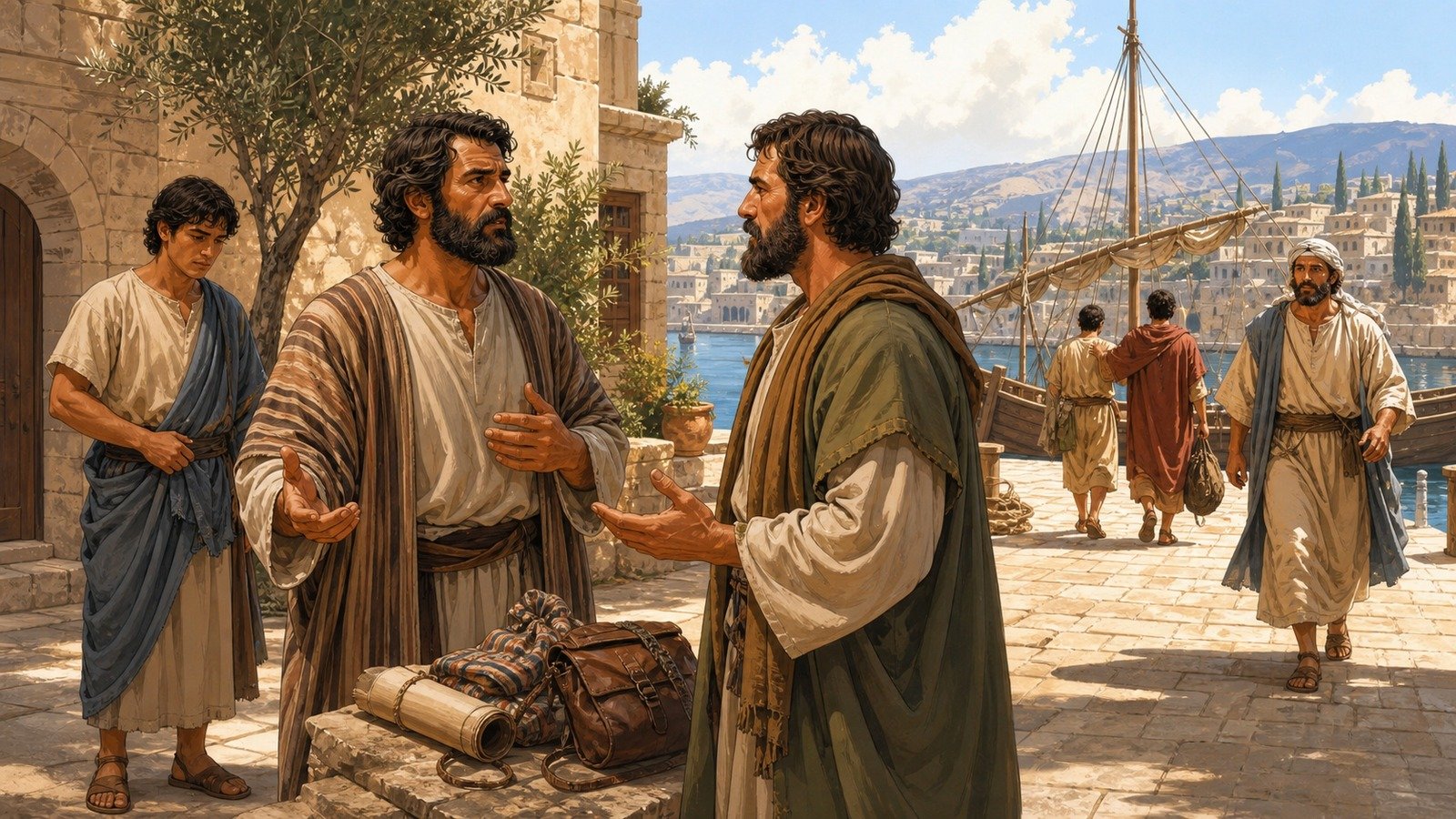
Planning a return visit to the churches founded on the first journey, Paul and Barnabas disagree sharply over whether to bring John Mark, who had left them partway through the earlier trip; the two separate, Barnabas taking Mark to Cyprus and Paul choosing Silas instead.
Further context
2 min readSome time later Paul says to Barnabas: let us go back and visit the believers in all the towns where we preached the word of the Lord and see how they are doing.
Barnabas wants to take John, also called Mark. Paul does not, because he had deserted them in Pamphylia and had not continued with them in the work.
They had such a sharp disagreement that they parted company.
The word used for the disagreement gives English the word paroxysm, and nothing is done to soften it. Two men who had worked together for years, one of whom had vouched for the other when nobody else would, split up in an argument about a young relative.
Both positions are defensible and neither is criticised. Paul is running a mission across hostile territory where a man leaving halfway is a serious matter, and he had a first journey's experience to judge by. Barnabas, whose name meant son of encouragement and whose entire record is of backing people other people had written off, was doing again exactly what he had done for Paul.
Mark was also Barnabas's cousin, which Paul mentions elsewhere, so family loyalty is in it too.
So Barnabas took Mark and sailed for Cyprus, which was his own island and the first stop of the earlier journey. Neither of them appears again in the record of the early church. Paul chose Silas and left, commended by the believers to the grace of the Lord, and went through Syria and Cilicia, strengthening the churches.
What happened afterwards is worth knowing, because it does not end where the quarrel does.
Writing from prison years later, Paul mentions Mark among his fellow workers and tells a congregation to welcome him. In what is generally taken to be his last surviving letter he asks Timothy to bring Mark with him, because he is helpful to me in my ministry.
Early tradition, from the second century onwards, identifies this man as the writer of the second Gospel and as Peter's interpreter in Rome.
The quarrel also doubled the mission. Two teams went out instead of one.
Silas, whom Paul takes instead, is one of the two men sent from Jerusalem with the council's letter, so his selection also brings the ruling's authority along on the journey. He is called Silvanus in the letters, appears as co-sender of both letters to Thessalonica, and is named as the man through whom Peter's first letter was written.
Nothing further is recorded of Barnabas anywhere, though Paul mentions him respectfully twice in letters written afterwards.
John Mark's desertion at Perga is mentioned twice and never explained. Homesickness, fear of the mountain roads, and disagreement about preaching to Gentiles have all been proposed, and there is no evidence for any of them.
Silas is also described as a Roman citizen a few chapters later, when the two of them are beaten at Philippi, which made him a useful travelling companion in colonies where that mattered.
The two teams that resulted covered Cyprus and Asia Minor simultaneously, and nothing suggests either man regarded the arrangement as a failure afterwards.