
A dispute over whether Gentile converts must be circumcised and keep the Law of Moses brings Paul and Barnabas to Jerusalem; after debate, Peter and James speak in favour of not burdening Gentile believers, and the council sends a letter asking only that they avoid a short list of specific practices.
Further context
2 min readCertain people came down from Judea to Antioch and were teaching the believers: unless you are circumcised, according to the custom taught by Moses, you cannot be saved.
That is the question, and it is not a technicality. Circumcision was the sign of the covenant with Abraham, commanded in the law, and men had died rather than abandon it under Antiochus IV. What was being asked was whether a Gentile had to become a Jew in order to become a Christian.
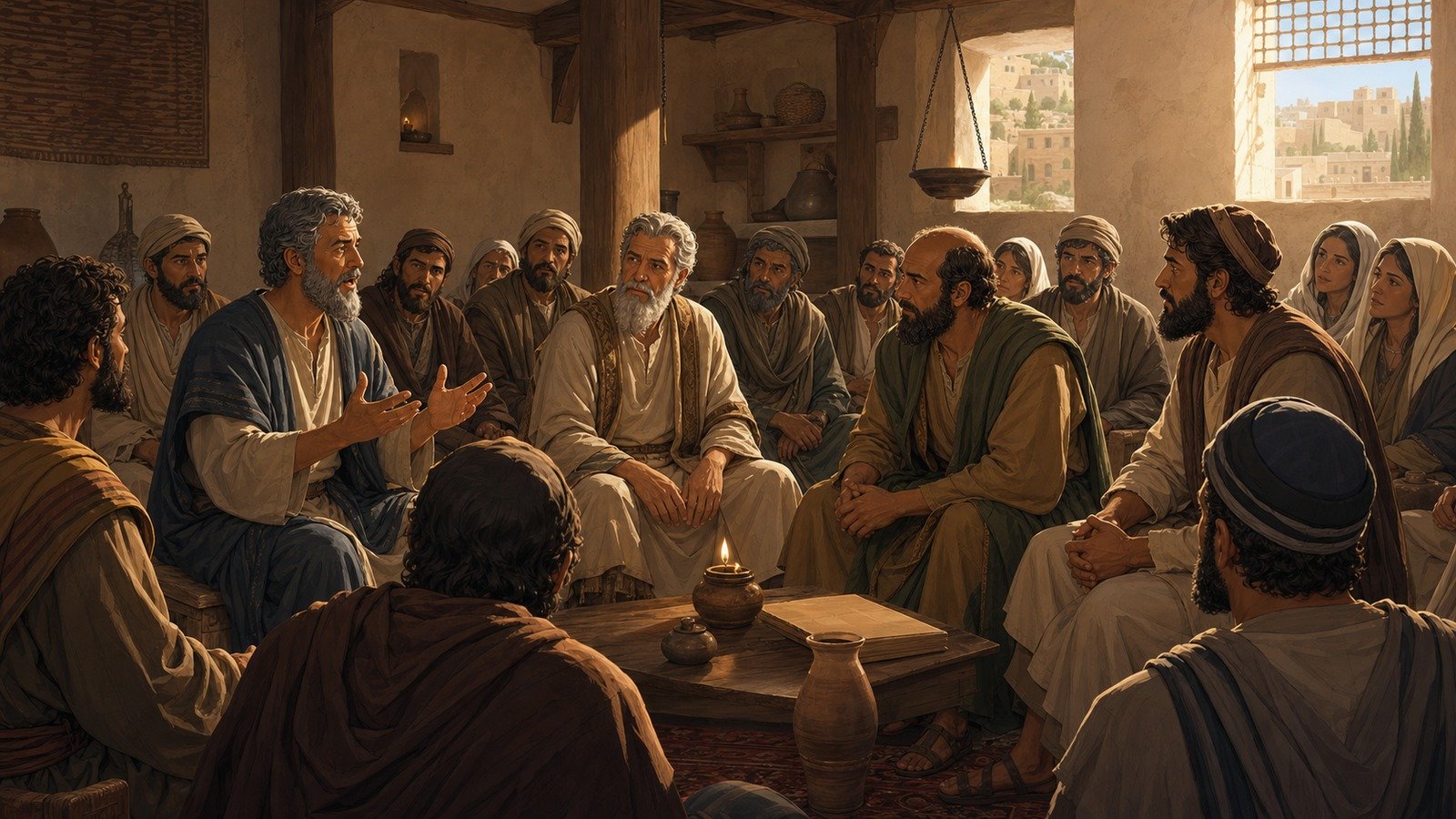
Paul and Barnabas are appointed to go up to Jerusalem to see the apostles and elders about it, and the meeting that follows is the first church council.
There was much discussion, which is a restrained way of putting it. Some of the believers who belonged to the party of the Pharisees stood up and said the Gentiles must be circumcised and required to keep the law of Moses. These are Christians who are also Pharisees, and their position is the conservative reading of their own Scriptures.
Peter speaks first, and his argument is the one he had used before: God, who knows the heart, showed that he accepted the Gentiles by giving the Holy Spirit to them, just as he did to us. He did not discriminate between us and them, for he purified their hearts by faith. Now then, why do you try to test God by putting on the necks of Gentiles a yoke that neither we nor our ancestors have been able to bear?
Then Barnabas and Paul report the signs and wonders God had done among the Gentiles through them.
James speaks last and gives the ruling, which indicates his standing: he is the brother of Jesus, who had not believed during his lifetime and now leads the Jerusalem church.
He quotes Amos on the restoration of David's fallen tent so that the rest of mankind may seek the Lord, including all the Gentiles who bear my name, and then gives his judgement: we should not make it difficult for the Gentiles who are turning to God.
Four requirements are set instead, and they are mostly about what makes shared meals possible: abstain from food polluted by idols, from sexual immorality, from the meat of strangled animals and from blood.
A letter is written and carried back to Antioch by delegates, and it opens with a phrase that has been quoted in church assemblies ever since: it seemed good to the Holy Spirit and to us.
The four requirements have been read in two ways. On one reading they are moral rules; on another they are the four prohibitions the law lays on foreigners living among Israel, which would make them a formula for coexistence at a shared table rather than a shortened moral code.
What the council did not do is as significant as what it did. It imposed no circumcision, required no Sabbath observance, and set no dietary code beyond those four items. A Jewish assembly in Jerusalem decided that Gentiles could belong without becoming Jews, and wrote it down.