

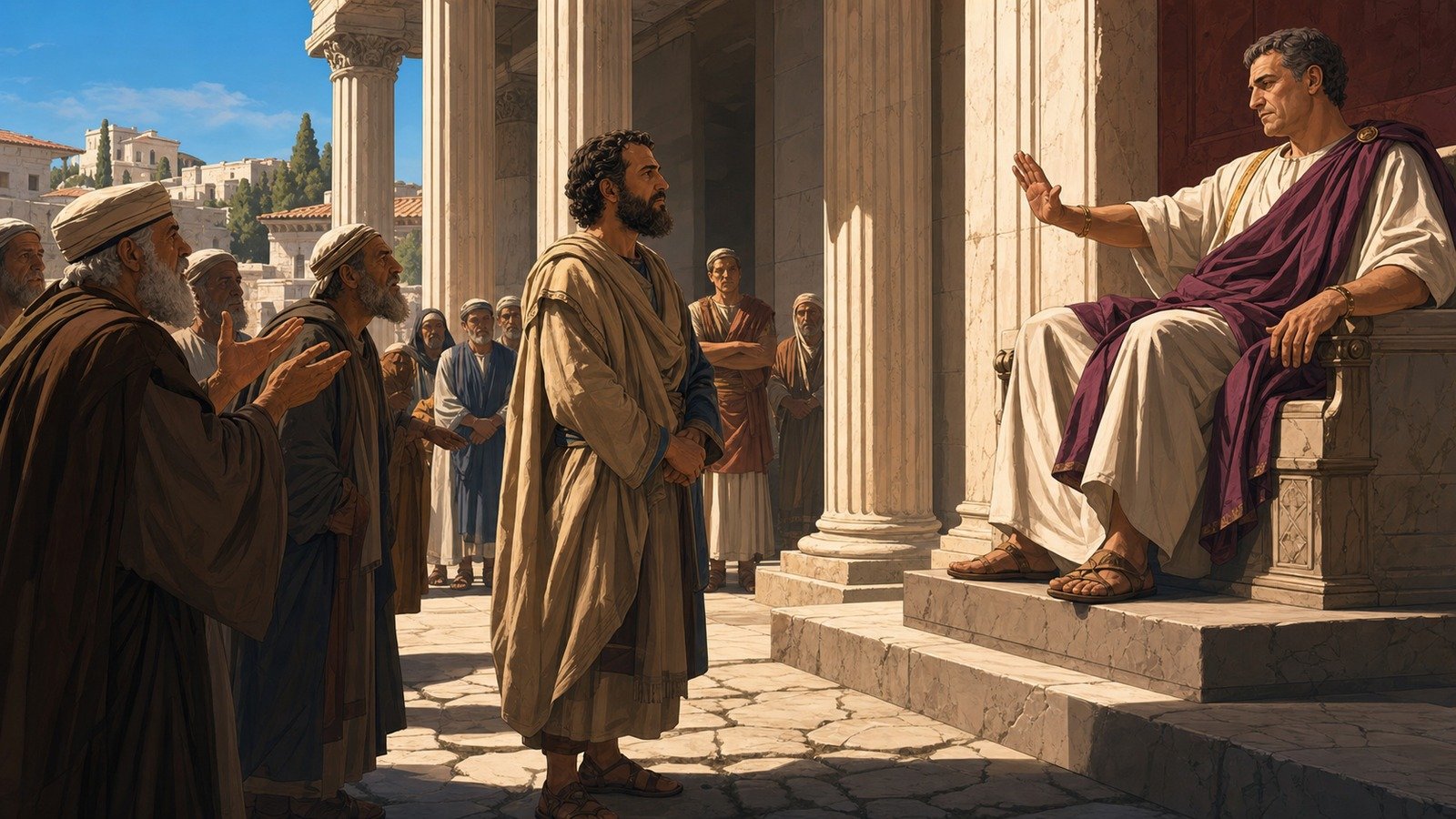
Jewish opponents in Corinth bring Paul before the proconsul Gallio, who dismisses the case as an internal religious dispute rather than a matter for Roman law, allowing Paul to continue his eighteen months of ministry in the city undisturbed.
Further context
2 min readWhile Gallio was proconsul of Achaia, the Jews of Corinth made a united attack on Paul and brought him to the place of judgement.
This one sentence is the single most useful piece of dating in the New Testament.
Gallio was Lucius Junius Gallio Annaeanus, elder brother of the philosopher Seneca and therefore a member of one of the best-connected families in the empire. An inscription found at Delphi, a copy of a letter from the emperor Claudius, mentions him as proconsul of Achaia and can be dated to AD 51 or 52. Proconsuls held office for a year, usually beginning in early summer.
That fixes Paul in Corinth in AD 51 or 52, and because his movements before and after can be counted forwards and backwards from there, it anchors the chronology of his whole working life, and with it a good deal of the first-century church.
The charge brought against him is: this man is persuading the people to worship God in ways contrary to the law.
Which law is precisely the question, and Gallio answers it before Paul can open his mouth.
If you Jews were making a complaint about some misdemeanour or serious crime, it would be reasonable for me to listen to you. But since it involves questions about words and names and your own law, settle the matter yourselves. I will not be a judge of such things.
So he had them ejected from the court.
The ruling matters more than it looks. Judaism was a permitted religion under Roman law, with legal protections; a new movement outside it would have had none. By classifying the dispute as internal to Judaism, a Roman proconsul in a senatorial province set a precedent that other magistrates could follow, and Paul worked for another decade without serious interference from Roman authority.
Then a final detail, reported without comment. Crowd feeling turns on Sosthenes, the synagogue leader, and they beat him in front of the court, and Gallio shows no concern whatever.
A man named Sosthenes appears a few years later as co-sender of a letter Paul writes to this same city.
Achaia was the Roman province covering southern Greece, with Corinth as its capital, and a proconsul governed it for a single year on appointment by the senate.
Seneca, Gallio's brother, was tutor and then adviser to Nero, and both men were forced to take their own lives in the aftermath of a conspiracy in the mid-sixties. Gallio is described by his brother as universally liked, which is not usually said of provincial governors.
That a proconsul's ruling in a provincial capital could set the terms for later magistrates is not a formal legal doctrine but it was how Roman practice worked, and the record of the following years shows local officials repeatedly declining to treat the movement as a criminal matter.
Delphi is about a hundred and thirty kilometres from Corinth across the gulf, and the inscription found there was cut into stone at the sanctuary, where imperial correspondence was displayed publicly. Its survival in fragments is the accident on which the whole chronology hangs.