

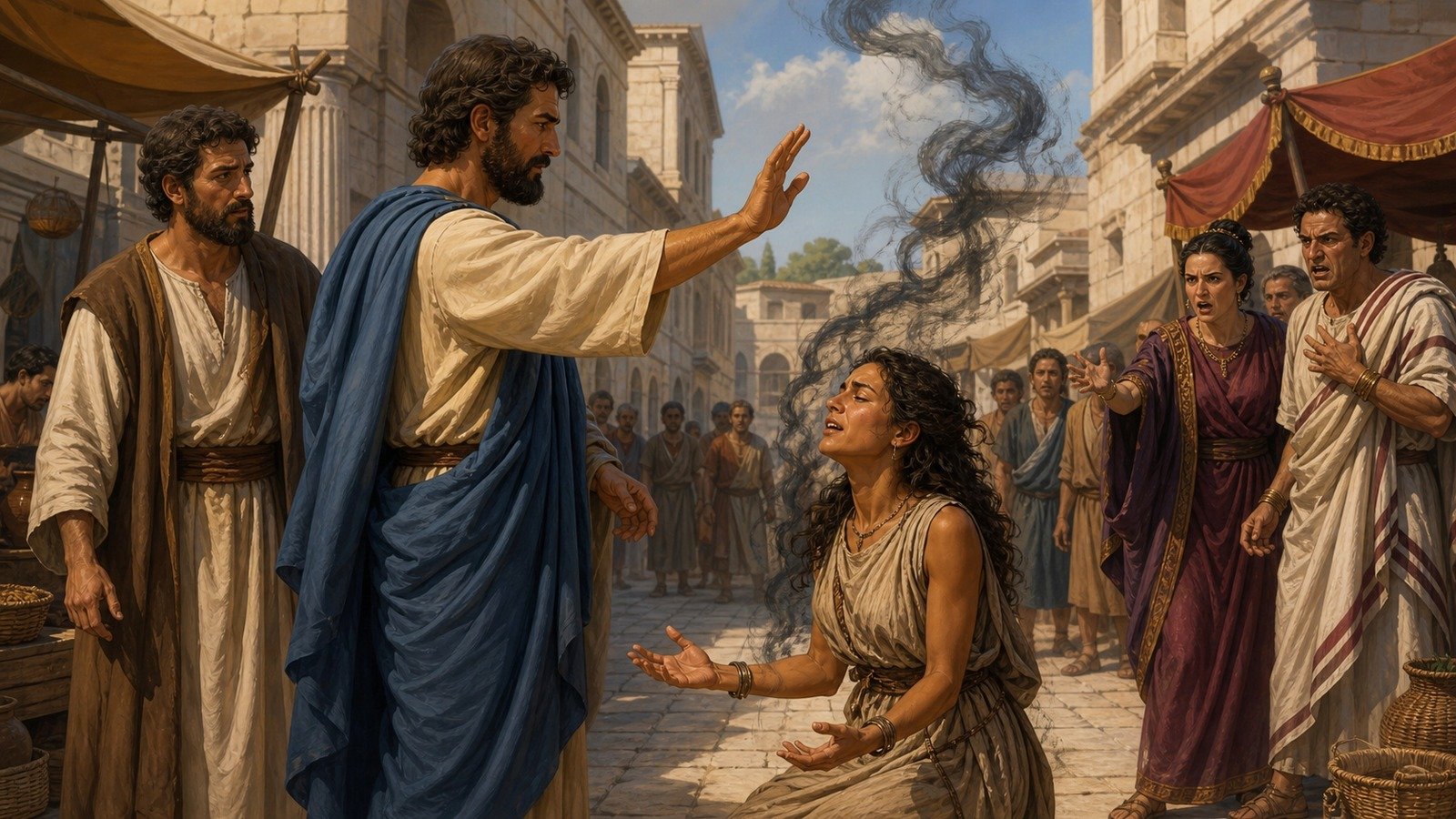
A slave girl whose fortune-telling brings her owners considerable profit follows Paul's group shouting about them for days; Paul, apparently more irritated than moved, commands the spirit out of her in Jesus' name.
Further context
2 min readOn the way to the place of prayer, Paul and his companions are met by a slave girl who has a spirit by which she predicted the future. She earned a great deal of money for her owners by fortune-telling.
The Greek describes her as having a python spirit, which is a technical term rather than an image. Python was the serpent killed by Apollo at Delphi, and the priestess who gave the oracles there was called the Pythia; by the first century the word was being used generally of ventriloquising spirits and the people through whom they were held to speak. Plutarch, a priest at Delphi in this period, discusses such people.
She is a slave, and she is owned by more than one person, which was a normal arrangement for a valuable asset.
She follows Paul and the others, shouting: these men are servants of the Most High God, who are telling you the way to be saved.
Everything in that sentence is accurate, which is what makes the episode strange. Most High God was a title used by Jews and also by pagans of Zeus, so a Philippian crowd could hear it either way, but nothing she says is false.
She keeps this up for many days. Finally Paul became so annoyed that he turned round and said to the spirit, in the name of Jesus Christ I command you to come out of her. At that moment the spirit left her.
The word for his reaction means worn down or exasperated, and it is the only exorcism in the New Testament attributed to irritation. Nothing is said about compassion for the girl, which readers have noticed for centuries and which the writer evidently saw no need to improve.
When her owners realised that their hope of making money was gone, they seized Paul and Silas and dragged them into the marketplace to face the authorities.
The charge they bring says nothing about money. These men are Jews, and are throwing our city into an uproar by advocating customs unlawful for us Romans to accept or practise.
An appeal to civic identity and a hint of anti-Jewish feeling, in a colony proud of being Roman, from men whose actual grievance is a lost income stream.
Nothing is said about what happened to the girl. She is freed of the spirit and disappears from the story, and her owners' first recorded thought is their income.
Fortune-telling by slaves was a recognised commercial activity, and the money went to the owner. A girl of that kind was an investment, and the loss they suffered was the loss of a producing asset, which is why the case went straight to the magistrates.
Delphi's oracle was still operating in this period, though in decline, and Plutarch wrote a treatise asking why its verses had grown worse. A python spirit in a Roman colony in Macedonia is a provincial version of a very old institution.
Philippi's magistrates are called strategoi, the Greek rendering of the Latin title used by the senior officials of a Roman colony, and the lictors with their rods are named separately, which is the correct establishment for a colony of that standing.