

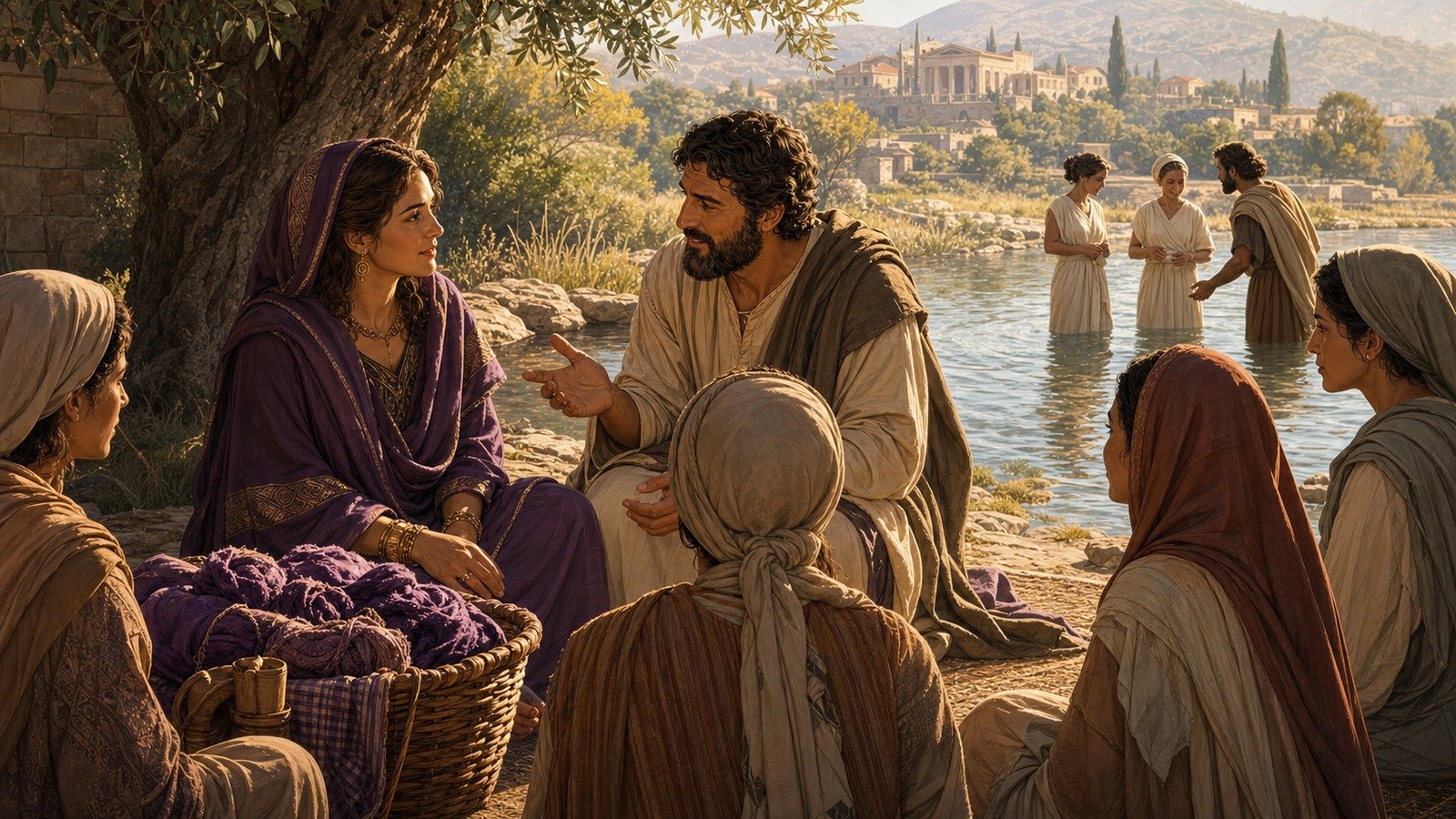
At Philippi, Paul meets a group of women praying by a river; a merchant of purple cloth named Lydia responds to his message, is baptised with her household, and offers her home as a base for the mission.
Further context
2 min readPhilippi was a Roman colony, the leading city of that district of Macedonia, settled with veterans after the battle fought there in 42 BC in which Antony and Octavian defeated the assassins of Julius Caesar. Its inhabitants held Roman citizenship, its inscriptions are in Latin, and its people were conscious of the fact, which becomes relevant a few days later.
On the Sabbath Paul and his companions go outside the city gate to the river, where they expect to find a place of prayer.
That expectation carries an implication. A synagogue required ten Jewish men, and the absence of one in a city of this size means the Jewish community was very small. What they find by the water is a group of women.
They sit down and speak to the women who had gathered there.
One of those listening was a woman from the city of Thyatira named Lydia, a dealer in purple cloth, who was a worshipper of God. The Lord opened her heart to respond to Paul's message.
Every detail there is worth unpacking.
Thyatira was in the province of Asia and was known for its dyeing trade; inscriptions from the town mention a guild of dyers. Purple cloth was the luxury end of the textile market, and the dye came either from shellfish or, in that region, from the madder root, which produced a cheaper imitation. Either way she is in business, trading at distance from her home city, with a household of her own, which describes a woman of independent means.
A worshipper of God is the standing term for a Gentile attached to the synagogue without being a proselyte.
When she and the members of her household were baptised, she invited them to her home. If you consider me a believer in the Lord, she said, come and stay at my house. And she persuaded them.
The verb is strong enough to suggest they took some persuading, which is in character for a man who elsewhere insists on paying his own way by working.
The first person named as a convert in Europe is a businesswoman, and the church at Philippi appears to have met in her house.
Philippi becomes the congregation Paul is warmest about. He calls them his joy and crown, thanks them for sending money repeatedly when no other church did, and writes to them from prison about learning to be content.
Purple was the most heavily regulated colour in the Roman world, with the deepest shades reserved by law for senatorial and imperial use, so a dealer in it was trading at the top of the market and dealing with people who mattered.
Her household being baptised with her follows a pattern that occurs several times, and how much it includes has been argued about for centuries, since a household in that world meant family, slaves and dependants. Churches that baptise infants and churches that do not have both read these verses closely.
Philippi is also the only church Paul allowed to support him financially while he worked, which he mentions to them explicitly and which sits oddly with his refusal of money everywhere else. Whatever the relationship was, it was exceptional.