

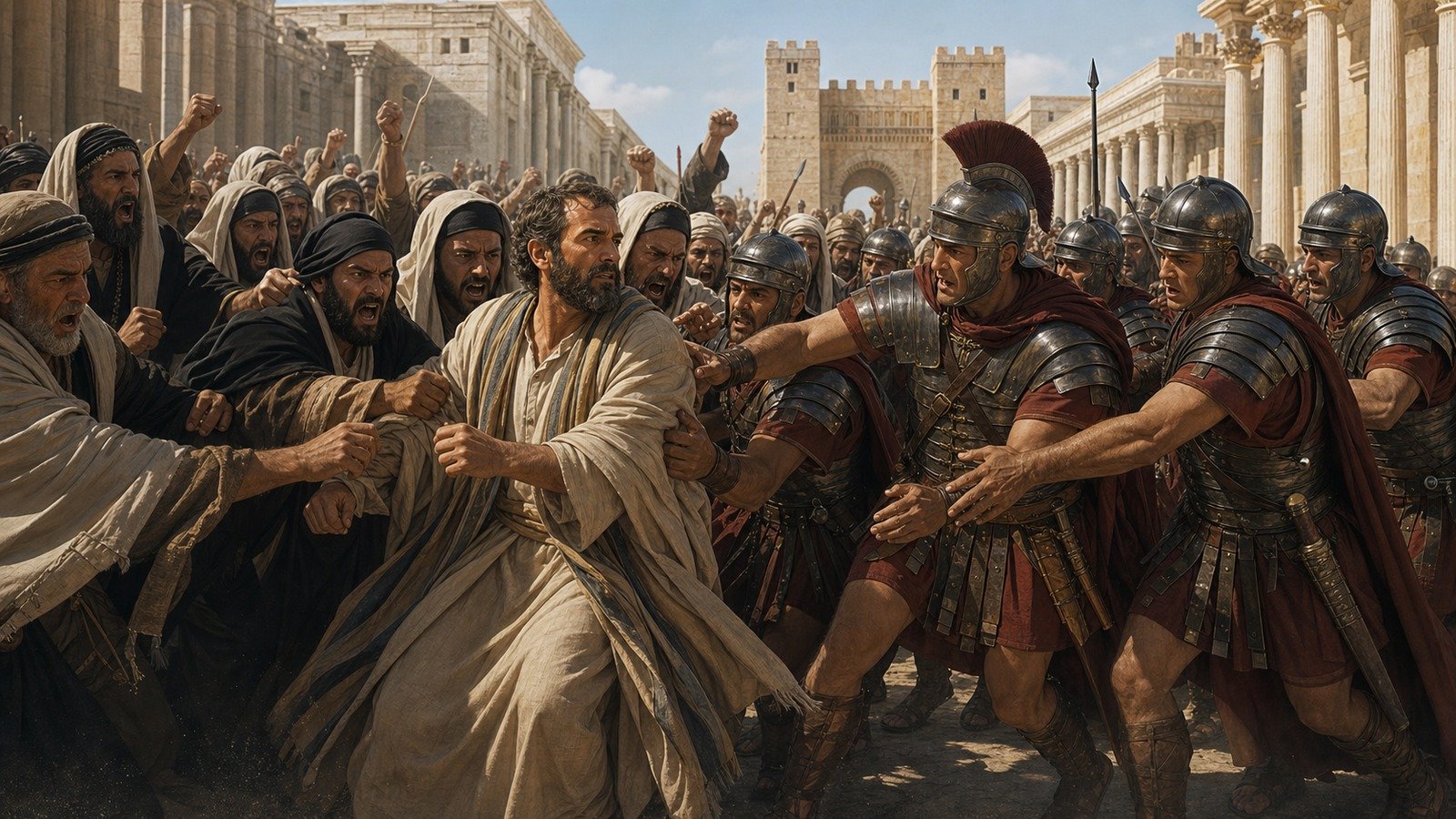
Jews from the province of Asia recognise Paul in the Temple and falsely accuse him of bringing a Gentile into its restricted area; a mob drags him out intending to kill him, and he is saved only by the intervention of a Roman commander and his troops.
Further context
2 min readJews from the province of Asia see Paul at the temple, stir up the whole crowd and seize him, shouting: fellow Israelites, help us! This is the man who teaches everyone everywhere against our people and our law and this place. And besides, he has brought Greeks into the temple and defiled this holy place.
The accusation is then explained: they had previously seen Trophimus the Ephesian in the city with Paul and assumed Paul had brought him into the temple.
That charge was not a technicality and it was not idle. The temple courts were divided, and a stone barrier about a metre and a half high separated the outer court, where anyone could go, from the inner courts, which no Gentile could enter. Notices in Greek and Latin were fixed to it warning that any foreigner who passed would have himself to blame for his death that follows. Two of those inscriptions have been recovered, one complete, now in Istanbul, and one fragment in Jerusalem.
Josephus states that the Romans permitted the Jewish authorities to execute even a Roman citizen for this offence, which if accurate makes it the only capital jurisdiction they retained.
The whole city is aroused, and the people come running from all directions. Seizing Paul, they drag him from the temple, and immediately the gates are shut.
Closing the gates is the temple staff protecting the building rather than the man. What happens outside is not their concern.
While they are trying to kill him, news reaches the commander of the Roman cohort that the whole city is in an uproar. He at once takes soldiers and centurions and runs down to the crowd.
The garrison was housed in the Antonia fortress at the north-west corner of the temple platform, with stairs leading directly down into the outer court, which is why the response is measured in minutes.
When the rioters see the troops they stop beating Paul. The commander arrests him, orders him bound with two chains, and tries to find out who he is and what he has done. Some in the crowd shout one thing and some another, and being unable to get at the truth because of the uproar, he orders him taken into the barracks.
The soldiers have to carry him up the steps because of the violence of the mob, and the crowd follows shouting: get rid of him!
The barrier inscription reads, in full: no foreigner is to enter within the balustrade and enclosure around the temple area. Whoever is caught will have himself to blame for the death that follows. It is the only surviving ancient text that prescribes a death penalty in the imperative for trespass.
Trophimus is named in a later letter as being left ill at Miletus, which is the last that is heard of the man whose presence in the city started a riot.
That the temple gates were shut behind him is the last time Paul is recorded inside the building. He spends the next four years in Roman custody at Caesarea and Rome.