

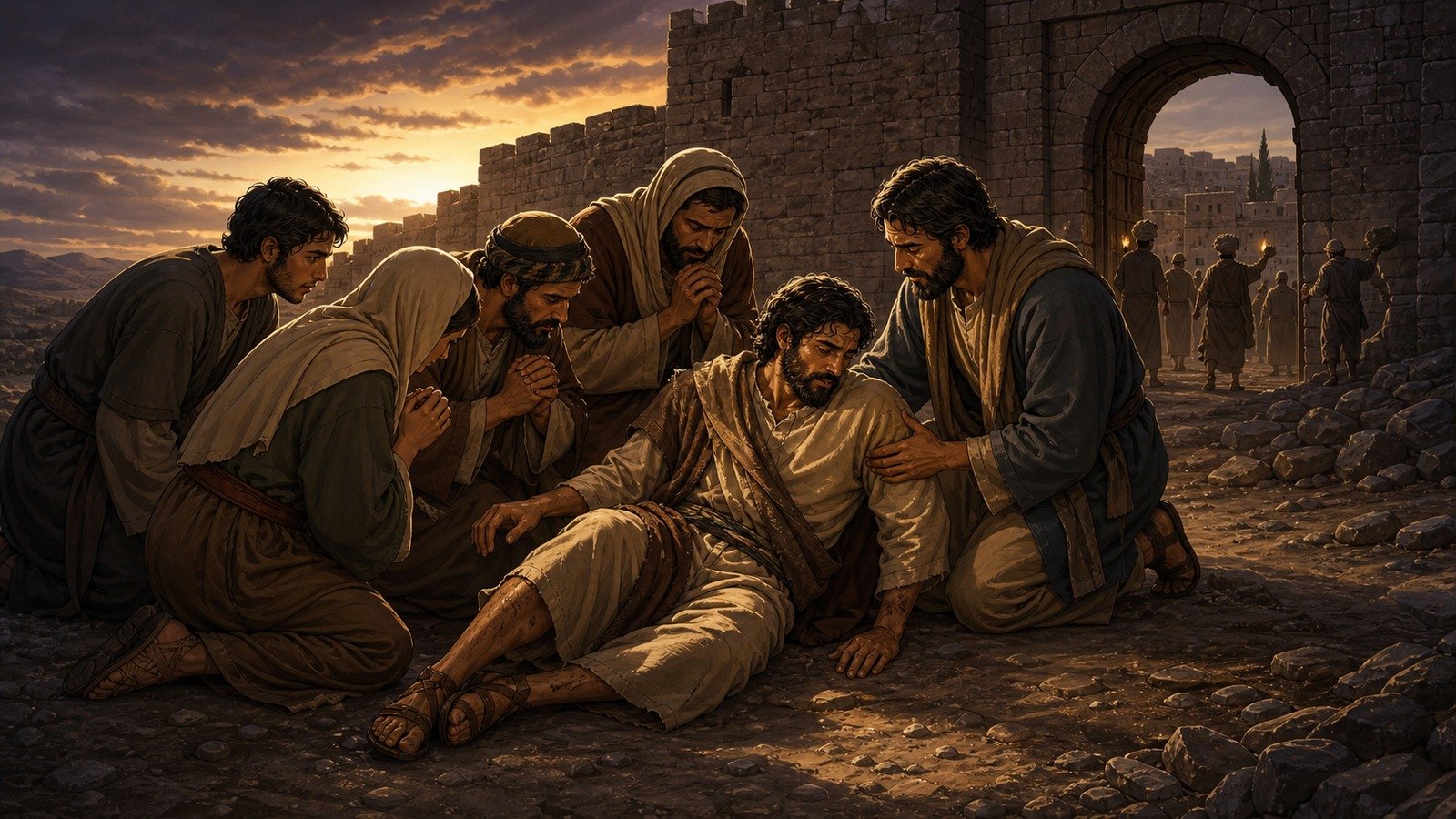
Opponents from Antioch and Iconium follow Paul to Lystra, stone him and drag him out of the city assuming he is dead; he gets up and returns to the city the next day, then leaves for Derbe.
Further context
2 min readThen some Jews came from Antioch and Iconium and won the crowd over. They stoned Paul and dragged him outside the city, thinking he was dead.
The distances involved say something about the determination behind it. Pisidian Antioch is roughly two hundred kilometres from Lystra by road, and Iconium about thirty. Men travelled for days to break up a mission in a town most of them had no connection with.
They also won the crowd over, and it is the same crowd that had wanted to sacrifice bulls to him a short time earlier. Nothing illustrates the volatility of an ancient town better than one afternoon in Lystra.
Stoning was a Jewish form of execution, carried out by throwing the condemned down and dropping stones on the chest, and the fact that Paul survived it suggests the mob version was less systematic than the judicial one.
Dragging the body outside the city was ordinary practice: a corpse inside the walls was a defilement, and the same thing had been done with Stephen. Paul had stood and watched that.
But after the disciples had gathered round him, he got up and went back into the city.
There are disciples in Lystra, which means the mission had already produced a congregation, and one of them was almost certainly a boy called Timothy, who is recruited from this town on the next visit and whose mother and grandmother are named as believers.
Going back into the city the same evening, after that, is either courage or stubbornness, and Paul does not distinguish between them anywhere in his letters.
The next day he and Barnabas left for Derbe.
Writing to the Corinthians years afterwards he lists what he had been through, and the tally includes being stoned once, which is this. In the letter to the Galatians, addressed to churches in this region, he refers to bearing on his body the marks of Jesus, and whatever else that means, the scars were real.
The pattern of the whole journey is now established, and it does not vary. He arrives, preaches in the synagogue, gains converts among Jews and God-fearing Gentiles, meets organised opposition, is driven out or beaten, and leaves behind a functioning congregation that survives without him.
Paul refers to this district in a letter to the Corinthians written years afterwards, describing a man caught up to the third heaven fourteen years earlier, and some readers have connected that experience with the hours he spent apparently dead outside Lystra. The connection is speculative and the arithmetic is roughly right.
The disciples gathering round him is stated without any claim about what happened. He got up and walked back in.
He returned to Lystra twice more on later journeys, which is the detail that says most about him.
Antioch and Iconium sending men to Lystra also shows that the opposition was organised across a region rather than being a series of local reactions. Somebody was following the mission and briefing the next town.
Whether the crowd that had wanted to sacrifice to him joined in the stoning is unknown, and the sequence of the two scenes leaves the question standing.