

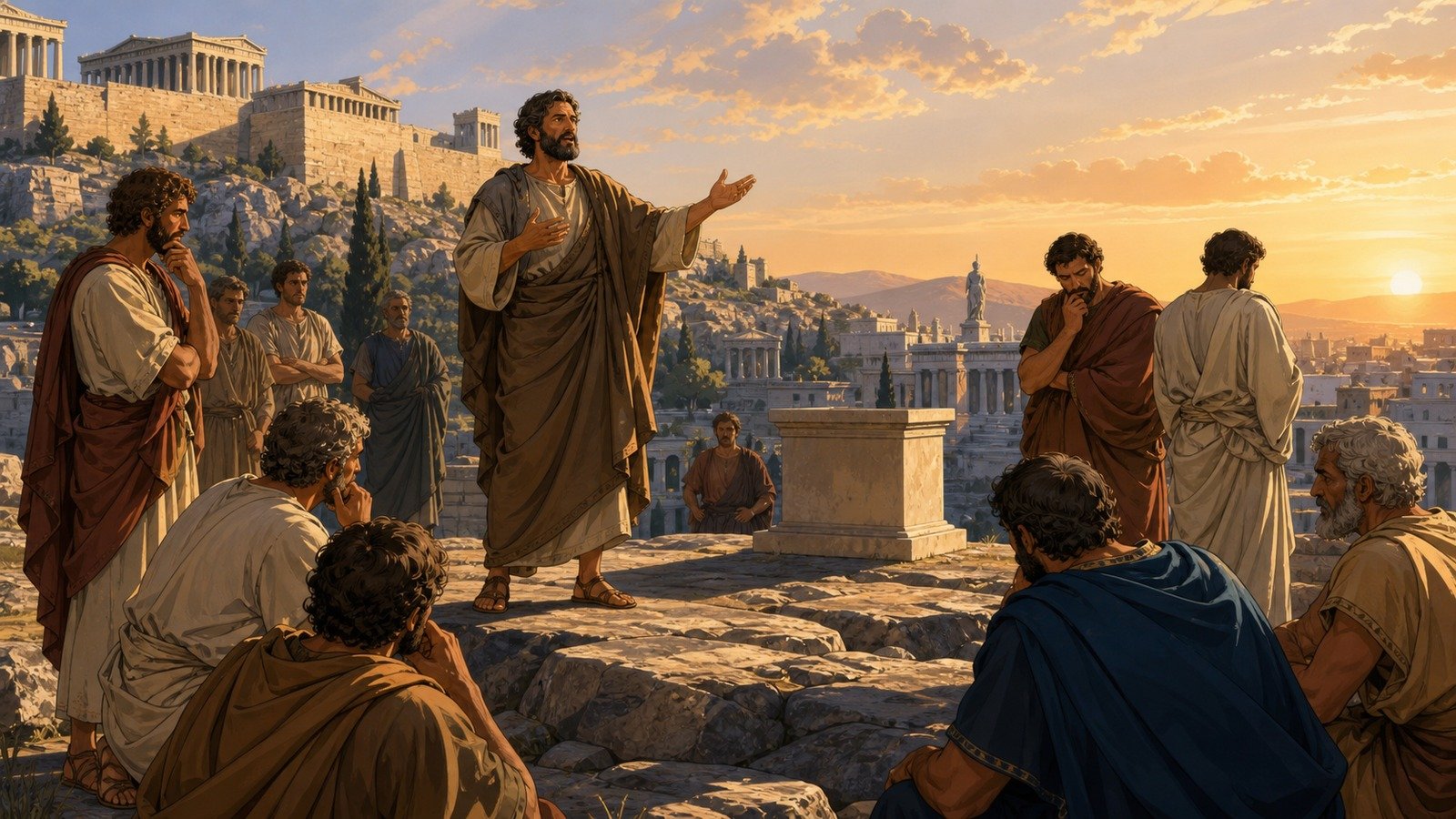
Distressed by the idols filling Athens, Paul is invited to address the city's philosophers at the Areopagus; he starts from an altar inscribed "to an unknown god" and argues toward the resurrection, a claim that draws both mockery and a handful of converts.
Further context
2 min readWhile Paul waits in Athens he is greatly distressed to see that the city is full of idols.
Athens by this period was politically unimportant and culturally supreme, a university town living on a reputation four hundred years old. Its temples and statues were famous; a Roman satirist joked that it was easier to find a god there than a man.
He reasons in the synagogue with the Jews and God-fearing Greeks, and in the marketplace day by day with those who happen to be there, which is exactly what Socrates had been doing in the same square.
A group of Epicurean and Stoic philosophers begin to debate with him. Those two schools dominated philosophy in this period and they held opposite positions: the Epicureans taught that the gods existed but took no interest in human affairs, and that the soul dissolved at death; the Stoics held that a divine reason pervaded everything and that virtue consisted in living according to it.
Some ask what this babbler is trying to say, using a word for a bird pecking up seeds, meaning a scavenger of scraps of other people's ideas. Others say he seems to be advocating foreign gods, because he was preaching about Jesus and the resurrection.
They bring him to a meeting of the Areopagus, the ancient council of the city named after the hill of Ares, which retained authority over religious matters.
The speech he gives is his most famous and it contains not a single quotation from Scripture. He begins with an altar he has seen inscribed to an unknown god, and offers to name it. He argues that God does not live in temples built by human hands and is not served by human hands as if he needed anything. He says God determined the times and places for people to live so that they would seek him, though he is not far from any one of us.
Then he quotes two Greek poets: for in him we live and move and have our being, and, we are his offspring.
The audience holds until he mentions the resurrection of the dead. Some sneer, others say they will hear him again.
A few become followers, including Dionysius, a member of the council, and a woman named Damaris.
The two quotations are from Epimenides of Crete and from Aratus, a poet from Cilicia, which was Paul's own province. Using a Cilician poet in Athens is the sort of thing a man does when he wants a hostile audience to know he can.
The results at Athens were the thinnest of any city he worked in, and no letter to a church there survives. Whether that is a comment on the method or on the city has been argued for centuries, usually by people with a view about preaching.
The Areopagus council met on the hill or in a colonnade in the marketplace, and its authority in this period covered education, morals and the introduction of new gods, which is precisely the charge Socrates had faced in the same city four and a half centuries earlier.