

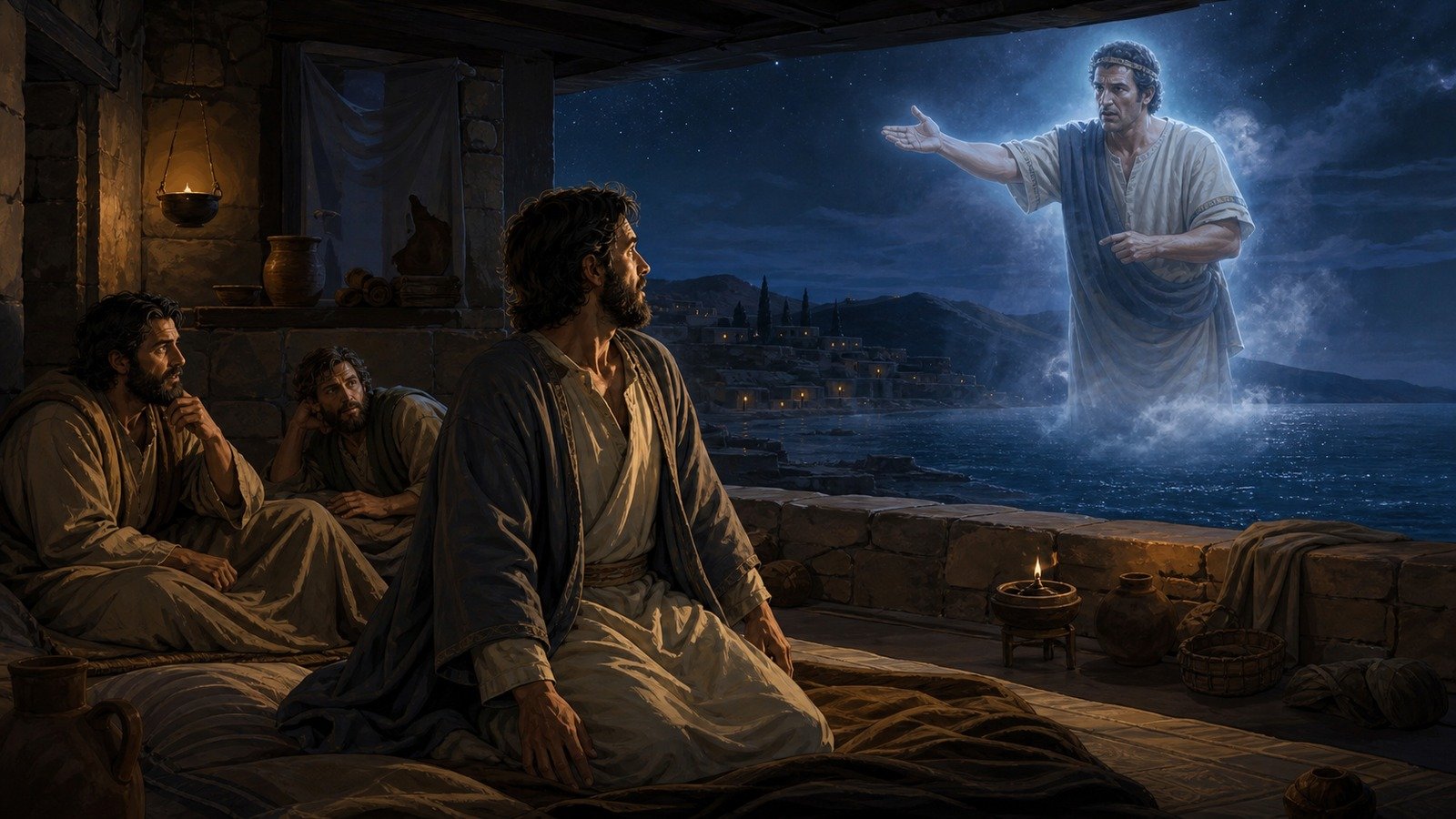
Prevented, Luke says, by the Holy Spirit from preaching in the province of Asia, Paul instead sees a night vision of a Macedonian man pleading, "come over and help us," and the group concludes God is calling them to Macedonia, taking the gospel into Europe for the first time.
Further context
2 min readPaul and his companions travel throughout the region of Phrygia and Galatia, having been kept by the Holy Spirit from preaching the word in the province of Asia. When they come to the border of Mysia they try to enter Bithynia, but the Spirit of Jesus will not allow them to.
Nothing is said about how the prohibition was communicated, and the striking thing is what is being prevented. Asia meant the western coast of Asia Minor with Ephesus at its centre, a wealthy and populous province, and Bithynia lay along the Black Sea. Both were obvious destinations. Paul later spends three years at Ephesus, so the block is about timing rather than about the place.
So they pass by Mysia and go down to Troas, which is where the road runs out. Troas was a Roman colony and a port on the Aegean, near the site of ancient Troy, and standing there a traveller is looking across water at Europe.
During the night Paul has a vision of a man of Macedonia standing and begging him: come over to Macedonia and help us.
After Paul had seen the vision, we got ready at once to leave for Macedonia.
That change of pronoun is one of the small mechanical details that historians find interesting. From this sentence the narrative shifts into the first person plural and stays there for a stretch, then reverts, then returns later. The straightforward reading is that the writer joined the party at Troas, and it is the main basis for the traditional identification of him as Luke, a physician named in three of Paul's letters as a companion.
They sail from Troas straight for Samothrace, an island with a mountain visible for a great distance, then to Neapolis, and from there inland to Philippi.
The crossing takes two days, and the return trip later takes five, which is the sort of incidental detail nobody bothers to invent.
Whatever else it was, that voyage moved the movement from Asia into Europe. Within twenty years there were congregations in Philippi, Thessalonica, Berea, Athens, Corinth and Rome, and four of Paul's surviving letters are addressed to churches on the European side.
Bithynia, closed to Paul here, receives a letter from Peter within a generation, and it is the province whose governor Pliny wrote to Trajan around AD 112 asking what to do about the Christians in it, describing them as numerous enough that the temples had been deserted.
Troas appears again twice, once for the incident with Eutychus and once in a request for a cloak left behind there.
The stretches written in the first person cover the crossing to Philippi, the voyage from Philippi to Jerusalem years later, and the journey to Rome, which is to say the sea travel. Whoever was writing was on those ships.
Mysia, Bithynia, Phrygia and Galatia are named in a single sentence, and the route they describe is a long loop through the interior of Asia Minor with no recorded preaching in it.
What is being described is a party of men walking for weeks in a direction they had not chosen, finding doors closed, and arriving at the coast with nowhere left to go.