

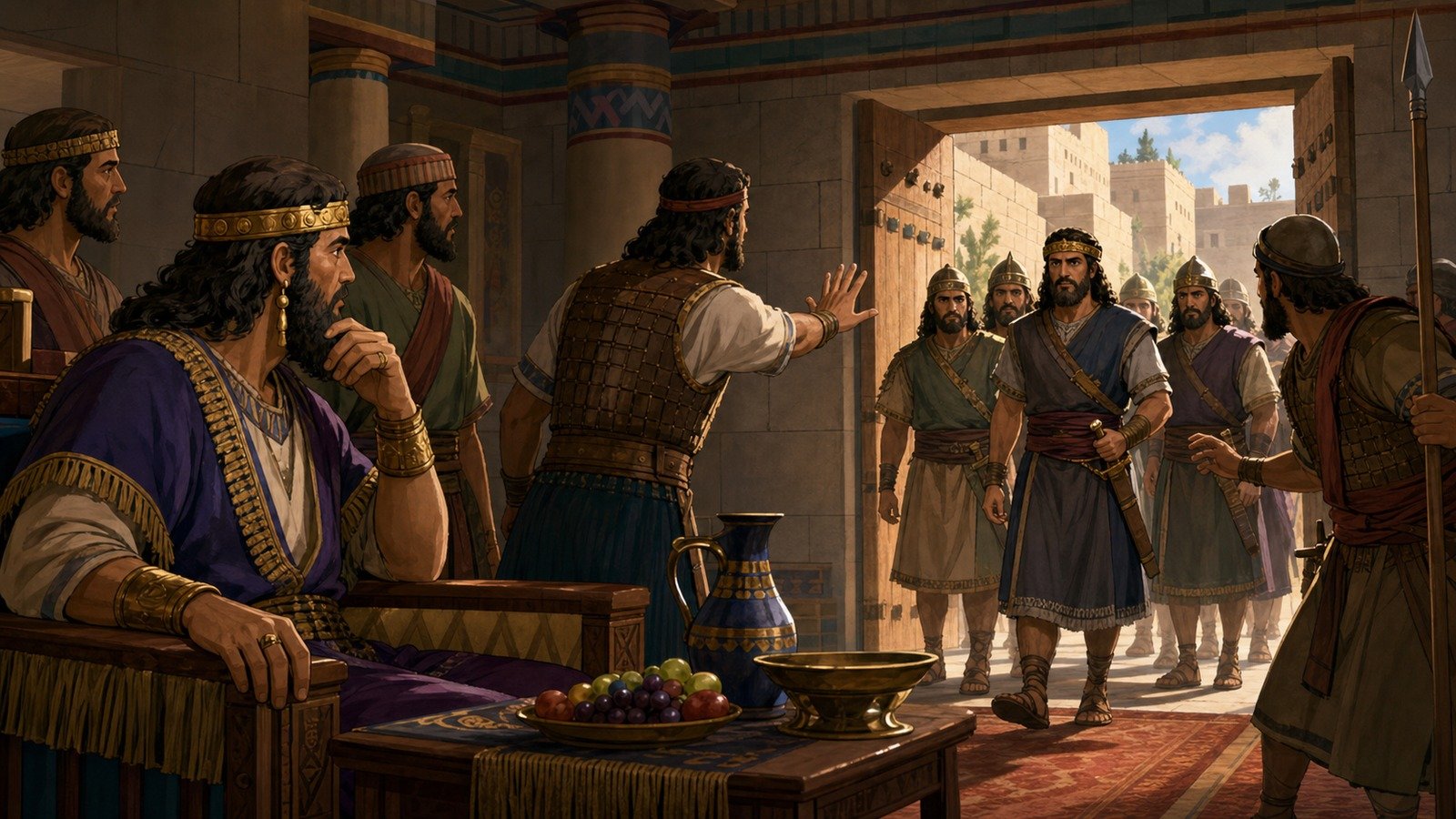
Menahem's son Pekahiah reigns only two years before his own military officer Pekah assassinates him in the royal citadel with fifty Gileadite allies.
Further context
3 min readTwo years, and then one of his own chief officers kills him in the citadel of the royal palace at Samaria, along with two other men, and takes the throne.
Pekah son of Remaliah brings fifty men of Gilead with him to do it. That detail identifies the faction. Gilead is the Israelite territory east of the Jordan, and it is the region that had already been overrun by Aram in the previous century and was most exposed to Assyrian pressure. Men from the frontier are killing a king whose father had bought Assyrian protection with a levy on the wealthy.
The politics underneath the murder are the politics of the whole region for the next twenty years. There are two positions available to a small state on Assyria's border: pay and survive as a vassal, or join a coalition and fight. Menahem paid. His son inherited the policy. Pekah kills him and takes the other position, and immediately allies with Damascus against Assyria.
The two years are also the point at which Isaiah's career begins in the south. He dates his own call to the year Uzziah died, and the crisis that Pekah's alliance with Damascus creates for Judah a few years later produces some of the most quoted material in his book. Everything happening in Samaria in these two decades has a running commentary being written a day's journey away.
The northern kingdom is now switching foreign policy by assassination, which means every change of direction costs a king.
The reign is given four sentences, and the verdict is the same formula applied to every one of these men. What makes it worth noticing here is that the formula has become entirely disconnected from anything happening. A king reigns two years, is murdered by his own officer, and receives an assessment about golden calves set up two centuries earlier by a man he never met. The writers are measuring every one of these reigns against a single question and they are not interested in the rest.
Something else is worth stating about this stretch. Judah in the south, over exactly the same period, is running one dynasty with an orderly succession, occasional reformers and a temple that stays open. The two kingdoms began at the same moment with the same population and the same religion, and by the middle of the eighth century one of them has had nine dynasties and seven murdered kings while the other has had one family for two hundred years.
The prophets working in the north during these years do not treat the instability as the problem. They treat it as the symptom.
Two years, and he is killed by Pekah son of Remaliah, one of his own chief officers, in the citadel of the royal palace at Samaria, along with two men from Gilead and fifty men of Gilead.
The Gileadites are the detail worth noticing. Gilead was the territory east of the Jordan, the part of the kingdom Assyria was about to annex first, and a coup carried out by fifty men from there points to a faction that wanted a harder line against Assyria than Menahem's tribute policy had allowed.
Pekahiah is the last king of Israel to inherit a throne from his father. Everything after him is taken by force.