

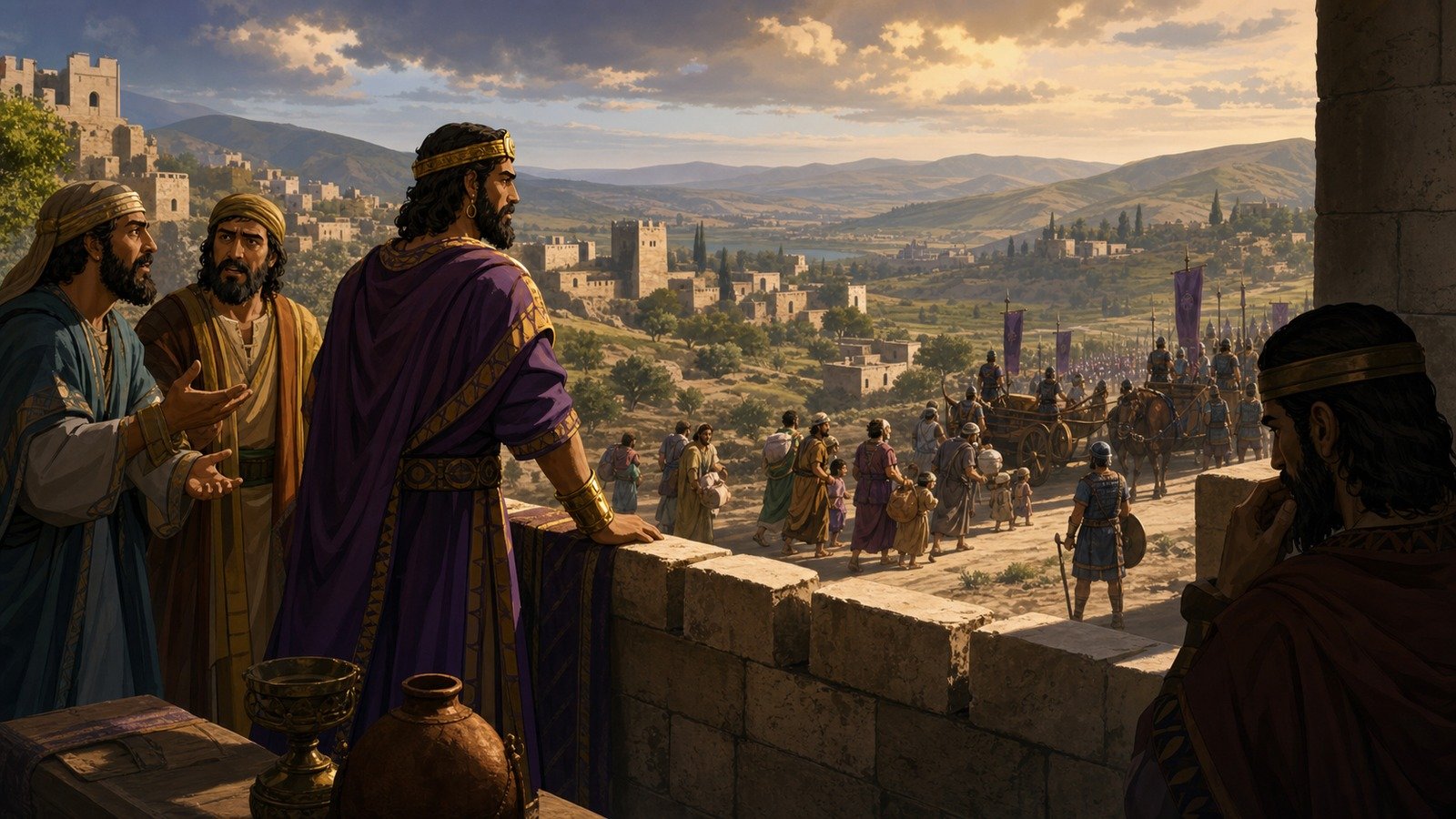
Pekah allies with Aram against Judah and Assyria, provoking Tiglath-Pileser III to strip away Israel's northern and Transjordan territories and deport their populations; Pekah is himself assassinated by Hoshea shortly after.
Further context
3 min readTwenty years is the figure given for Pekah, and it overlaps the reigns of Menahem and Pekahiah, which is one of the harder chronological problems in this period. The usual explanation is that he held a rival claim in Gilead east of the Jordan for years before taking Samaria, and dated his own reign from the earlier point.
His policy is resistance, and it is a catastrophe.
He allies with Rezin of Damascus against Assyria and the two of them try to force Judah into the coalition. When Ahaz of Judah refuses, they march on Jerusalem to depose him and install a puppet, which is the crisis behind some of Isaiah's best-known material, including the instruction not to fear these two smouldering stubs of firewood and the sign of a child called Immanuel.
Ahaz responds by appealing directly to Tiglath-Pileser III and paying for intervention with the temple treasury. Assyria comes, and what it does to the northern kingdom is recorded from both sides.
Tiglath-Pileser captures Ijon, Abel Beth Maakah, Janoah, Kedesh and Hazor, along with Gilead and Galilee and all the land of Naphtali, and deports the people to Assyria. That is the entire north and the whole of Transjordan, which is most of the kingdom. What remains is Samaria and the hill country of Ephraim around it.
The Assyrian records confirm it and add a detail. Tiglath-Pileser's inscriptions describe the campaign, list the deportations, and state that the Israelites overthrew Pekah and that he installed Hoshea over them. The biblical account says Hoshea conspired against Pekah, attacked and assassinated him, and became king. Both are true from different angles: a coup carried out with an empire's approval.
The excavated evidence at Hazor includes a destruction layer from exactly this campaign, and the population transfers are the beginning of a policy that will be applied to the rest of the kingdom twelve years later.
What the deportations do is worth stating because it is the reason the northern tribes disappear. Assyrian practice was not extermination but resettlement: leading families were moved hundreds of kilometres away and other conquered populations were moved in. A people separated from its land, its shrines and its neighbours, and mixed with settlers from elsewhere, stops being a distinct nation within a couple of generations. Galilee and Gilead are emptied first, in Pekah's reign, and the rest follows.
Isaiah's response to the crisis Pekah created is worth noting for its confidence. He tells Ahaz that within sixty-five years Ephraim will be too shattered to be a people, and describes the two kings threatening Jerusalem as smouldering stubs of firewood. Within a dozen years one of them is dead and the other's capital has fallen.
He is the last king of Israel but one, and he loses three quarters of the country during a policy of resistance that lasted twenty years.
The twenty years given for Pekah overlap the reigns of Menahem and Pekahiah, which is one of the harder chronological knots in these books, and the usual solution is a rival kingship in Gilead before he took Samaria.
His policy was resistance, and he formed a coalition with Rezin of Damascus and tried to force Judah into it, which is the war that produces the sign of Immanuel in Isaiah and the appeal by Ahaz to Assyria for help.
Tiglath-Pileser III's response removed the whole northern and eastern part of the kingdom: Ijon, Abel Beth Maakah, Janoah, Kedesh, Hazor, Gilead and Galilee, all of Naphtali, with the population deported to Assyria. Assyrian records describe the same campaign and name Pekah.
Hoshea then killed him and took the throne, and Assyrian records claim credit for installing him.