

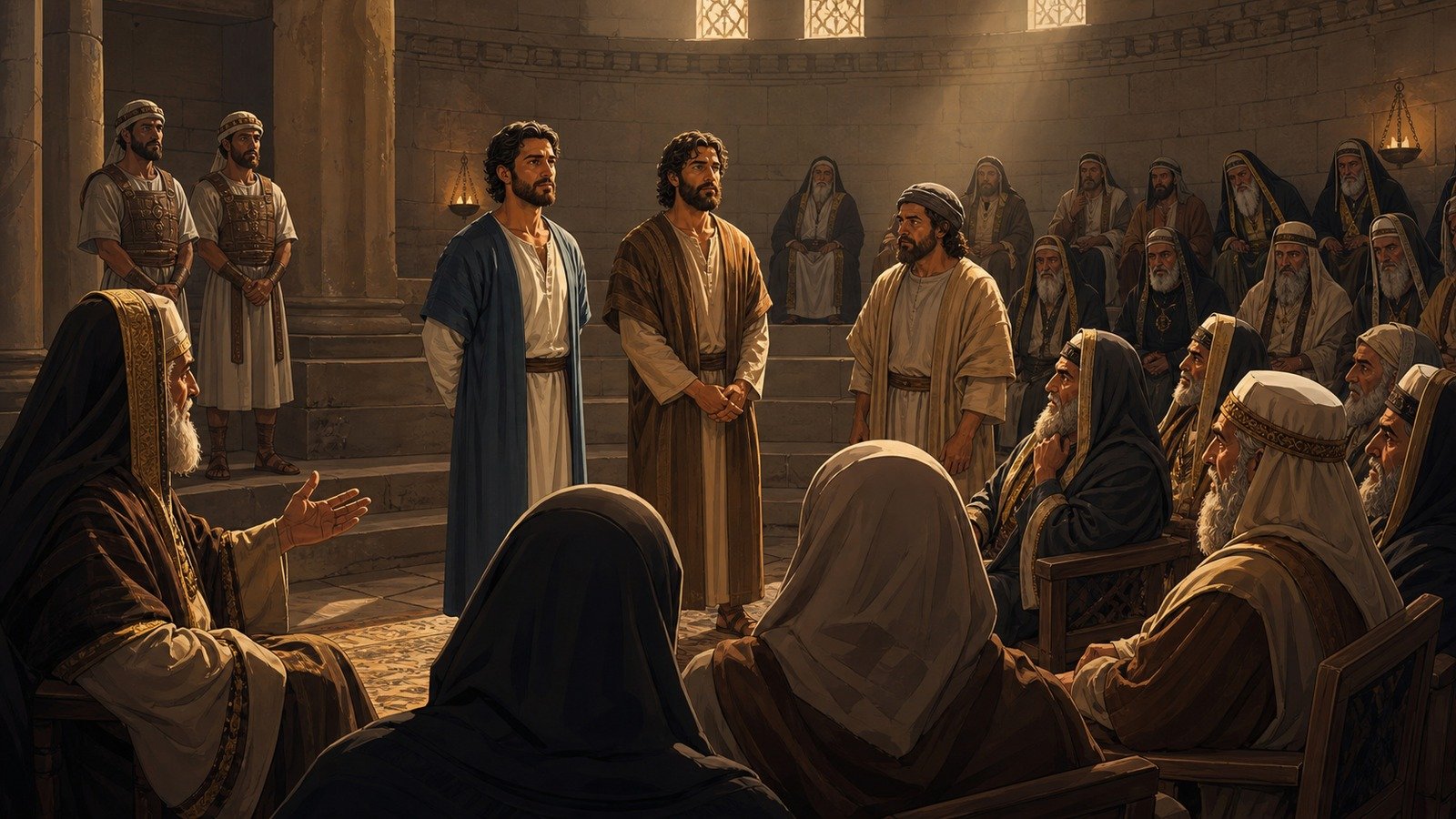
Annoyed at the apostles' preaching of the resurrection, the Temple authorities arrest Peter and John; unable to deny the healed man standing before them, the council can only warn the apostles to stop speaking in Jesus' name, a warning they refuse to keep.
Further context
2 min readThe next morning the rulers, elders and teachers of the law meet in Jerusalem, along with Annas the high priest, Caiaphas, John and Alexander and the other men of the high priest's family.
That is the same body, and largely the same individuals, who had condemned Jesus about two months earlier. Peter is standing in front of the man in whose courtyard he had denied ever knowing him.
The reason the Sadducees in particular were disturbed is doctrinal as well as political. They denied the resurrection of the dead as a matter of principle, and two fishermen were standing in the temple courts announcing that a specific dead man had been raised, with a healed beggar as an exhibit.
By what power or what name did you do this?
Peter's answer is short and gives no ground. It is by the name of Jesus Christ of Nazareth, whom you crucified but whom God raised from the dead, that this man stands before you healed. Then the line from the psalm about the stone the builders rejected, applied to the men in the room who did the rejecting.
Salvation is found in no one else, for there is no other name under heaven given to mankind by which we must be saved.
The council's reaction contains a detail that has been quoted ever since. When they saw the courage of Peter and John and realised that they were unschooled, ordinary men, they were astonished and they took note that these men had been with Jesus. Unschooled means without formal rabbinic training, not illiterate.
Their difficulty is set out plainly: since they could see the man who had been healed standing there with them, there was nothing they could say.
So the men are sent outside while the council confers, and the deliberation is reported in the same candid style as the earlier one about John's baptism. What are we going to do with these men? Everyone living in Jerusalem knows they have performed a notable sign, and we cannot deny it. But to stop this thing from spreading any further among the people, we must warn them to speak no longer to anyone in this name.
The reply they get is one of the foundational statements of Christian civil disobedience: which is right in God's eyes, to listen to you, or to him? You be the judges. As for us, we cannot help speaking about what we have seen and heard.
They are threatened further and released, because the council could find no way to punish them without provoking the people. The man who had been healed was over forty years old.
Annas is called the high priest here although Caiaphas held the office, and the usage reflects how people spoke rather than a mistake: a man deposed by a foreign governor kept the title in Jewish eyes and, in this family's case, the power as well.
Nothing in the council's deliberation disputes the healing. What is being decided is how to contain something that everyone in Jerusalem already knows about, and the instrument chosen is a prohibition on using a name.