

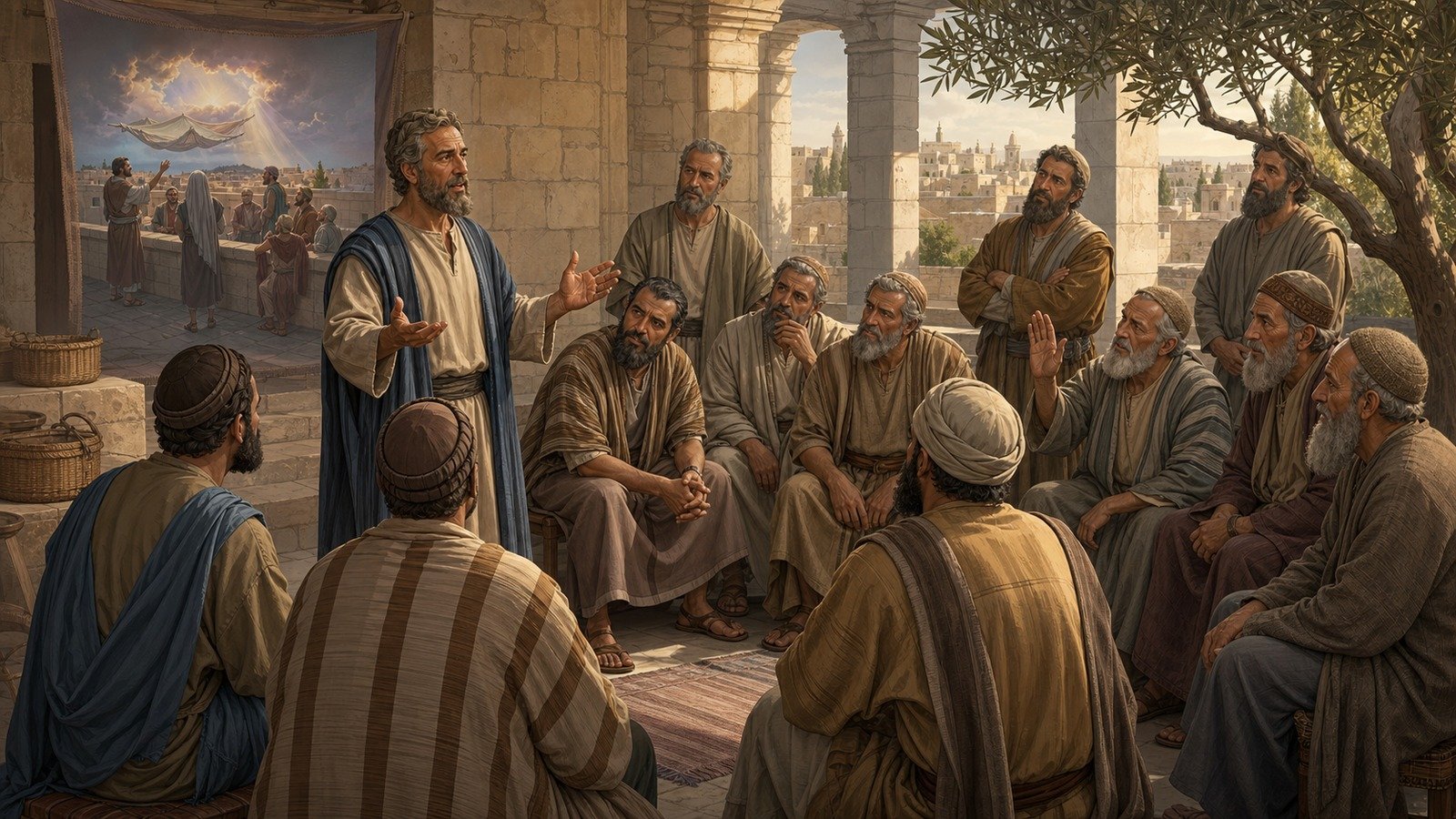
Criticised by circumcised believers in Jerusalem for eating with Gentiles, Peter recounts his vision and Cornelius' conversion; his account satisfies his critics, who conclude, "God has granted even the Gentiles repentance that leads to life."
Further context
2 min readNews travels ahead of Peter. By the time he gets back to Jerusalem the apostles and believers throughout Judea have heard that the Gentiles have also received the word of God, and the circumcised believers criticise him.
The charge is not about preaching to Gentiles. It is narrower and more domestic: you went into the house of uncircumcised men and ate with them.
Table fellowship is the pressure point, and it stays the pressure point for the next twenty years. Preaching to a Gentile costs nothing; sitting down to eat what he serves means abandoning the food laws in practice, and it was the question that later produced a public quarrel between Peter and Paul at Antioch, which Paul describes in a letter without much charity towards anyone involved.
Peter's defence is simply to tell them what happened, in order, from the beginning. The vision of the sheet. The three men at the gate. The Spirit telling him to go with them. The six brothers who went with him. The angel Cornelius had seen.
Then his conclusion, and it rests entirely on the interruption: as I began to speak, the Holy Spirit came on them as he had come on us at the beginning. Then I remembered what the Lord had said: John baptised with water, but you will be baptised with the Holy Spirit. So if God gave them the same gift he gave us, who was I to think that I could stand in God's way?
The argument is not from principle but from evidence. Something happened, in front of witnesses, that nobody had arranged.
When they heard this, they had no further objections and praised God, saying: so then, even to Gentiles God has granted repentance that leads to life.
The word even is doing a great deal of work in that sentence, and it is worth reading it without irony. These were men who had grown up with a boundary that defined who they were, being asked to accept that it had been moved by somebody else, on the basis of a report from a colleague. They accepted it in one meeting.
The full argument, with a council, delegations and a written ruling, was still to come, and it came because of Antioch.
The six brothers who went with Peter are mentioned twice, and their presence is deliberate. A man expecting to be questioned took witnesses, which is the behaviour of someone who knew exactly how controversial the journey was before he made it.
That the meeting ended in agreement is remarkable and it did not settle the practice. Paul's account of the confrontation at Antioch some years later has Peter withdrawing from Gentile tables when men came from James, which is the same issue reappearing under social pressure.
Peter recounting the whole sequence in order, rather than arguing from principle, is the method used throughout this period. What persuades the Jerusalem believers is a narrative with named witnesses and a checkable chronology.
The phrase the circumcised believers is used without embarrassment for a faction within the church, and the same group reappears at the council and behind the trouble at Antioch and in Galatia.