

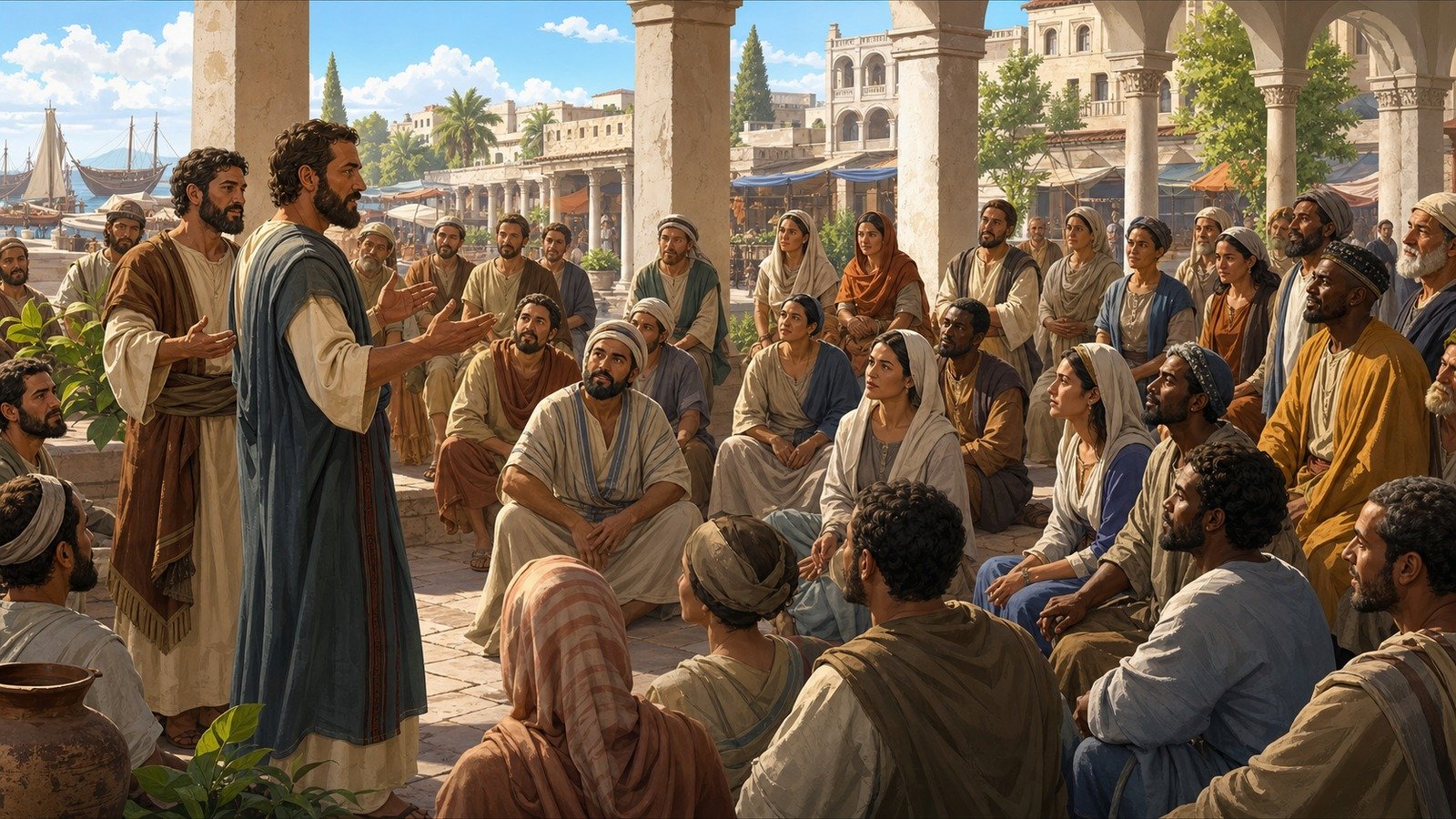
Believers scattered by the earlier persecution begin preaching to Gentiles at Antioch in Syria with considerable success; Barnabas is sent to investigate, brings Saul from Tarsus to help teach the growing church, and it is here, Luke notes, that disciples are first called Christians.
Further context
2 min readThe believers scattered by the persecution over Stephen travel as far as Phoenicia, Cyprus and Antioch, telling the message only to Jews. But some of them, men from Cyprus and Cyrene, go to Antioch and begin to speak to Greeks also.
Nobody instructed them to do this. The men who took the decisive step are unnamed, and they were from Cyprus and north Africa, which is to say Greek-speaking Jews of the diaspora who had grown up among Gentiles and found the boundary less absolute than it looked from Jerusalem.
Antioch on the Orontes was the third city of the empire after Rome and Alexandria, with a population usually estimated at several hundred thousand, capital of the province of Syria, on the trade routes from Mesopotamia and with a port at Seleucia sixteen kilometres away. It had a large and long-established Jewish community with recognised civic rights. It was also famous for a pleasure resort at Daphne with a temple to Apollo, and Roman writers used its name as shorthand for laxity.
The Lord's hand was with them, and a great number of people believed and turned to the Lord.
News reaches Jerusalem and they send Barnabas, which was a well-judged choice: a Cypriot himself, and the man who had already vouched for Saul when nobody else would. When he arrives and sees what the grace of God has done, he is glad and encourages them all to remain true to the Lord with all their hearts.
Then he goes to Tarsus to look for Saul, and when he finds him brings him back to Antioch, and the two of them teach there for a year.
That is Paul brought out of a decade of obscurity by the same man who had sponsored him at the start.
It was at Antioch that the disciples were first called Christians.
The name was almost certainly coined by outsiders and it follows a Latin pattern used for the followers of a political figure, on the model of Herodians or Caesarians. It occurs only twice more in the New Testament, once in a jibe from a king and once in a letter about suffering for the name, and the believers went on calling themselves disciples, brothers, saints and the Way.
Antioch becomes the base of everything that follows. Every journey Paul makes begins and ends there.
Antioch's advantage over Jerusalem for this purpose was its distance. Six hundred kilometres from the temple, in a Greek city with a mixed population, the question of what a Gentile believer had to do looked different from how it looked in a courtyard within sight of the sanctuary.
The city was destroyed by earthquakes several times and never recovered its position; the modern town of Antakya sits on the site.
Barnabas being sent rather than an apostle is itself a decision. Jerusalem sent an inspector who was likely to approve, and he did, and then went and fetched the one man best equipped to build on it.
Barnabas is described as a good man, full of the Holy Spirit and faith, which is the only time that assessment is made of anyone in the account, and it is made of the man who kept vouching for people.