

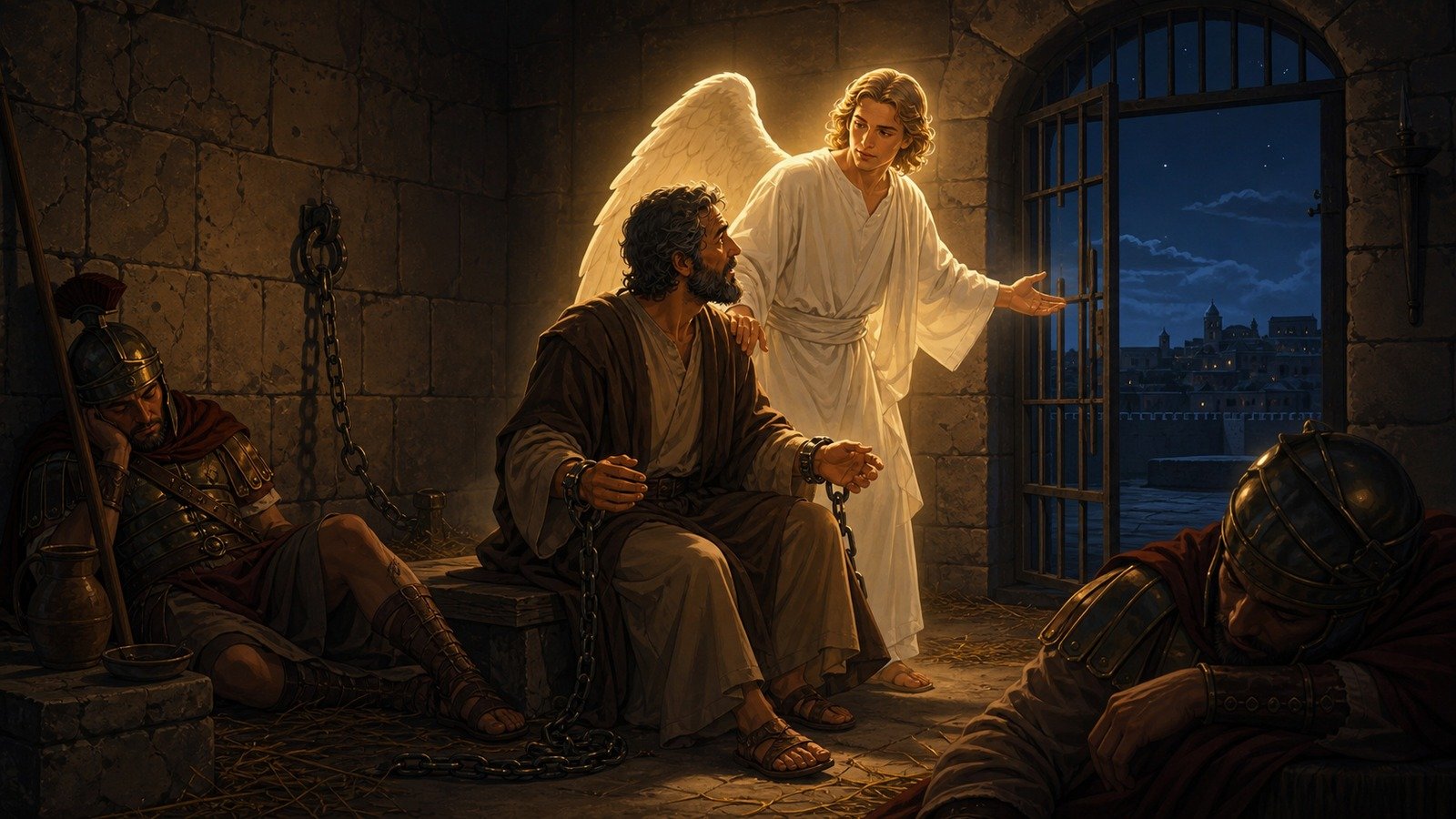
Encouraged by the reaction to James' death, Herod imprisons Peter as well; an angel wakes Peter, loosens his chains and leads him past the guards and through the city gate, which Peter at first takes for a vision.
Further context
2 min readPeter is arrested during the Festival of Unleavened Bread and put in prison, handed over to four squads of four soldiers each, with the intention of bringing him out for public trial after the Passover.
Sixteen men for one prisoner, working in four watches, is a serious arrangement, and the reason for it becomes clear when the sentence about the last escape is remembered. Peter had been in custody before and had not stayed.
The church was earnestly praying to God for him.
The night before Herod is to bring him to trial, Peter is sleeping between two soldiers, bound with two chains, with sentries at the entrance. That he was asleep at all, on the night before a trial that had killed James a few days earlier, is the detail the writer keeps.
An angel appears and the light shines in the cell. He strikes Peter on the side and wakes him: quick, get up. The chains fall off his wrists.
Then a sequence of instructions delivered as though to someone half awake, which he was. Put on your clothes and sandals. Wrap your cloak around you and follow me.
Peter follows him out, with no idea that what the angel is doing is really happening; he thinks he is seeing a vision. They pass the first and second guards and come to the iron gate leading to the city, which opens for them by itself. They walk the length of one street, and then the angel leaves him.
Only then does he come to himself: now I know without a doubt that the Lord has sent his angel and rescued me.
He goes to the house of Mary, the mother of John Mark, where many people have gathered and are praying. He knocks at the outer entrance, and a servant girl named Rhoda comes to answer. Recognising his voice, she is so overjoyed that she runs back without opening the door and announces that Peter is standing there.
You are out of your mind, they tell her. When she keeps insisting, they say it must be his angel.
Peter keeps knocking.
The people praying for his release cannot believe he is at the door, and the comedy of it is preserved rather than smoothed away.
Rhoda is a servant girl who is named, which is rare enough to be worth noting; the great majority of servants in ancient narrative are anonymous.
Peter tells the household to report to James and the brothers, and then leaves for another place, which is the last time he appears in the narrative except at the council. Where he went is unknown, and the traditions that take him eventually to Rome are later.
Passover week appears again as the setting, and for the same reason as before: the city was full, feeling ran high, and a public execution would have pleased the crowds the king depended on.
Herod's intention to bring him out for public trial after the Passover repeats the calculation made about Jesus a decade earlier: not during the festival, in case of a riot.