

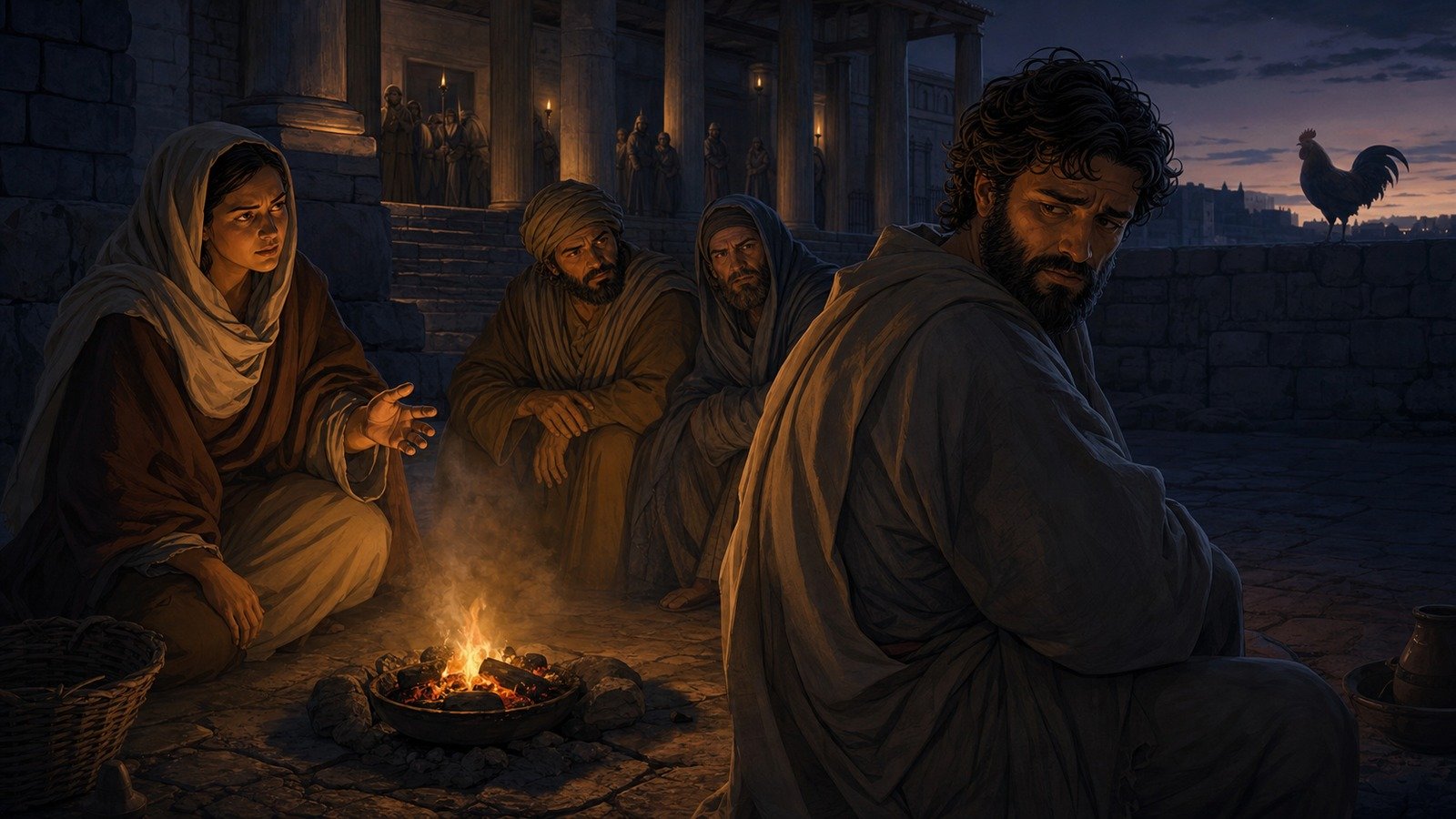
In the courtyard below the hearing, Peter denies knowing Jesus three times before a rooster crows, exactly as Jesus had predicted, and weeps bitterly once he realises what he has done.
Further context
2 min readPeter follows at a distance and gets into the courtyard of the high priest's house, where the servants and guards have lit a charcoal fire because the night is cold, and he sits down among them to see how it will end.
That is not cowardice. Every other disciple has run. He is inside the compound of the man conducting the trial, warming his hands with the arresting party.
The first challenge comes from a servant girl on duty at the gate. You also were with that Nazarene, Jesus. He denies it: I do not know or understand what you are talking about.
He moves out to the entrance. She sees him again and says to those standing round, this fellow is one of them. He denies it again.
After a while the bystanders press it, and the detail they use is one he cannot argue with. Surely you are one of them, for you are a Galilean. Galilean speech was recognisably different in accent and pronunciation, and rabbinic sources joke about Galileans confusing guttural consonants. He had opened his mouth and given himself away.
The third denial is the worst of the three: he begins to call down curses, and swears to them, I do not know this man you are talking about.
Immediately a rooster crows.
Then a line that has no parallel anywhere else. The Lord turned and looked straight at Peter. The trial was being held in the house whose courtyard he was standing in, and at that moment the prisoner was being moved across it.
Peter remembers the words spoken a few hours earlier, when he had said he would go with him to prison and to death, and he goes outside and weeps bitterly.
Why this episode survives in all four accounts is a question worth asking. It is the most humiliating thing on record about the man who became the leader of the Jerusalem church, and the early Christian communities had every incentive to leave it out. That it was preserved, in detail, including the cursing, suggests it was told by the person it happened to.
The last of the resurrection appearances includes a scene beside another charcoal fire, and a threefold question put to the same man.
The rooster is a small problem of its own. A tradition attested later held that keeping chickens in Jerusalem was forbidden because they scratched up unclean things, which would make a crowing cock inside the walls unlikely; against that, the Roman garrison used a bugle call at the end of the third watch that was known as cockcrow, and the guards in that courtyard would have heard it.
Neither point affects what happened in the courtyard, and both are the sort of detail that gets argued about because the scene itself is beyond argument.
Peter's restoration takes place beside a charcoal fire on a beach in Galilee some weeks later, and the same rare word for that kind of fire is used in only these two places in the New Testament.