

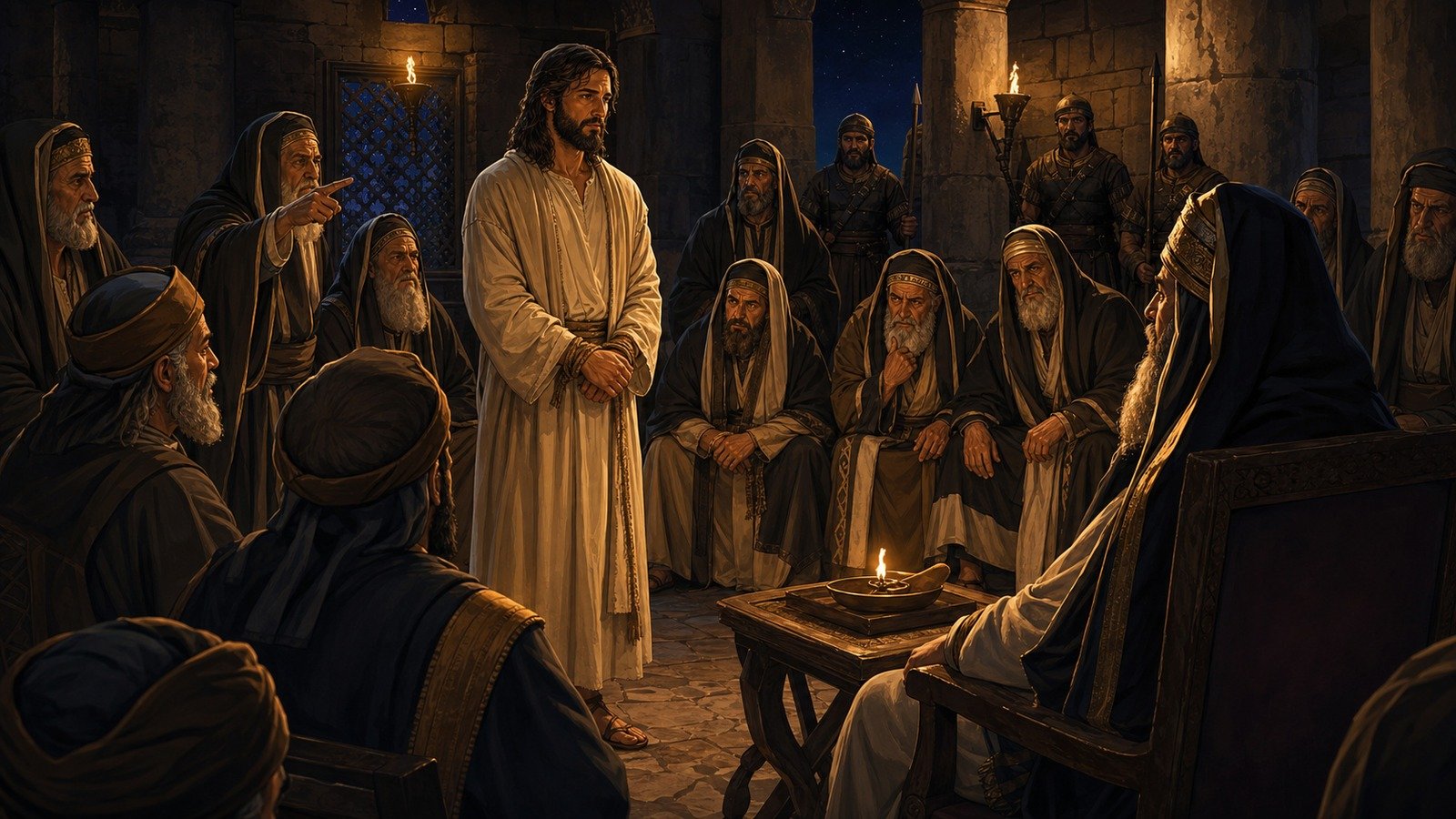
Jesus faces an irregular night hearing before the Sanhedrin, where his acknowledgement of being "the Messiah, the Son of God" is treated as blasphemy, and he is beaten and mocked by those holding him.
Further context
2 min readJesus is taken first to Annas, who had been high priest years earlier and had been deposed by the Romans, and who remained the most powerful man in the family. Five of his sons held the office after him, and Caiaphas, the serving high priest, was his son-in-law. Jewish thinking held the high priesthood to be for life, so a man removed by a foreign governor kept the title in the eyes of many.
Then to Caiaphas, where the chief priests and the whole council are assembled.
The procedure is irregular by the standards Jewish law itself later set out. Capital cases were to be heard by day, not at night; a verdict of guilt could not be delivered on the same day as the trial; and cases were not to be held on the eve of a festival. The rules as written down come from a later period and may describe an ideal rather than the practice of AD 33, but even allowing for that, a hearing convened in the small hours in the high priest's residence is not a court sitting normally.
The evidence collapses. Many testify falsely, and their statements do not agree, which mattered because the law required two witnesses in exact agreement. The nearest thing to a charge is a garbled version of something he had said about destroying the temple and raising it in three days, and even on that the witnesses contradict each other.
Throughout it he says nothing, which is itself a strategy and also fulfils something in Isaiah about a man who did not open his mouth.
Caiaphas stands up and puts the question directly, under oath: are you the Messiah, the Son of the Blessed One?
I am, he answers, and then adds a sentence that does the real damage: and you will see the Son of Man sitting at the right hand of the Mighty One and coming on the clouds of heaven. That combines a line from a psalm about a figure seated at God's right hand with Daniel's vision of one like a son of man coming with the clouds and being given authority over all nations.
The high priest tears his clothes, which was the prescribed reaction to hearing blasphemy. Why do we need any more witnesses? You have heard the blasphemy.
They all condemn him as worthy of death. Then some begin to spit at him, blindfold him, strike him and say, prophesy!
The high priesthood in this period was a Roman appointment, granted and withdrawn at the prefect's discretion, which is why so many men held it in so few years and why one family managed to keep it. Caiaphas served about eighteen years, longer than anyone else in the century, and was removed in AD 36 by the same governor who removed Pilate.
Tearing the garments was formally prescribed on hearing blasphemy, and the tear was made in a specific way, downward and by hand, and the garment could not be mended.
The council met ordinarily in a chamber within the temple precincts, so a hearing held in a private residence was already outside normal procedure before anything was said.