

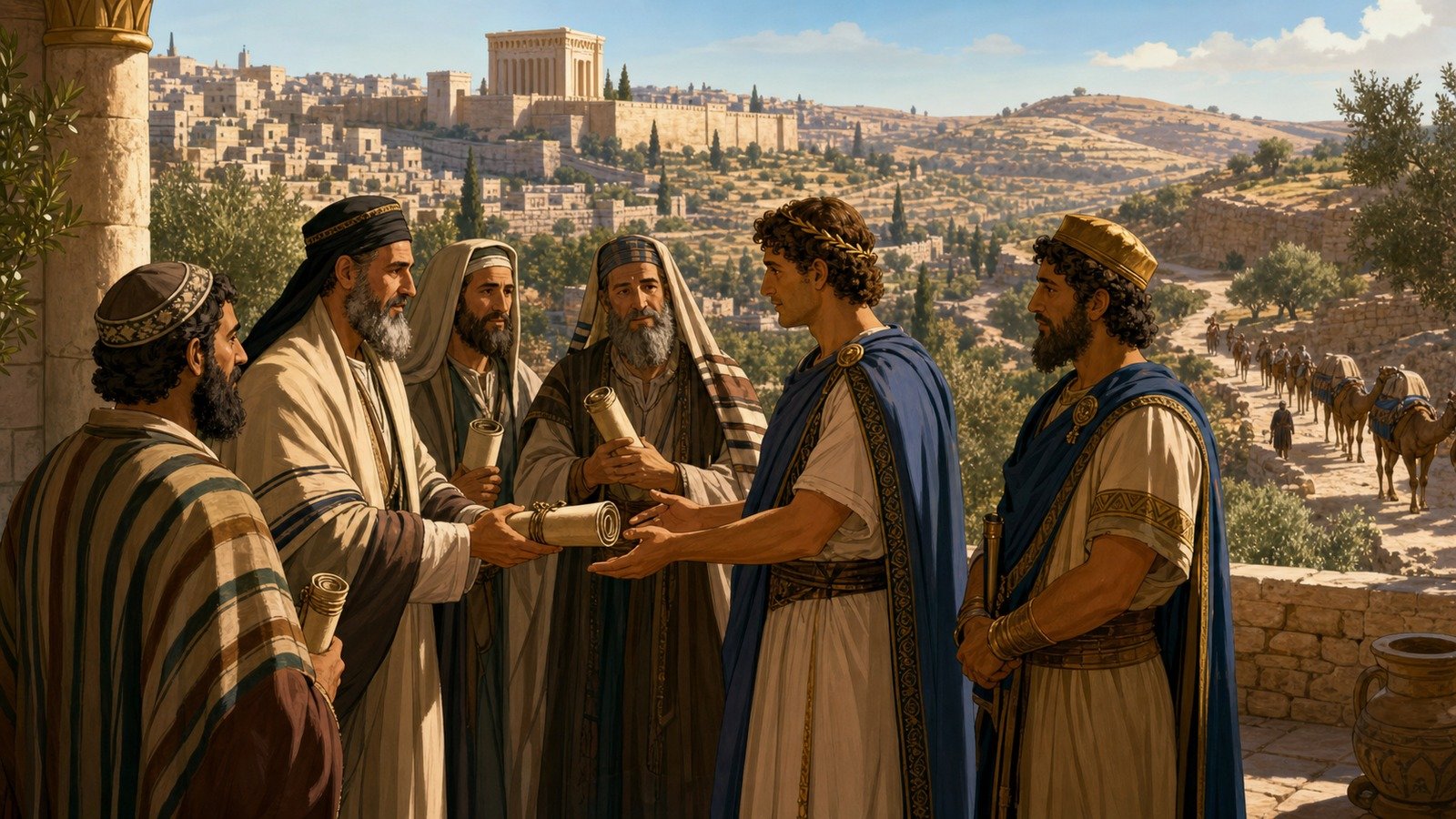
Judea falls initially under the Ptolemaic dynasty ruling from Egypt, a period that includes the Septuagint's beginnings, the Greek translation of the Hebrew Scriptures used extensively by New Testament writers.
No canonical Scripture reference (historical context outside the Protestant canon)
Further context
3 min readFor about a hundred and twenty-five years Judea is a district of Ptolemaic Egypt, administered from Alexandria, and the arrangement is on the whole comfortable.
The Ptolemies governed through local elites and did not interfere with religion. In Judea that meant the high priest continued to run the temple state, collect the taxes owed to Alexandria and settle internal disputes, and Jerusalem was left to itself as long as the money arrived. A collection of Greek papyri from the Egyptian countryside, the Zenon archive, includes correspondence from an official who travelled through Palestine in the 250s BC on business, and it shows a functioning provincial economy with estates, trade in grain, oil and slaves, and Jewish landowners doing business with Egyptian officials.
Alexandria itself becomes the largest Jewish community outside Judea and the most important. Estimates put the Jewish population of the city in the hundreds of thousands by the first century, occupying two of its five districts, with its own institutions and a substantial synagogue.
That community produces the single most consequential document of the period. Beginning in the third century BC, the Hebrew scriptures are translated into Greek, starting with the five books of Moses and continuing over the following two centuries. The name Septuagint comes from a legend, preserved in a Greek letter of uncertain reliability, that seventy-two scholars produced identical translations in seventy-two days. What is beyond doubt is that a Jewish community that no longer read Hebrew easily now had its own scriptures in the language it spoke.
The effects of that are enormous and mostly unintended. It made Jewish thought accessible to educated Greeks and Romans for the first time, and it produced a class of interested outsiders who attended synagogues without converting, the God-fearers who turn up repeatedly in the missionary journeys of Paul. It fixed vocabulary that the New Testament writers would use, including the Greek words behind covenant, glory, righteousness and Christ. And its rendering of a Hebrew word for a young woman as a term meaning virgin, in one line of Isaiah, is the version Matthew quotes.
The books that later Christians would argue about as apocryphal or deuterocanonical also circulate in this Greek collection and not in the Hebrew one, which is where the difference between Protestant and Catholic Old Testaments ultimately comes from.
One episode from the end of it shows how the arrangement worked and how it broke. A powerful Jerusalem family, the Tobiads, held the tax farm for the province and grew rich on it, and their quarrel with the ruling high-priestly family over the contract is one of the threads that runs straight into the crisis under the Seleucids. The trouble that eventually produces the Maccabean revolt begins as a dispute about revenue collection between two Jerusalem dynasties.
Nothing much happens politically. That is why it is remembered as a good period.
Ptolemy I took Judea in 301 BC and his family held it for about a century, governing from Alexandria with a light hand.
The great achievement of the period is the translation of the Hebrew scriptures into Greek, begun in Alexandria in the third century BC and known as the Septuagint from the tradition that seventy-two scholars produced it in seventy-two days. That story comes from a work called the Letter of Aristeas and is generally regarded as embroidered.
What the translation did is hard to overstate. It made the scriptures available to Jews who no longer read Hebrew, of whom there were very many in Egypt, and it made them available to Greeks. It also fixed a Greek vocabulary for Hebrew religious terms which the New Testament writers inherited whole, and it is the version they usually quote.
Alexandria's Jewish community became the largest outside Judea and produced Philo two centuries later.