

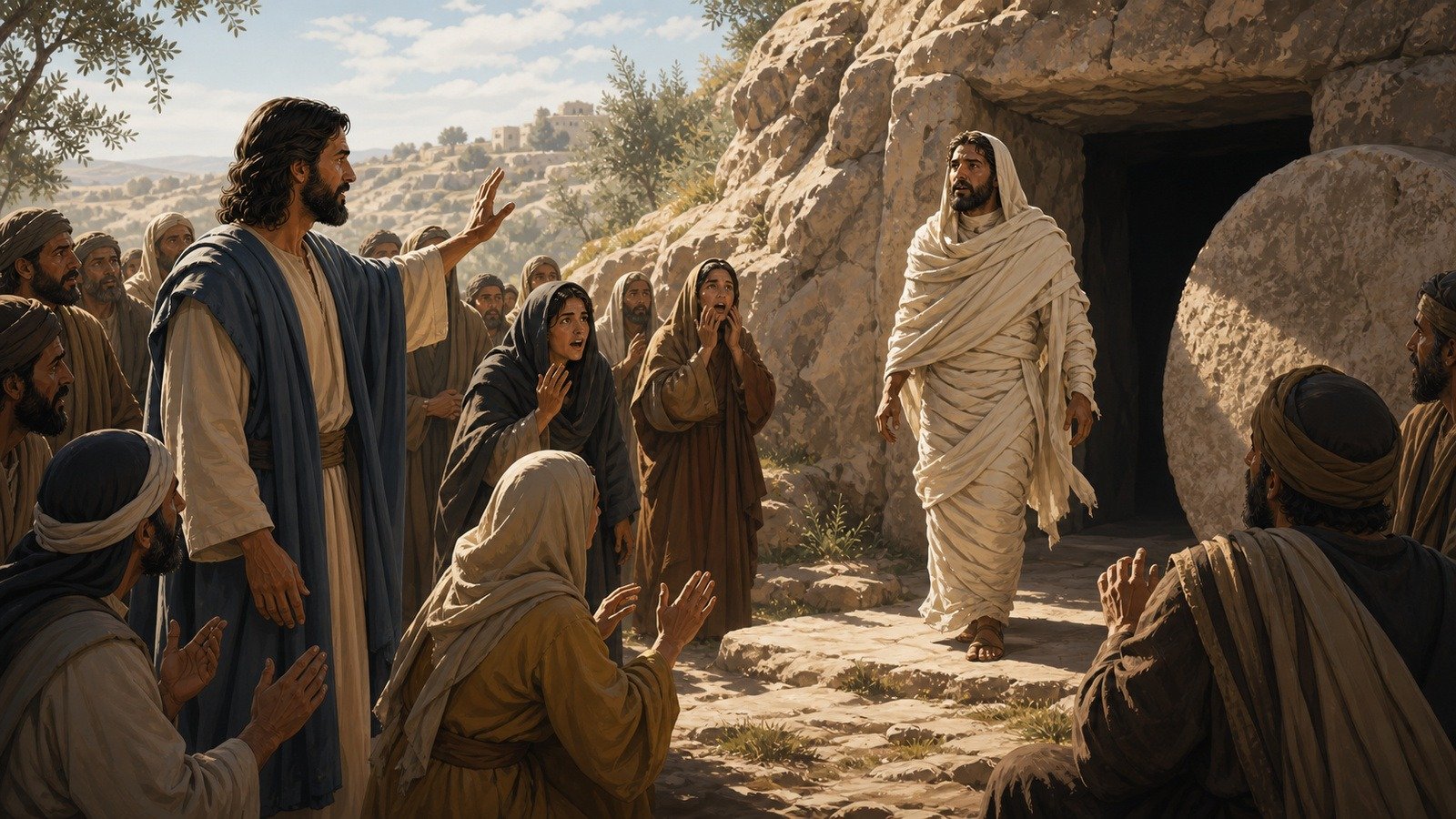
Jesus deliberately delays going to his sick friend Lazarus, arriving after he has already been dead four days; weeping at the tomb despite knowing what he is about to do, he calls Lazarus out alive, the last and greatest of the "signs" recorded in John's Gospel.
Further context
3 min readA message comes from Bethany: Lord, the one you love is sick.
What Jesus does with it is the difficulty of the whole episode. He stays where he is for two more days. The stated reason is that this sickness will not end in death but is for God's glory, and the delay is deliberate.
By the time he arrives, Lazarus has been in the tomb four days. That number is not incidental. A belief current at the period held that the soul hovered near the body for three days and departed on the fourth, after which there was no possibility of revival. Whether the household held that view, four days settles any question of a coma or a premature burial.
Bethany is close to Jerusalem, less than three kilometres, and many Jews have come to comfort the sisters.
Martha goes out to meet him and says what both sisters say: Lord, if you had been here, my brother would not have died. Then, but I know that even now God will give you whatever you ask.
The exchange that follows contains her confession and one of the most quoted sentences in the Bible. Told her brother will rise again, she answers with the standard hope: I know he will rise again in the resurrection at the last day. The reply moves the hope from a date to a person. I am the resurrection and the life. The one who believes in me will live, even though they die.
Mary comes, falls at his feet and says the same sentence, weeping, with the mourners weeping around her.
Then a reaction described in unusually physical language. He was deeply moved in spirit and troubled, and the Greek verb behind deeply moved is one used elsewhere of a horse snorting; it carries anger, not just sorrow. What he is angry at is unclear, and readers have proposed death itself, the unbelief around him, and the professional mourning.
Jesus wept. The shortest verse in the English Bible, and the verb is a quiet one, describing tears rather than the loud wailing used of the crowd a line earlier.
At the tomb, a cave with a stone across the entrance, he says take away the stone. Martha objects on practical grounds: by this time there is a bad odour, for he has been there four days.
Then a loud voice: Lazarus, come out. The man comes out with his hands and feet wrapped in strips of linen and a cloth round his face, and has to be unwrapped.
Many believe. Others go to the Pharisees, and from that day the leadership begins planning his death.
Bethany has been continuously inhabited and the traditional tomb, a rock-cut chamber reached by steps, has been venerated since at least the fourth century, when a church was built beside it. The village's Arabic name preserves the connection to this day.
The response of the authorities is what makes this the turning point. A man walking around a village three kilometres from Jerusalem, days before Passover, who had been buried the previous week, was a fact that could not be argued down, and the council's discussion afterwards does not attempt to. They plan the death of Lazarus as well, because on account of him many were going over to Jesus and believing.
What began as a private grief in a household ends as the immediate cause of an execution.