

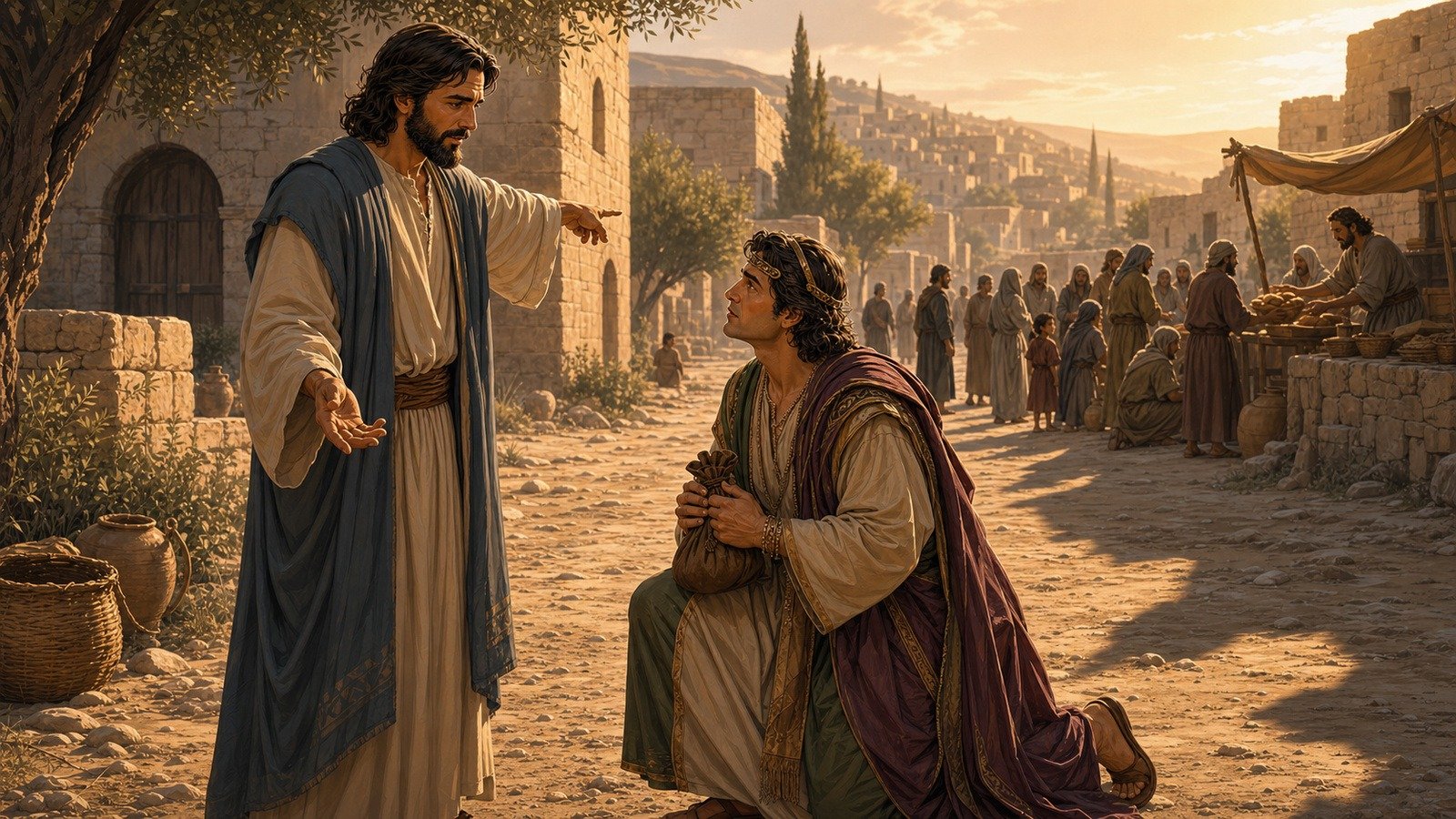
A wealthy young man asks what he must do to inherit eternal life; when Jesus tells him to sell his possessions and follow him, he leaves grieving, unable to part with his wealth, prompting Jesus' teaching that it is easier for a camel to pass through a needle's eye than for a rich person to enter the kingdom.
Further context
3 min readA man runs up to Jesus and falls on his knees in the road. Running and kneeling are both undignified for a man of standing, and he is a man of standing: the combined details describe him as young, wealthy, and a ruler, which most likely means a synagogue official or a member of a local council.
Good teacher, he asks, what must I do to inherit eternal life?
The first response is a question about the adjective. Why do you call me good? No one is good except God alone. Whether that is a denial or an invitation to think about what he has just said has been argued about since the second century.
Then the commandments, listed selectively: do not murder, do not commit adultery, do not steal, do not give false testimony, do not defraud, honour your father and mother. Every one of them concerns other people. The commands about God are not mentioned.
Teacher, he says, all these I have kept since I was a boy.
Nothing suggests he is lying. Jesus looked at him and loved him, which is the only time that is said of anyone in Mark, and it is said before the demand and not after the refusal.
One thing you lack. Go, sell everything you have and give to the poor, and you will have treasure in heaven. Then come, follow me.
That instruction is not given to anyone else. Zacchaeus gives away half and is told salvation has come to his house. Others support him from their own means and keep their households. This man is asked for all of it, which means the diagnosis is personal.
At this the man's face fell. He went away sad, because he had great wealth. He is the only person in the Gospels who is called and declines.
Then the remark about the camel and the eye of a needle. Attempts to soften it are old and none of them works: there is no evidence of a small gate in Jerusalem called the Needle's Eye, and the suggestion that the word means rope rather than camel rests on a variant reading that is almost certainly a later correction by someone who found the image too much. It is a deliberate absurdity, the largest animal in the region and the smallest hole anyone handled daily.
The disciples are amazed, and their question shows why: who then can be saved? In a framework where prosperity was widely read as evidence of God's favour, disqualifying the rich disqualified the people with the best prospects.
With man this is impossible, but not with God. All things are possible with God.
Peter then points out that they have left everything, and is told that no one who has left home or family or fields will fail to receive a hundred times as much, along with persecutions.
Which commandments he lists is worth a second look. Five of the six concern conduct towards other people, and do not defraud is not one of the ten at all but a phrase from elsewhere in the law about withholding a labourer's wages overnight. Inserting it into a list recited to a wealthy man is pointed.
Matthew adds a summary at the end of the list, love your neighbour as yourself, and it is the standard the man is then asked to meet in the most direct way available: sell what you have and give it to people who have nothing.