

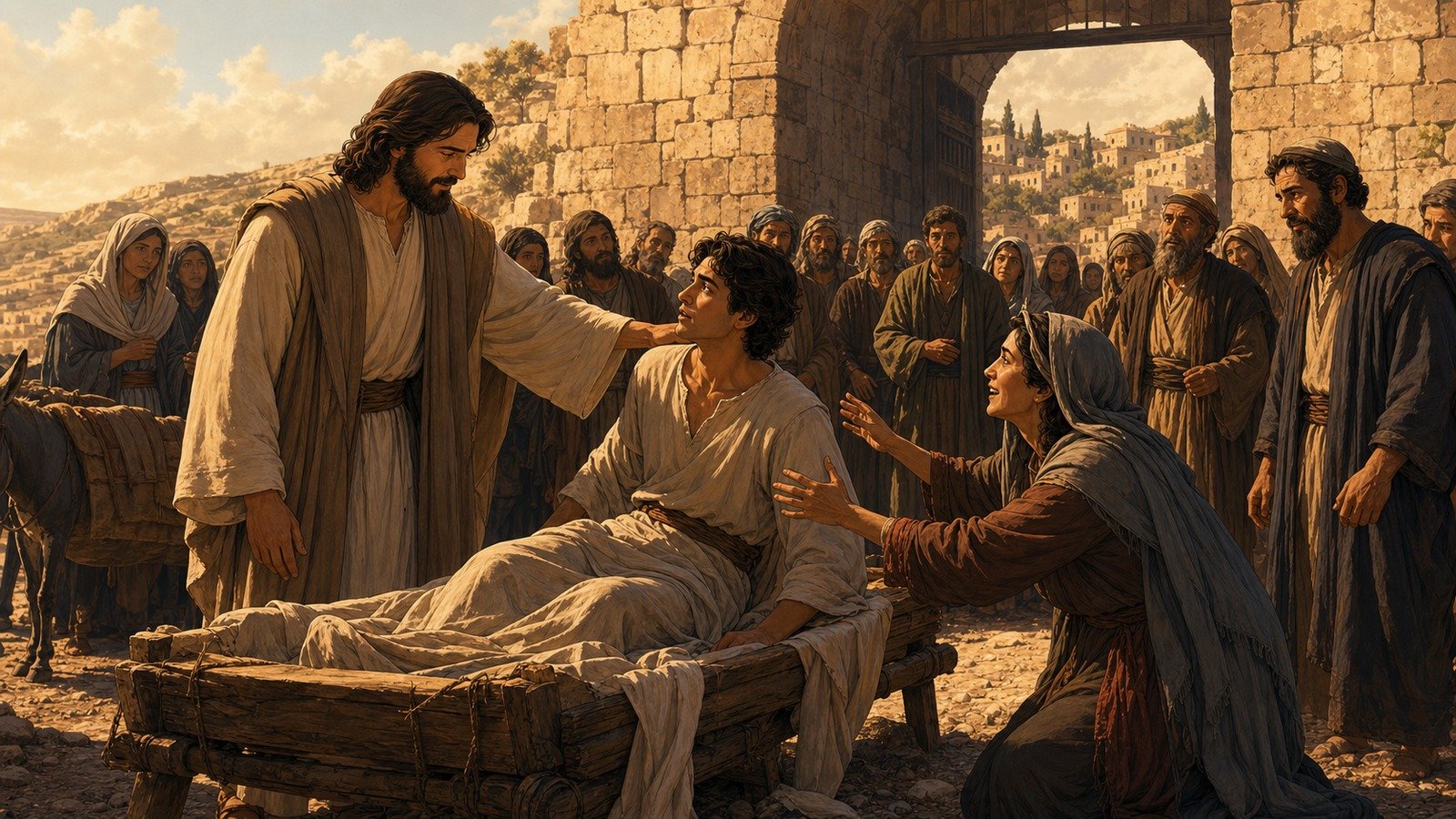
Encountering a funeral procession for a widow's only son at Nain, Jesus is moved with compassion, touches the coffin, and tells the young man to rise; he does, and the crowd, awestruck, spreads word that "a great prophet has appeared among us."
Further context
3 min readNain is a village on the northern slope of the hill of Moreh in southern Galilee, about ten kilometres south-east of Nazareth, and it is mentioned nowhere else in the Bible. Rock-cut tombs survive on the hillside east of the site, which is the direction a funeral procession would have been going.
Two crowds meet at the town gate. One is coming in with Jesus and one is coming out with a body.
The dead man is the only son of his mother, and she is a widow. Those two facts together describe a woman who has just lost everything. A widow without a son in that society had no legal standing, no income and no protector, and depended entirely on charity or on a relative willing to take her in. The funeral is not only a bereavement; it is the end of her ability to live.
Burial happened on the day of death, so this is within hours.
What moves him is stated directly, and the verb used is a strong one meaning to be moved in the depths: when the Lord saw her, his heart went out to her. Not to the young man, and not in response to a request, because nobody has asked for anything. The mother has not spoken and does not speak at any point in the episode.
He says two words to her: do not cry. Then he goes up and touches the bier, and the bearers stand still.
Touching anything connected with a corpse made a person unclean for seven days under the law and required a specific purification with the ashes of a red heifer. He touches it, and the procession stops, presumably because nobody knows what else to do.
Then: young man, I say to you, get up. The dead man sits up and begins to talk, and the last clause of the sentence is the point of the whole thing: and Jesus gave him back to his mother.
The crowd is filled with awe and says two things. A great prophet has appeared among us, and God has come to help his people. That first phrase is not a general compliment. Elijah had raised the son of a widow in that region, and Elisha had raised the son of a woman at Shunem, which is a village three or four kilometres from where they are standing.
News of this spreads throughout Judea and the surrounding country, and the next thing that happens is that John's disciples report all of it to him in prison.
Nain was a village on the northern slope of the hill of Moreh, about ten kilometres south-east of Nazareth, and the only entrance is from the north-west, where rock-cut tombs are visible in the hillside outside the walls.
Two crowds meeting at the gate is exactly what the topography allows.
The dead man is the only son of his mother, and she was a widow. That is not sentiment, it is a description of destitution. A woman with no husband and no son had no legal claim on anything and depended entirely on charity.
His reaction is described before he does anything: when the Lord saw her, his heart went out to her, and he said, do not cry.
Then he touches the bier, which made him unclean, and the bearers stand still.
Elijah and Elisha had each raised a widow's son, and the crowd's response makes the connection: a great prophet has appeared among us. God has come to help his people.