
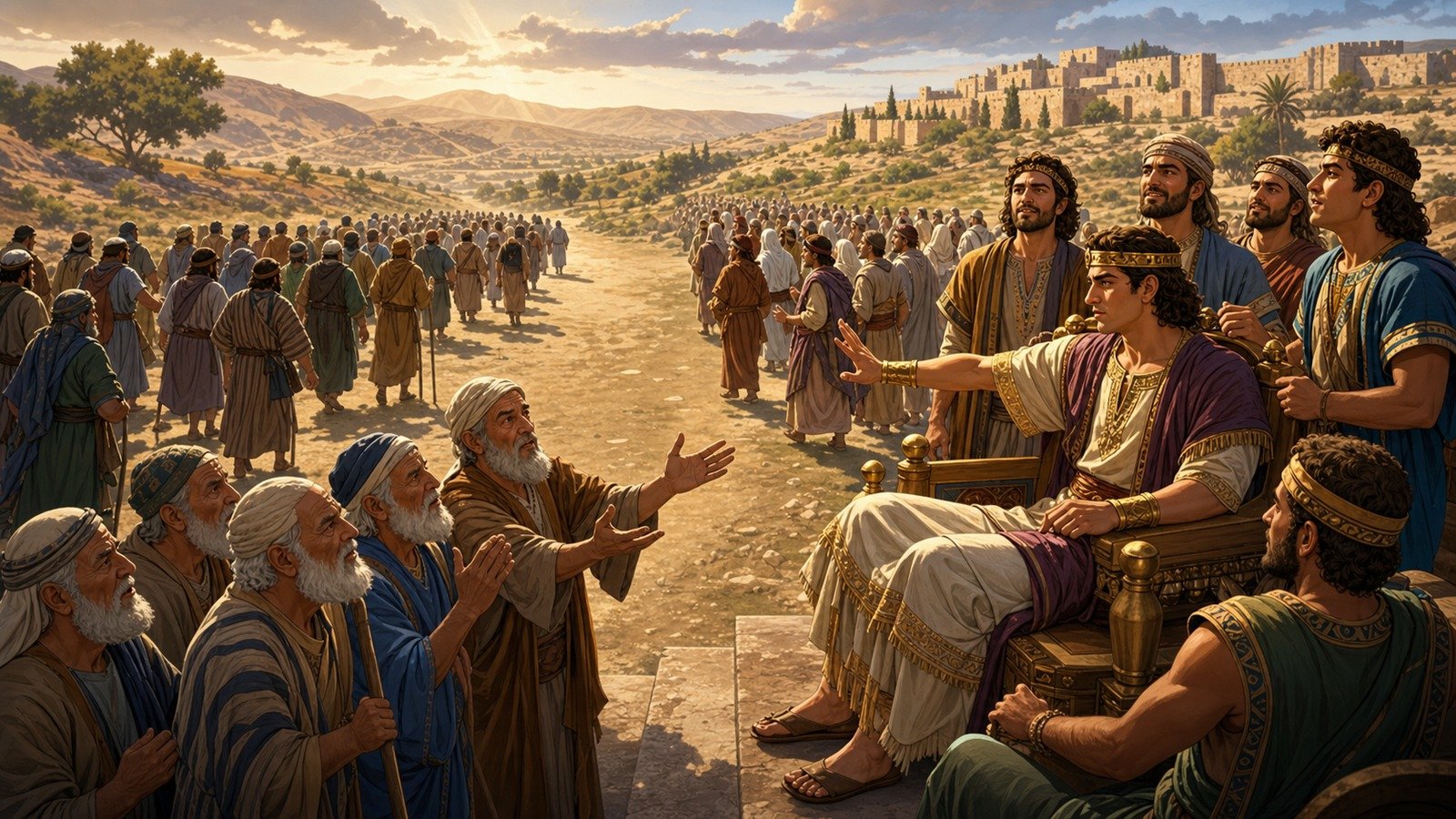
Rehoboam's harsh response to the northern tribes' request for lighter labour, rejecting his older advisors' counsel for his young friends', triggers a permanent split: ten tribes follow Jeroboam as the kingdom of Israel, leaving Rehoboam with Judah and Benjamin in the south.
Further context
3 min readThe whole nation goes to Shechem to make him king, which is itself significant: the new king travels north to be accepted rather than summoning the tribes to Jerusalem, so the northern tribes are treating the succession as something they confirm.
Jeroboam is sent for from Egypt and speaks for them, and the request is specific and moderate. Your father put a heavy yoke on us, but now lighten the harsh labour and the heavy yoke he put on us, and we will serve you. They are not asking for independence. They are asking for the conscription and the supply quotas to be reduced, and they offer service in exchange.
He asks for three days and takes advice twice.
The elders who had served his father tell him that if he serves these people today and gives them a favourable answer, they will always be his servants. The younger men who had grown up with him tell him to say something else, and the reply they compose is deliberately obscene: my little finger is thicker than my father's waist. My father laid on you a heavy yoke; I will make it heavier. My father scourged you with whips; I will scourge you with scorpions, which is a term for a barbed lash.
He delivers it word for word.
The answer comes back in the same slogan Sheba had shouted a generation earlier: what share do we have in David, what part in Jesse's son? To your tents, Israel! Look after your own house, David!
His response is to send out the one official guaranteed to inflame them, Adoniram, the man in charge of forced labour. He is stoned to death, and the king gets into his chariot and escapes to Jerusalem.
Ten tribes make Jeroboam king. Judah remains, with Benjamin attached, and the two-kingdom arrangement lasts for two centuries until the north is destroyed by Assyria.
Rehoboam musters a hundred and eighty thousand fighting men to force reunification and is stopped by a prophet with a one-sentence message: do not fight against your relatives, for this is my doing. They listen and go home, which is the only sensible decision anybody makes in the whole episode.
Two things are worth holding together. The split is presented as the direct consequence of a young king insulting a delegation, and as the fulfilment of something a prophet had announced to Jeroboam years earlier while Solomon was still alive. Both are stated, and there is no attempt to reconcile them.
The economic grievance underneath is real and it had been building for a generation. The twelve supply districts that fed the court were northern, the conscription for the building projects fell on the north, and the temple and palace those men built stood in a southern city.
Shechem, where the assembly is held, is not a neutral choice. It lay in the north, between Mount Ebal and Mount Gerizim, and it was where Joshua had renewed the covenant and where Abraham had first stopped in the land. Summoning a Davidic king north to be confirmed there is already a statement about who holds what.
Rehoboam is forty-one and has been raised in the palace. The older men who advise him to lighten the load had served his father and knew what the load was; the young men he grew up with had never carried any of it.
The answer he gives, that his little finger is thicker than his father's waist, was preserved word for word, which suggests it was repeated for a very long time afterwards.