

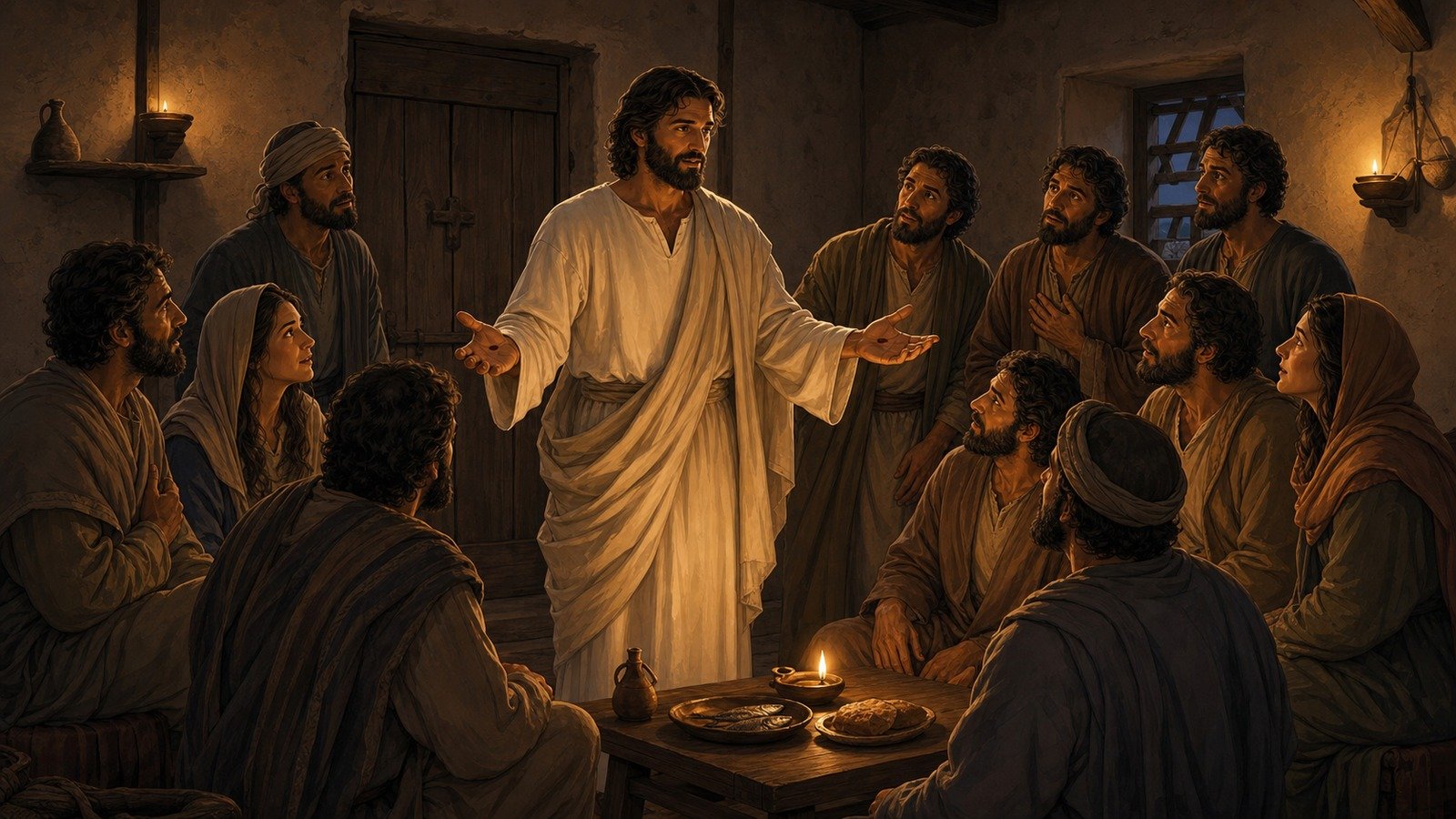
Jesus appears to the disciples gathered behind locked doors, shows them his wounds to prove he is not a ghost, eats with them, and breathes on them, "Receive the Holy Spirit," commissioning them before Thomas, who was absent, hears about it.
Further context
2 min readOn the evening of that same Sunday the disciples are together behind locked doors, and the reason is stated without embarrassment: for fear of the Jewish leaders.
Jesus comes and stands among them and says, peace be with you.
The greeting is the ordinary Hebrew shalom, which is what anyone said on entering a room, and it is the last thing this room expected to hear.
They are startled and frightened, thinking they see a ghost, and what follows is a deliberate demonstration against exactly that idea. Why are you troubled, and why do doubts rise in your minds? Look at my hands and my feet. It is I myself. Touch me and see; a ghost does not have flesh and bones, as you see I have.
Then he asks whether they have anything to eat, and they give him a piece of broiled fish, and he takes it and eats it in front of them.
That detail is doing specific work. Belief in ghosts and apparitions was widespread in the ancient world, and a Greek audience would have found a returning spirit easier to accept than a raised body. Eating fish is not a mystical gesture; it is a man settling an argument about what kind of thing he is.
He opens their minds so they can understand the Scriptures, and repeats what he had told the two on the road: the Messiah will suffer and rise from the dead on the third day, and repentance for the forgiveness of sins will be preached in his name to all nations, beginning at Jerusalem. You are witnesses of these things.
Then a commission and a gift. As the Father has sent me, I am sending you. And with that he breathes on them and says, receive the Holy Spirit.
The breathing is not incidental. The same verb is used when God breathes life into the first man, and when Ezekiel is told to prophesy to the breath so that the dry bones may live.
If you forgive anyone's sins, their sins are forgiven; if you do not forgive them, they are not forgiven.
That sentence has been read in very different ways: as authority given to the whole church, as the basis for priestly absolution, and as a statement that the message they carry either releases people or leaves them where they are. The differences run along the same lines as most others between the churches.
The locked doors are mentioned twice, once here and once a week later when Thomas is present, and both times his arrival is described without any account of how he got in.
The commission given in this room is briefer than the one on the mountain in Galilee and it does the same work: as the Father has sent me, I am sending you. Everything the movement did for the next fifty years is a working out of that sentence, and the men receiving it had been hiding behind a bolted door when it was spoken.
Broiled fish is an unglamorous detail, and its presence is one of the reasons the scene is hard to categorise as a vision. Visions do not ask for food.