

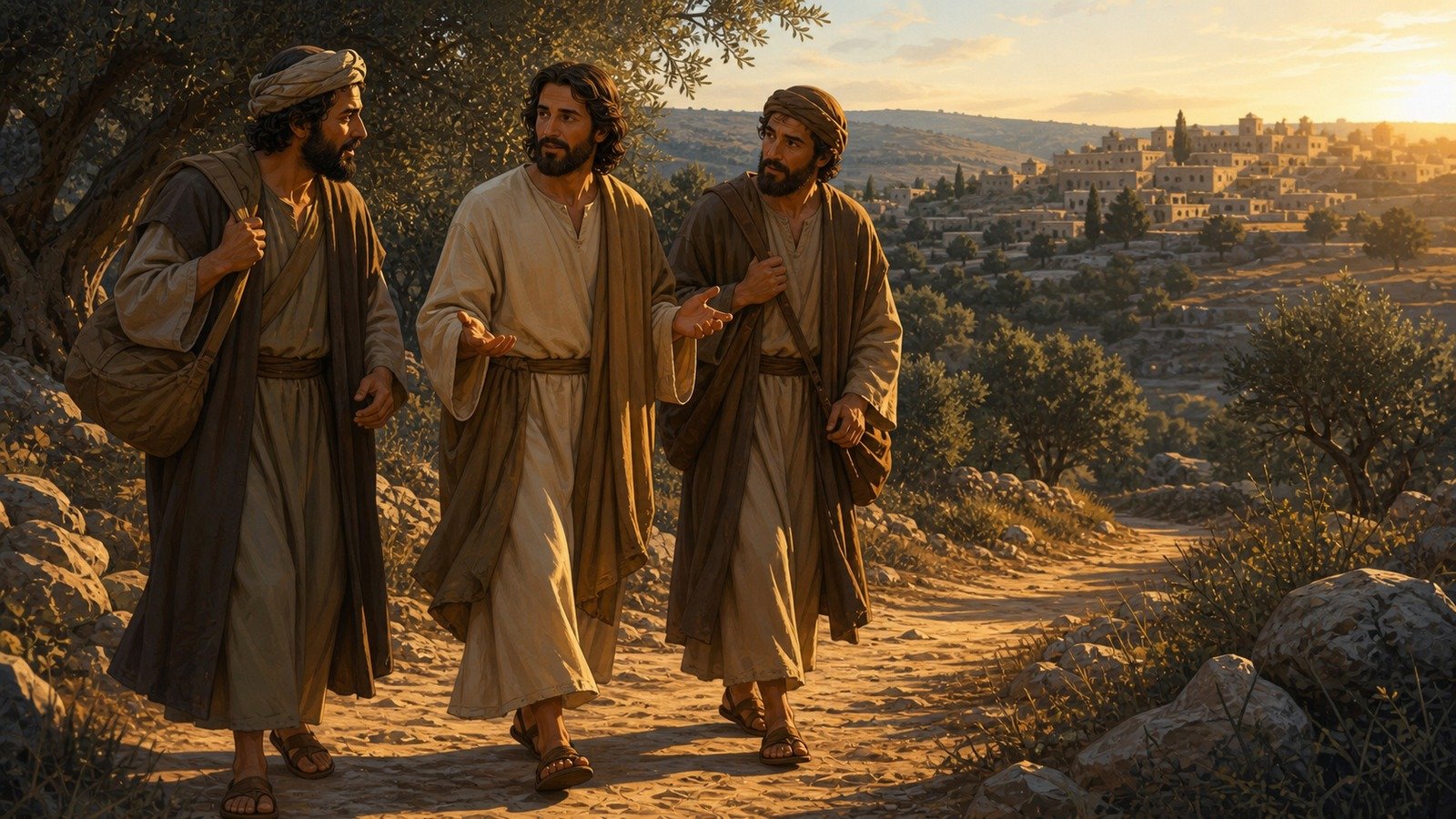
Jesus walks unrecognised with two disciples on the road to Emmaus, explaining how the Scriptures pointed to his suffering, until he breaks bread with them and they finally recognise him, at which point he vanishes from their sight.
Further context
2 min readTwo disciples are walking to a village called Emmaus, about eleven kilometres from Jerusalem, on the same Sunday afternoon. One is named Cleopas and the other is not named at all, which has produced centuries of speculation and no answer.
Where Emmaus was is unresolved. Four candidate sites have been proposed, and the distance given in the manuscripts varies, some copies reading about twenty-eight kilometres instead of eleven, which would make a return journey the same evening implausible.
They are talking about everything that has happened, and Jesus comes up and walks along with them, but they were kept from recognising him.
What are you discussing together as you walk along?
They stand still, their faces downcast, and Cleopas answers with a question that is unintentionally comic: are you the only one visiting Jerusalem who does not know the things that have happened there in these days?
What things?
Their summary is the most valuable thing in the episode, because it is a statement of what his followers believed on the third day, before anything had been resolved. He was a prophet, powerful in word and deed. The chief priests handed him over to be sentenced to death, and they crucified him. Then the sentence that carries the disappointment: but we had hoped that he was the one who was going to redeem Israel.
They add that it is the third day, that some women had astonished them with a report of angels saying he was alive, and that others went to the tomb and found it as the women had said, but him they did not see.
The reply is a rebuke and then a lesson. How foolish you are, and how slow to believe all that the prophets have spoken! Did not the Messiah have to suffer these things and then enter his glory? And beginning with Moses and all the Prophets, he explained to them what was said in all the Scriptures concerning himself.
That is the longest Bible study in history and not one word of its content is preserved.
As they approach the village he acts as if he is going further, and they urge him to stay, because it is nearly evening. At the table he takes bread, gives thanks, breaks it and begins to give it to them, and their eyes are opened and they recognise him, and he disappears.
Were not our hearts burning within us while he talked with us on the road?
They get up and walk back to Jerusalem that same hour, in the dark.
Cleopas is named nowhere else in the New Testament. A second-century writer identifies a Clopas as the brother of Joseph, which if the names are the same would make one of the two walkers a relative, and would give a reason for the second one to be left unnamed if she was his wife.
The meal at the end has been read as an ordinary act of hospitality and as an echo of the supper four days earlier, since the four verbs are the same: took, gave thanks, broke, gave.