

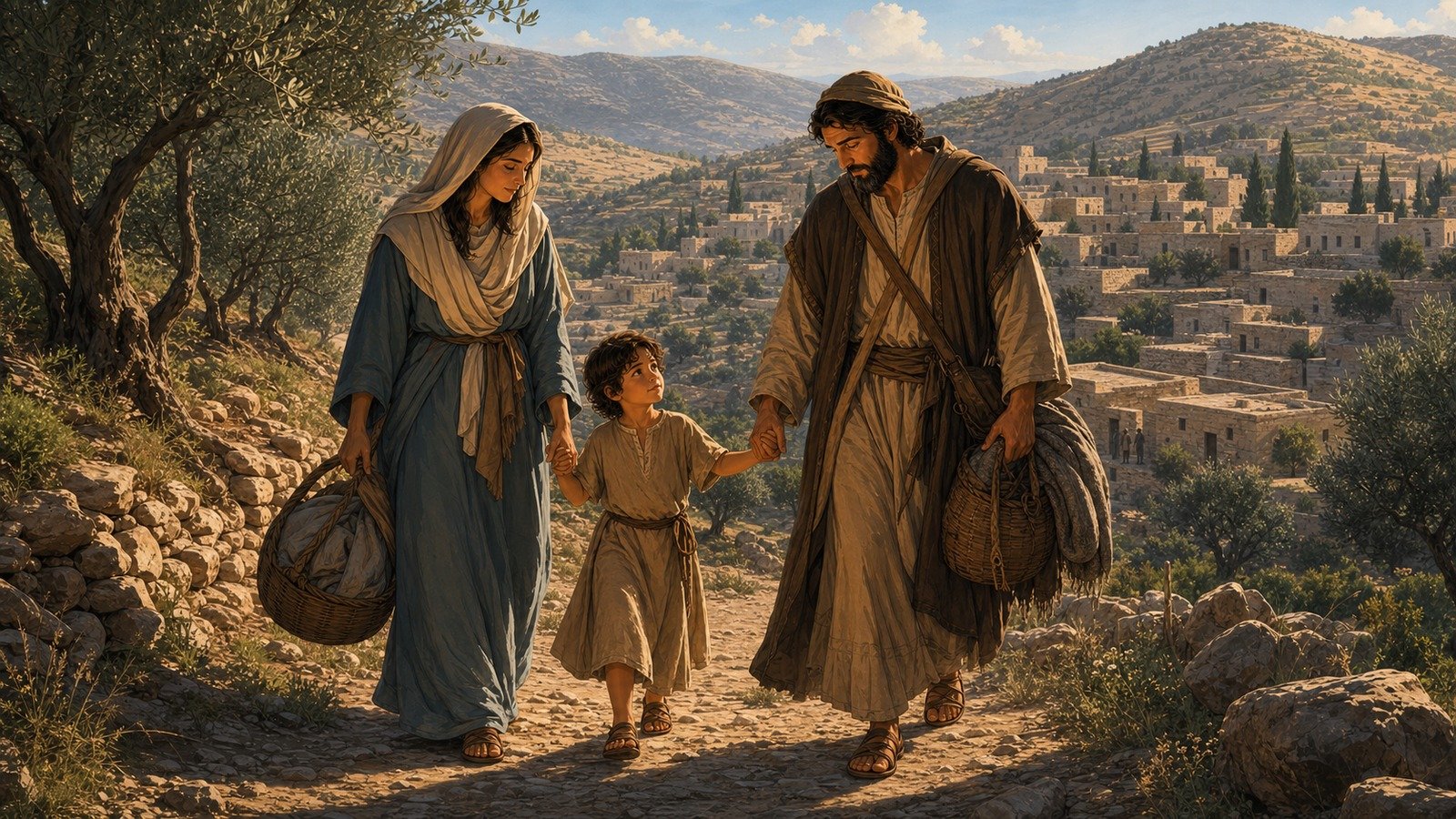
After Herod's death, an angel tells Joseph it is safe to return, but he settles the family in Nazareth in Galilee rather than Judea, avoiding Herod's equally volatile son Archelaus, and Jesus grows up there.
Further context
3 min readHerod dies and an angel tells Joseph in a dream to take the child and his mother and go to the land of Israel, because those who were trying to take the child's life are dead. The plural is worth noticing, since it is the same phrasing used when Moses was told it was safe to return to Egypt.
He sets out, and then learns that Archelaus is reigning in Judea in his father's place, and is afraid to go there. Warned in a dream again, he withdraws to the district of Galilee and settles in Nazareth.
The fear was well founded. Herod's kingdom had been divided between three sons and Judea went to the worst of them. Archelaus opened his reign by sending troops into the temple courts at Passover and killing about three thousand people, ruled for ten years, and was deposed by Augustus after a joint delegation of Jews and Samaritans complained about his brutality. Judea was then placed under direct Roman administration, which is the arrangement Pontius Pilate is operating under thirty years later.
Galilee went to Antipas, who ruled it for over forty years and is the Herod of the Gospel narratives, the man who executes John the Baptist and to whom Pilate sends Jesus during the trial.
Nazareth itself is worth describing because its obscurity is the point. It appears in no earlier writing at all, and excavation indicates a small agricultural village of perhaps two to four hundred people, with rock-cut tombs, cisterns, winepresses and terraced fields. It is about six kilometres from Sepphoris, which Antipas was rebuilding as his capital during Jesus' childhood, and a builder in Nazareth would have had steady work a morning's walk away.
Nathanael's question when he first hears the name, can anything good come from there, is the ordinary reaction of a man from a nearby town.
Two things follow from settling there. The child grows up in Galilee, which is agricultural, mixed in population, some distance from the temple establishment and looked down on by Judeans, whose accent later gives Peter away in a courtyard. And Matthew attaches a quotation to the move that has no clear source: he will be called a Nazarene. No such sentence appears in the prophets, and proposals include a play on the Hebrew word for a branch in Isaiah, or a summary of the general prophetic theme that the deliverer would be despised.
Both Gospels that cover the childhood then close it in a sentence. The child grew and became strong; he was filled with wisdom, and the grace of God was on him.
The decision to settle in Galilee is presented as a calculation. Archelaus had taken over Judea, and his opening act had been the massacre of about three thousand people in the temple courts at Passover. He was removed by Augustus after ten years following complaints from his own subjects and exiled to Gaul.
Galilee under Antipas was a quieter proposition, and Nazareth was an obscure village in it, off the main roads, about six kilometres from Sepphoris, which Antipas was rebuilding as his capital during exactly these years. A building trade in a town that close to a major construction site is an obvious living, and it is the trade Joseph and later Jesus are described as following.
The eighteen years after the visit to the temple are covered in one sentence, and the sum of what is known about the whole of his life between the ages of twelve and thirty is that he grew, worked and lived in that village.