

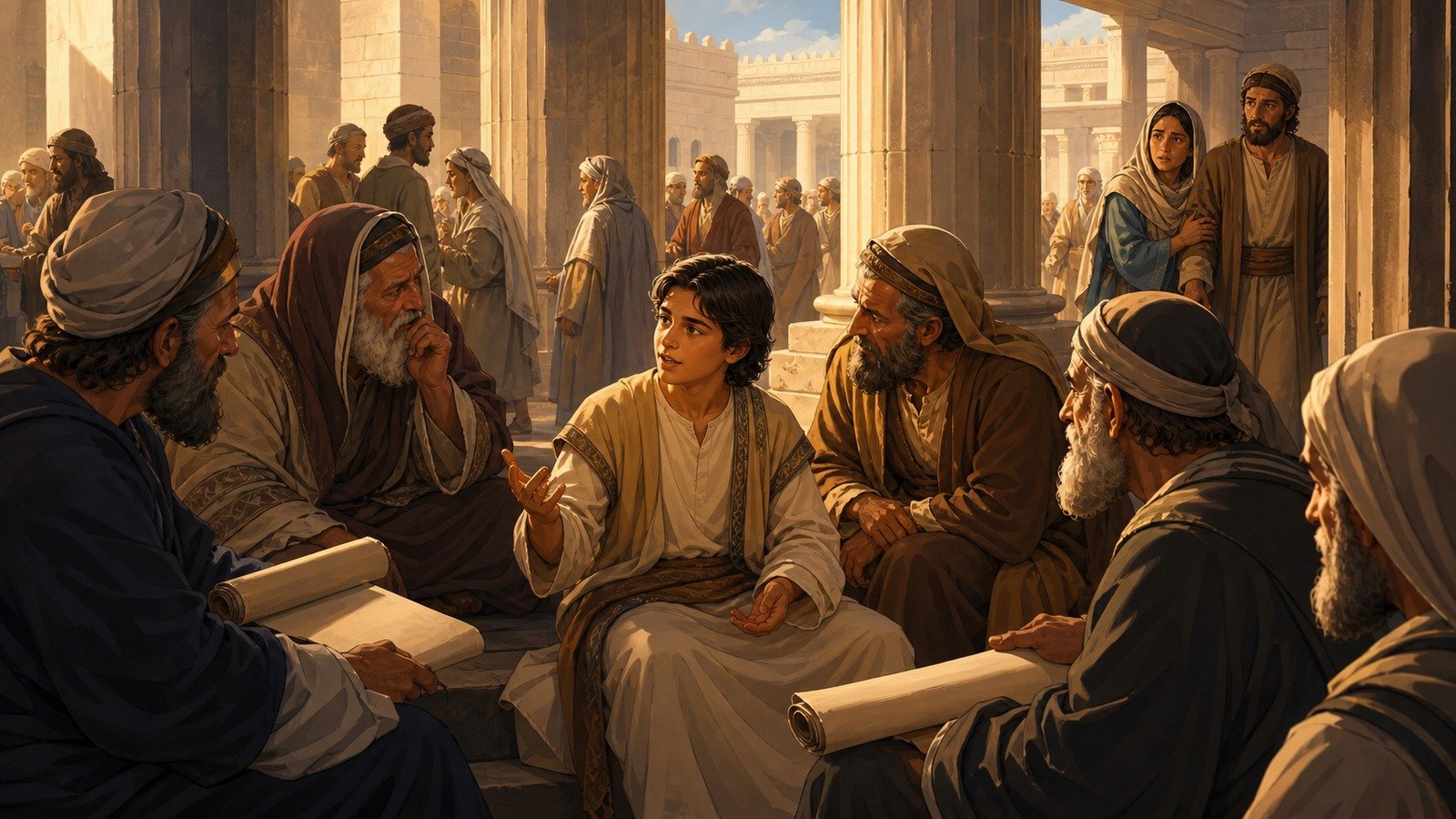
During a Passover pilgrimage, the twelve-year-old Jesus stays behind in the Temple, found after three days sitting among the teachers, listening and asking questions, telling his anxious parents he had to be "in my Father's house." This is the only recorded incident of Jesus' childhood.
Further context
3 min readThe family goes up to Jerusalem every year for Passover, which was one of three festivals adult males were required to attend, and travelling as a group from Galilee meant a party of relatives and neighbours covering about a hundred and fifty kilometres over several days.
Jesus is twelve, which is the year before the age at which a Jewish boy took on the obligations of the law, and the later ceremony marking that transition does not yet exist in any formal way.
When the festival ends the party leaves and he stays behind without their knowledge. They assume he is somewhere in the caravan, travel a full day, and then start looking among their relatives and friends. Anyone who has travelled with an extended family will recognise the mechanism exactly: two parents each assuming the child is with the other or with cousins.
They go back and search Jerusalem for three days, which is a long time to be looking for a child in a crowded city, and find him in the temple courts sitting among the teachers, listening to them and asking them questions.
What he is doing is worth describing precisely, because the popular picture has him lecturing. He is sitting, listening and asking, which is exactly what a student in that setting did, and the rabbinic method proceeded by question and counter-question. Everyone who heard him was amazed at his understanding and his answers, and the amazement is at a twelve-year-old holding his own in that room, not at a child instructing his elders.
His mother's question is the reaction of any parent who has just found a missing child, and it is not gentle: son, why have you treated us like this? Your father and I have been anxiously searching for you.
His answer is the first thing he is recorded saying, and it is a question with an edge in it: why were you searching for me? Did you not know I had to be in my Father's house? The Greek is ambiguous and can equally mean about my Father's business. Either way, the word father is being used of somebody other than the man standing in front of him, and the note attached is that they did not understand what he was saying to them.
The three days are worth thinking about. Jerusalem at Passover held several times its normal population, the family had already travelled a day out and a day back, and the temple courts covered fourteen hectares. Nothing suggests they searched the temple first, which is its own small observation about where parents look for a missing twelve-year-old.
Then he goes back to Nazareth with them and is obedient to them, and eighteen years pass in one sentence before he is heard of again.
Passover pilgrimage from Galilee meant travelling in a large party of relatives and neighbours, which is why a day passes before he is missed, and the assumption that a twelve-year-old was somewhere in the group was entirely reasonable.
Three days is what it takes to find him: one going, one returning, and one searching.
Where he is found matters. Not in the sanctuary but in the temple courts, sitting among the teachers, listening to them and asking them questions. That is the ordinary form of rabbinic instruction, and what astonishes the listeners is his understanding and his answers rather than any claim he makes.
His mother's question is the reproach of a parent who has spent three days frightened: son, why have you treated us like this? Your father and I have been anxiously searching for you.
The answer, the first words of his recorded anywhere, is a question back: did you not know I had to be in my Father's house? They did not understand it.