

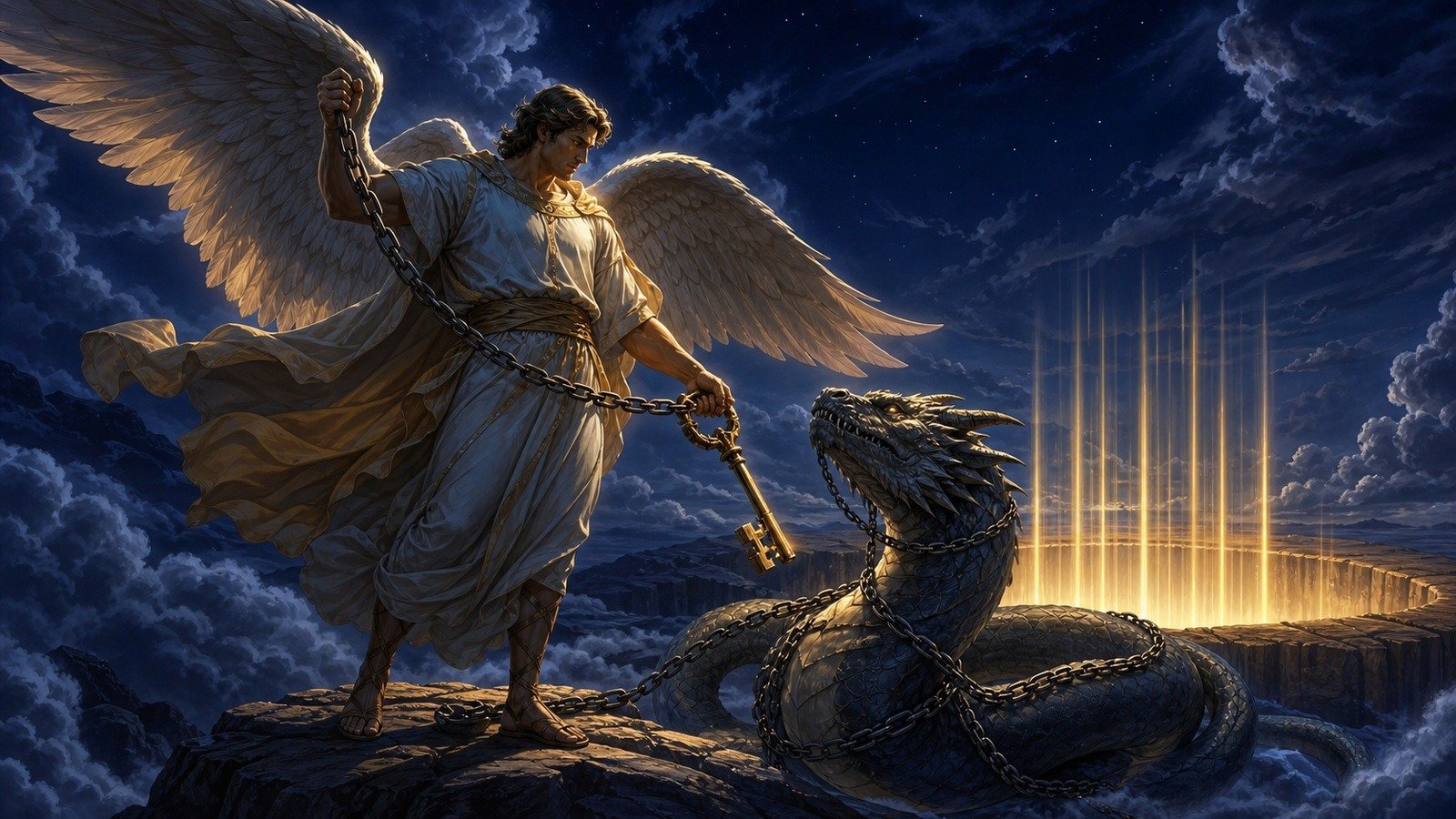
An angel seizes "the dragon, that ancient serpent," binds him for a thousand years and throws him into the Abyss, sealing it so he can no longer deceive the nations until that period ends.
Further context
3 min readAn angel comes down out of heaven, holding the key to the Abyss and a great chain in his hand. He seizes the dragon, that ancient serpent, who is the devil, or Satan, and binds him for a thousand years.
The four names are repeated from the earlier scene, and the point of listing them is that there is no ambiguity about who is being restrained.
The angel throws him into the Abyss, locks and seals it over him, to keep him from deceiving the nations any more until the thousand years are ended. After that he must be set free for a short time.
The word for a thousand years gives English the term millennium, and few passages of this length have generated more division.
Three broad readings have shaped Christian history and it is worth naming them plainly, because each is held by serious people and the same words yield all three.
Premillennialism holds that Christ returns before the thousand years and reigns on earth during them. It is the oldest position attested in the second century and it is dominant in much of the evangelical world today.
Postmillennialism holds that the gospel gradually transforms the world, producing a long period of peace, after which Christ returns. It was widespread in the eighteenth and nineteenth centuries, when it fed a great deal of missionary and social reform work, and collapsed as a majority view after the First World War.
Amillennialism holds that the thousand years is a symbol for the present age between the resurrection and the return, during which Satan's power to deceive the nations is limited rather than absent. It became the standard view of the western church from Augustine onward and is held by most Catholic, Orthodox, Lutheran, Anglican and Reformed teaching.
The disagreements between them are not trivial and they have shaped how whole traditions read history, politics and the future.
What all three have to account for is the specific claim made here, which is narrow: the binding is described as preventing one thing, the deceiving of the nations, and it is described as temporary and as ending with a release.
The three positions are not a modern development. Papias and Irenaeus in the second century expected an earthly reign; Origen read the imagery symbolically; Augustine, in the fifth century, set out the reading that became standard in the west and did so after having held the other one.
Nothing at all is described about the thousand years themselves. There is no account of conditions, no geography and no description of what anybody does, which is a considerable silence in a book full of detail.
Whichever reading is taken, the binding is stated in terms of an effect on the nations rather than on individuals.
The chain and the key are ordinary objects, and the Abyss has appeared before in the book as the place the locusts came from and the place the beast rises out of.
Sealing the pit repeats a gesture used earlier on a tomb outside Jerusalem, where the authorities set a seal on a stone so that any interference would show.
What the three readings share, and what is often lost in the arguments between them, is that all of them regard the period as bounded and all of them read the release as demonstrating something about human nature rather than about the strength of the one released.