

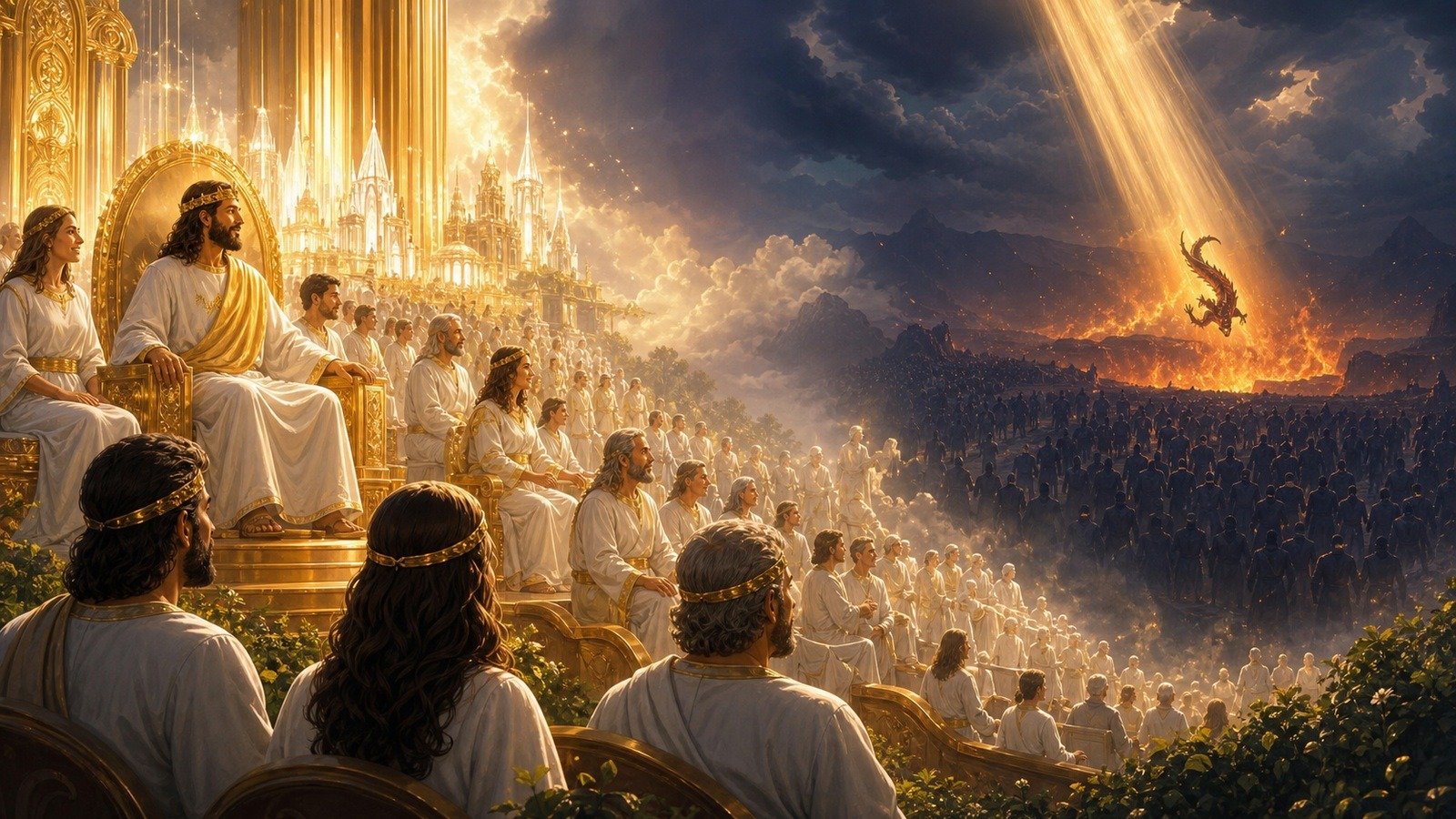
Those who had been faithful under persecution reign with Christ for the thousand years; when the period ends, Satan is released briefly, gathers the nations for a final rebellion, and is defeated and thrown into the lake of fire permanently.
Further context
3 min readJohn sees thrones on which were seated those who had been given authority to judge.
Then he identifies who they are, and the description is specific: the souls of those who had been beheaded because of their testimony about Jesus and because of the word of God. They had not worshipped the beast or its image and had not received its mark on their foreheads or their hands.
They came to life and reigned with Christ a thousand years.
Beheading was the Roman method of execution for citizens, and naming it locates the people concerned in the empire rather than anywhere else.
This is called the first resurrection, and a blessing is attached: blessed and holy are those who share in the first resurrection. The second death has no power over them, but they will be priests of God and of Christ and will reign with him.
Priests and kings together is the description given of God's people at the very start of the book and, before that, of Israel at Sinai.
When the thousand years are over, Satan is released from his prison and goes out to deceive the nations in the four corners of the earth, Gog and Magog, and to gather them for battle. In number they are like the sand on the seashore.
Gog and Magog come from Ezekiel, where Gog is a ruler of the land of Magog who comes against Israel from the far north and is destroyed. Here the two names are used together for the nations themselves.
They march across the breadth of the earth and surround the camp of God's people, the city he loves. But fire comes down from heaven and devours them.
Again there is no battle. The armies gather, and the sentence ends.
That the release happens at all is the hardest part of the passage. Satan is bound, the nations are undeceived for a long period, and when he is let out they follow him again immediately and in numbers beyond counting. Whatever else the sequence says, it says that restraining evil externally does not change anyone.
And the devil, who deceived them, was thrown into the lake of burning sulphur, where the beast and the false prophet had been thrown.
The first resurrection is named as such, which implies a second, and the second death is named, which implies a first. The book uses the pairing without explaining it, and the four terms have to be worked out against each other.
Reigning is promised, and no subjects are mentioned. The same problem attaches to the nations who are deceived after the release, since the sequence has already described the destruction of everyone opposed. Readers who take the sequences as consecutive have to account for where those people came from.
Gog and Magog reappear in later Jewish, Christian and Islamic tradition, and in medieval European legend they became giants and eventually a pair of statues in the Guildhall in London.
Those given authority to judge and those who had been beheaded are described in the same breath, and whether they are one group or two is unclear in the Greek. The martyrs judging is the reading most commentators take.
Sand on the seashore is the phrase used of Abraham's descendants and of the armies that came against Israel in the period of the judges, and here it is applied to the forces gathered at the end.
The camp of God's people is a wilderness image rather than a civic one, and it sits beside the city he loves in the same sentence, which is two pictures of the same thing.