

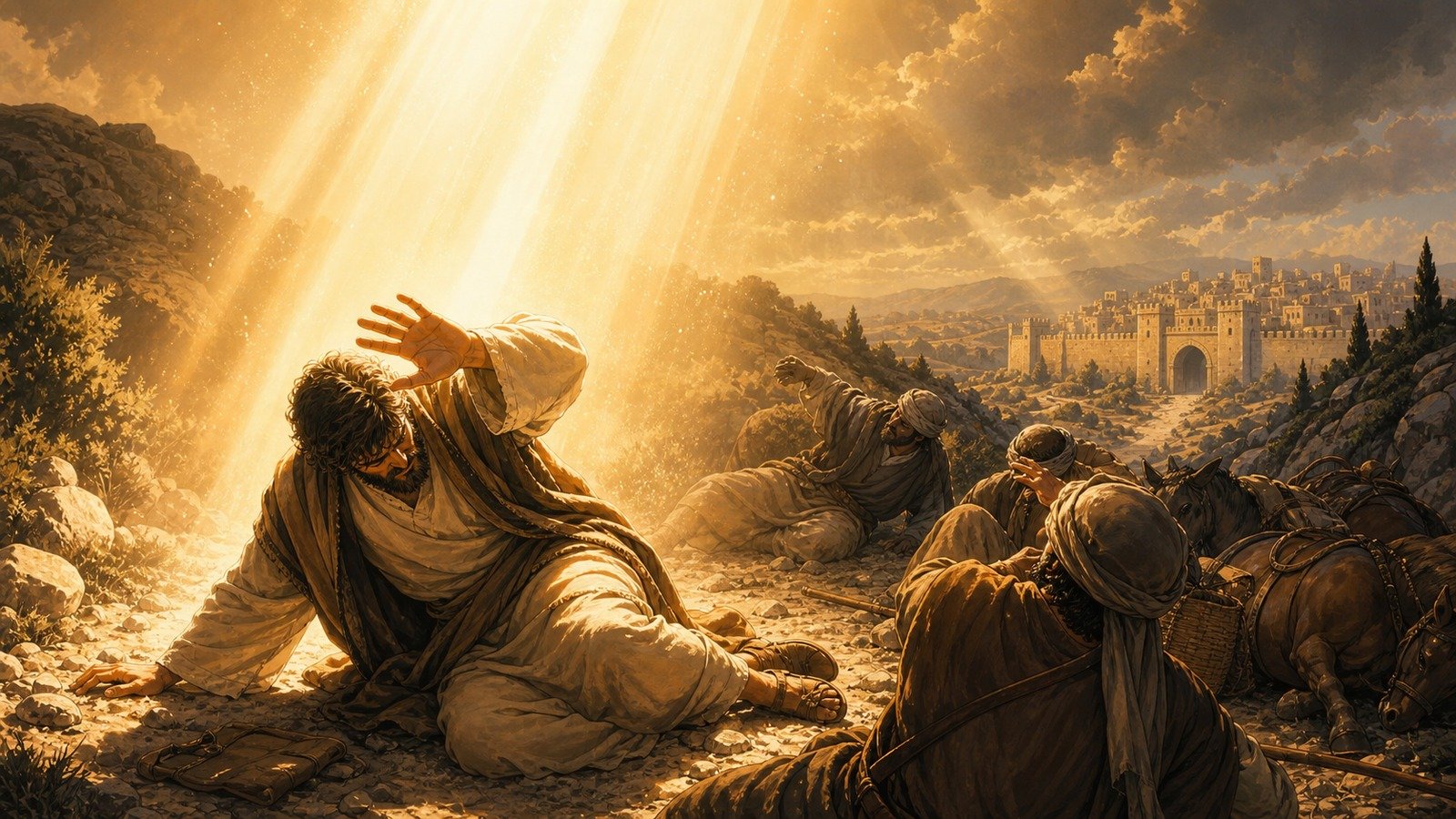
Travelling to Damascus with letters authorising the arrest of believers there, Saul is confronted by a blinding light and a voice identifying itself as Jesus; blinded for three days, he is restored and baptised by a disciple named Ananias, and begins the reversal that makes him the New Testament's central missionary figure.
Further context
2 min readSaul is still breathing out murderous threats against the Lord's disciples when he goes to the high priest and asks for letters to the synagogues in Damascus, so that if he finds any there who belonged to the Way, he might take them as prisoners to Jerusalem.
Damascus is about two hundred and twenty kilometres from Jerusalem, six or seven days on foot, and it lay outside Judea in the Roman province of Syria. The letters were needed because the high priest had no civil authority there; what he had was the standing to ask synagogue communities to cooperate.
The Way is the movement's earliest name for itself, used several times before Christian appears.
As he nears Damascus, a light from heaven flashes around him. He falls to the ground and hears a voice: Saul, Saul, why do you persecute me?
Who are you, Lord?
I am Jesus, whom you are persecuting.
The pronoun is the whole thing. He had been arresting people in houses in Jerusalem, and he is told that what he did to them was done to someone else.
Three accounts of this episode appear in the record of the early church, one narrated and two spoken by Paul himself, and they differ in small details about what his companions saw and heard. The differences have been catalogued since antiquity and the usual explanation is the ordinary one for a man retelling his own story to different audiences over thirty years.
He gets up blind and has to be led by the hand into the city, which for a man who set out with warrants is a reversal complete enough to be embarrassing. For three days he neither eats nor drinks.
In Damascus a disciple called Ananias is told to go to him, and objects, with reasons: Lord, I have heard many reports about this man and all the harm he has done to your holy people in Jerusalem. And he has come here with authority to arrest all who call on your name.
Go! This man is my chosen instrument to proclaim my name to the Gentiles and their kings and to the people of Israel. I will show him how much he must suffer for my name.
Ananias goes, calls him brother, and something like scales fall from his eyes.
The three years Paul later says passed before he went to Jerusalem are counted from this point, and the road he was travelling ran through the Hauran plain south-west of Damascus, in open country.
What happened to him has been explained medically more than once, most often as an epileptic seizure or a migraine with visual disturbance. Those proposals account for a light and a collapse, and they leave the rest where it was: a man who had built a career on stopping the movement spent the next thirty years being beaten, imprisoned and shipwrecked for it, and gave the same reason every time.
The three surviving versions of the episode are placed at intervals through the record deliberately: once as narrative, once addressed to a Jerusalem crowd, and once to a Roman governor and a Jewish king. Each time the emphasis shifts to fit the audience, and the core is identical.