

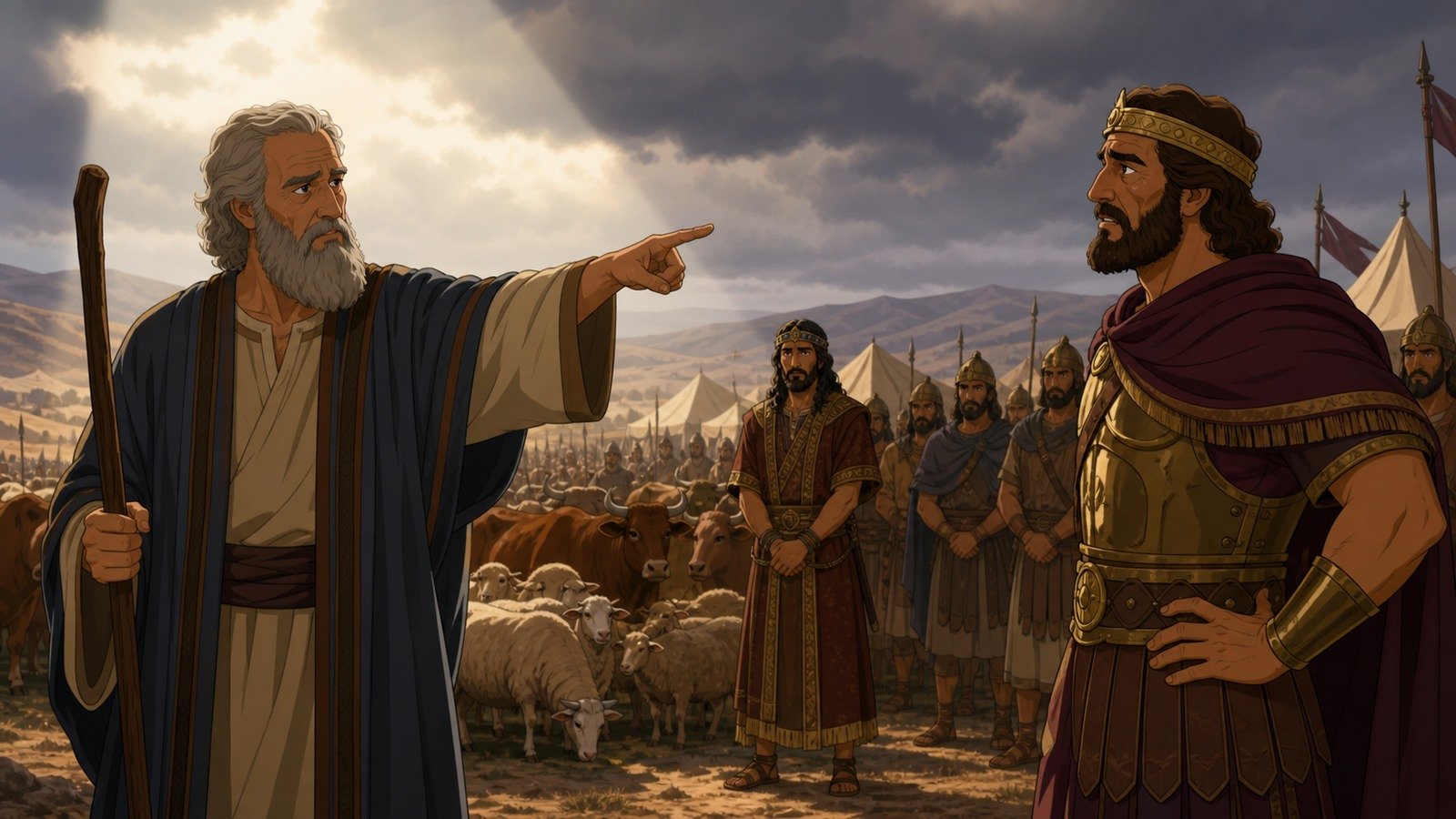
Saul is commanded to destroy the Amalekites and everything belonging to them, but spares King Agag and the best livestock. Samuel delivers the verdict that "to obey is better than sacrifice" and announces that God has rejected Saul as king.
Further context
2 min readThe commission is one of the hardest things in the Hebrew scriptures and there is no way to present it that removes the difficulty. Saul is sent against the Amalekites for what they did to Israel when it came up from Egypt, attacking the stragglers at the rear, and he is told to destroy everything: men, women, children, infants, cattle, sheep, camels and donkeys.
That instruction has been argued over for as long as anyone has read it, and no reading makes it comfortable. What can be said is that the command is specific to one people and one grievance, that it is never generalised into a policy, and that the whole episode is about a king who did not carry it out. Christians have taken positions on it ranging from accepting it as a unique judicial act, to reading the language as the conventional hyperbole of ancient military reporting, to treating it as a genuine moral problem in the text. Anyone who says the question is settled is overstating.
He warns the Kenites to move away first, because they had shown kindness to Israel coming out of Egypt, and they do.
He wins, and then keeps King Agag alive along with the best of the sheep, cattle, fat calves and lambs, destroying only what was despised and weak.
Samuel is told and is distressed, and cries out all night. When he arrives, Saul greets him with the words, the LORD bless you! I have carried out the LORD's instructions. Samuel's reply is one of the flattest lines in Scripture: what then is this bleating of sheep in my ears? What is this lowing of cattle that I hear?
Saul's defence shifts three times in the space of a conversation. The soldiers brought them. They were for sacrifice. Then, when pressed, I have sinned, I violated the LORD's command and your instructions, because I was afraid of the men and so I gave in to them.
The verdict comes in poetry, and it is among the most quoted things Samuel ever says. Does the LORD delight in burnt offerings and sacrifices as much as in obeying the LORD? To obey is better than sacrifice, and to heed is better than the fat of rams. For rebellion is like the sin of divination, and arrogance like the evil of idolatry. Because you have rejected the word of the LORD, he has rejected you as king.
Saul grabs the edge of Samuel's robe as he turns to go and it tears, and Samuel uses it: the LORD has torn the kingdom of Israel from you today and given it to one of your neighbours, to one better than you.
What Saul asks for at the end is the most revealing thing in the episode. I have sinned. But please honour me before the elders of my people and before Israel; come back with me, so that I may worship. He is not asking for forgiveness. He is asking not to be humiliated in public.
Samuel then executes Agag himself, and never goes to see Saul again as long as he lives.