

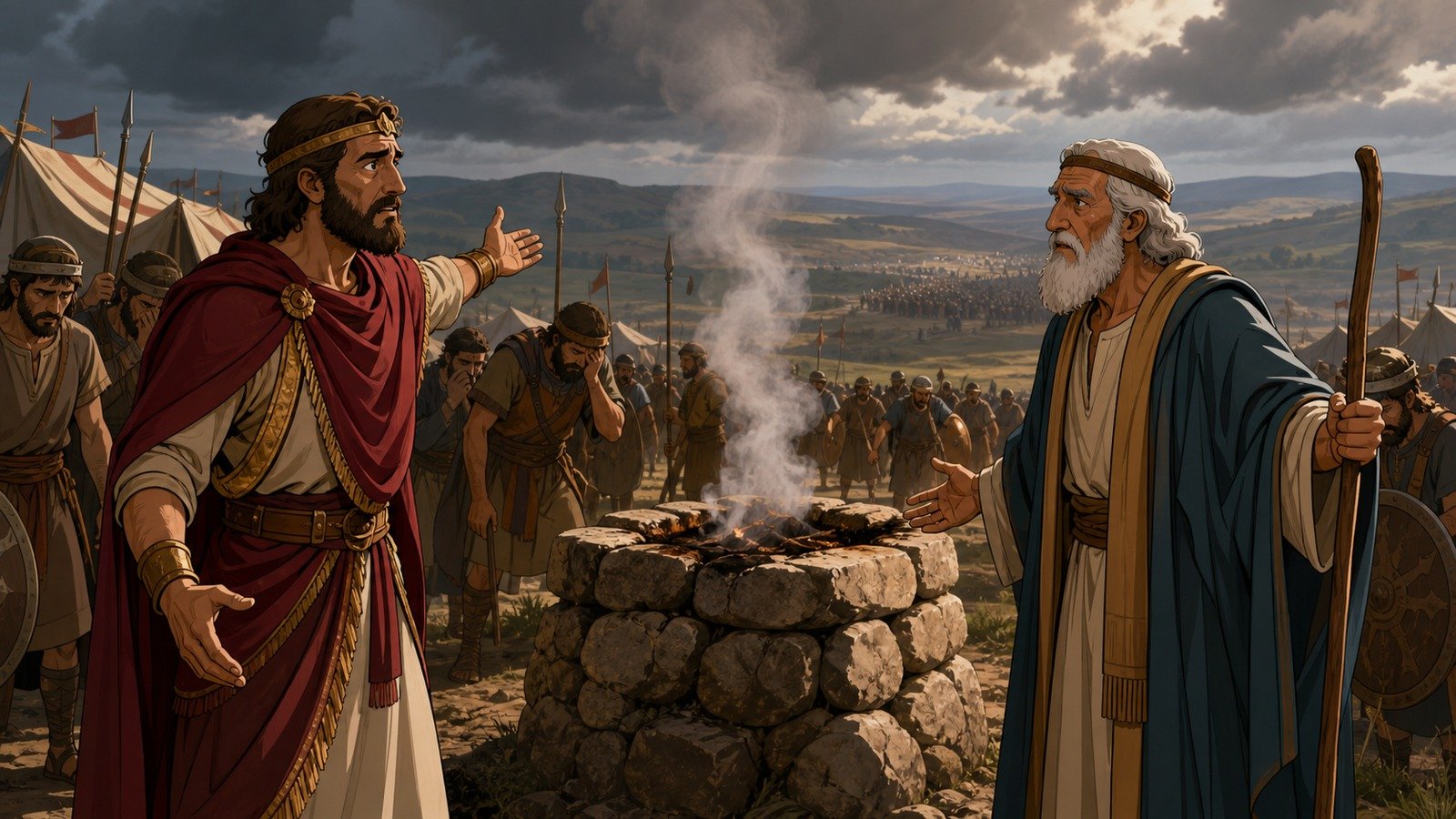
Facing a Philistine army and Samuel's delay, Saul offers a sacrifice himself rather than waiting for the priest, violating his role; Samuel arrives and tells him his dynasty will not endure because of this impatience.
Further context
2 min readJonathan attacks a Philistine outpost at Geba and the whole balance tips. The Philistines muster in force, and the numbers given for their chariots are very large, and the Israelites see the situation and hide in caves, thickets, rocks, pits and cisterns. Some cross the Jordan and leave the country altogether.
Saul is at Gilgal and the men with him are quaking with fear and beginning to scatter. He has been told to wait seven days for Samuel, who will come and offer the sacrifices and tell him what to do. He waits the seven days. Samuel does not arrive, the army is melting away, and Saul offers the burnt offering himself.
Samuel arrives as he finishes.
The exchange that follows repays attention because Saul's defence is entirely reasonable. When I saw that the men were scattering, and that you did not come at the set time, and that the Philistines were assembling at Micmash, I thought, now the Philistines will come down against me at Gilgal, and I have not sought the LORD's favour. So I felt compelled to offer the burnt offering. Every clause of that is true and the situation was genuinely urgent.
What he is told is that he acted foolishly and has not kept the command he was given, and that his kingdom will not endure. The LORD has sought out a man after his own heart and appointed him ruler over his people.
Readers have divided for a long time over what exactly the offence was, and the strongest reading takes the whole situation together rather than the single act. He waited seven days, which is the letter of the instruction, and stopped waiting at the point where waiting became expensive. The command was to wait until Samuel came, and the seven days were an outside estimate rather than a permission slip. What is being tested is whether a king appointed under a written constitution will operate inside it when the constitution is inconvenient, and the answer arrives in his second recorded crisis.
The detail that closes the episode is the one that explains the whole military situation. Not a blacksmith could be found in the whole land of Israel, because the Philistines had said, otherwise the Hebrews will make swords or spears. So all Israel went down to the Philistines to have their ploughshares, mattocks, axes and sickles sharpened, and the charges are itemised down to a third of a shekel for sharpening a goad. On the day of battle, not a soldier with Saul and Jonathan had a sword or spear in his hand; only Saul and his son had them.
An occupying power controlling the ironworking trade, with prices for farm tools recorded, is as precise a picture of the transition to the Iron Age as anywhere in ancient literature.