

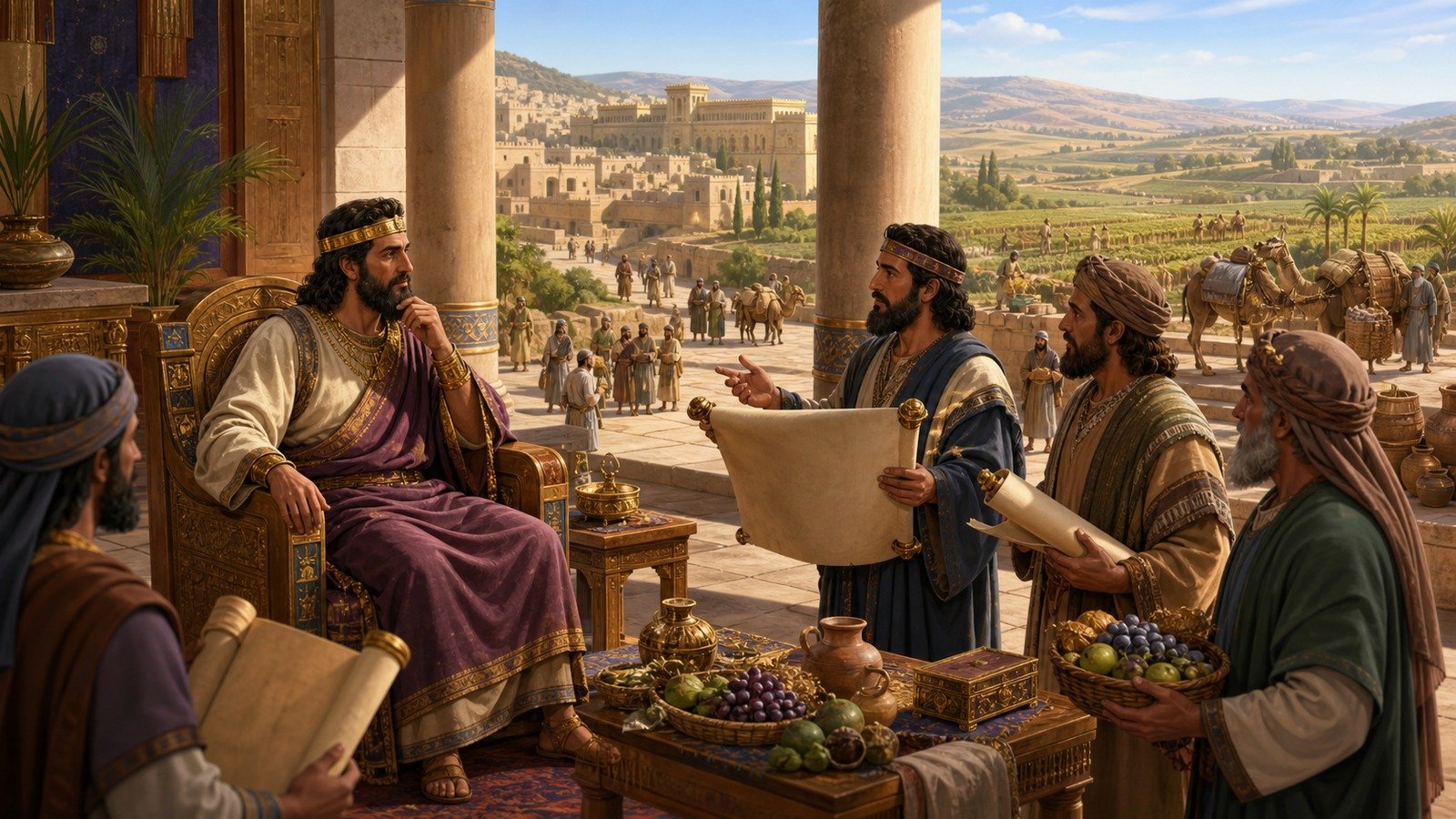
Solomon organises the kingdom into administrative districts, oversees a period of peace and prosperity across his reign, and becomes internationally renowned for wisdom that "surpassed the wisdom of all the people of the East."
Further context
2 min readThe list of officials that opens his reign is the first proper civil service in Israel's history, and it is longer and more specialised than anything under his father.
There is a priest, two secretaries, a recorder, a commander of the army, a supervisor of the district governors, a personal adviser to the king, a palace administrator and a man in charge of forced labour. That last post is new and it is the one that eventually destroys the kingdom.
Twelve district governors are appointed, each responsible for supplying provisions for the king and the royal household for one month of the year. The districts do not follow the old tribal boundaries, which is a deliberate administrative decision: cutting across tribal lines weakens tribal loyalty and strengthens the crown. Two of the governors are married to Solomon's daughters, which keeps the arrangement in the family.
The daily provision for the court is itemised: thirty cors of the finest flour and sixty of meal, ten head of stall-fed cattle, twenty of pasture-fed cattle, a hundred sheep and goats, as well as deer, gazelles, roebucks and choice fowl. That is somewhere in the order of five to seven thousand kilograms of flour a day, which implies an establishment of several thousand people.
He also has four thousand stalls for chariot horses and twelve thousand horses, with the barley and straw brought to wherever the horses were stationed by the same district system. Chariot cities are mentioned, and Megiddo, Hazor and Gezer have all produced monumental gateways of a similar design, which were once confidently dated to his reign and are now argued over, with some archaeologists placing them a century later.
The prosperity is described in a phrase that entered the language: during Solomon's lifetime Judah and Israel lived in safety, everyone under their own vine and under their own fig tree, from Dan to Beersheba. The territory he inherits runs from the Euphrates to the border of Egypt, and the surrounding kingdoms pay tribute and are at peace with him.
Underneath the prosperity is the mechanism his father's generation had been warned about. Samuel's speech to the elders who demanded a king listed exactly this: he will take your sons for his chariots, your daughters for his kitchens, the best of your fields, and a tenth of your grain and your flocks. Every item on that list is now in place and running as a system.
One more feature of the district system is worth stating because it explains the eventual split. Judah is not on the list of twelve districts. The tribes required to supply the court for a month each are northern, and the king's own tribe carries no part of the rota. Whether that is an omission in the record or a genuine exemption is argued, and either way the northern delegation that arrives a generation later is complaining about a burden its members had reason to think was unequally shared.
The bill arrives at the end of his reign, when the northern tribes send a delegation to his son asking for the burden to be lightened, and are refused.