

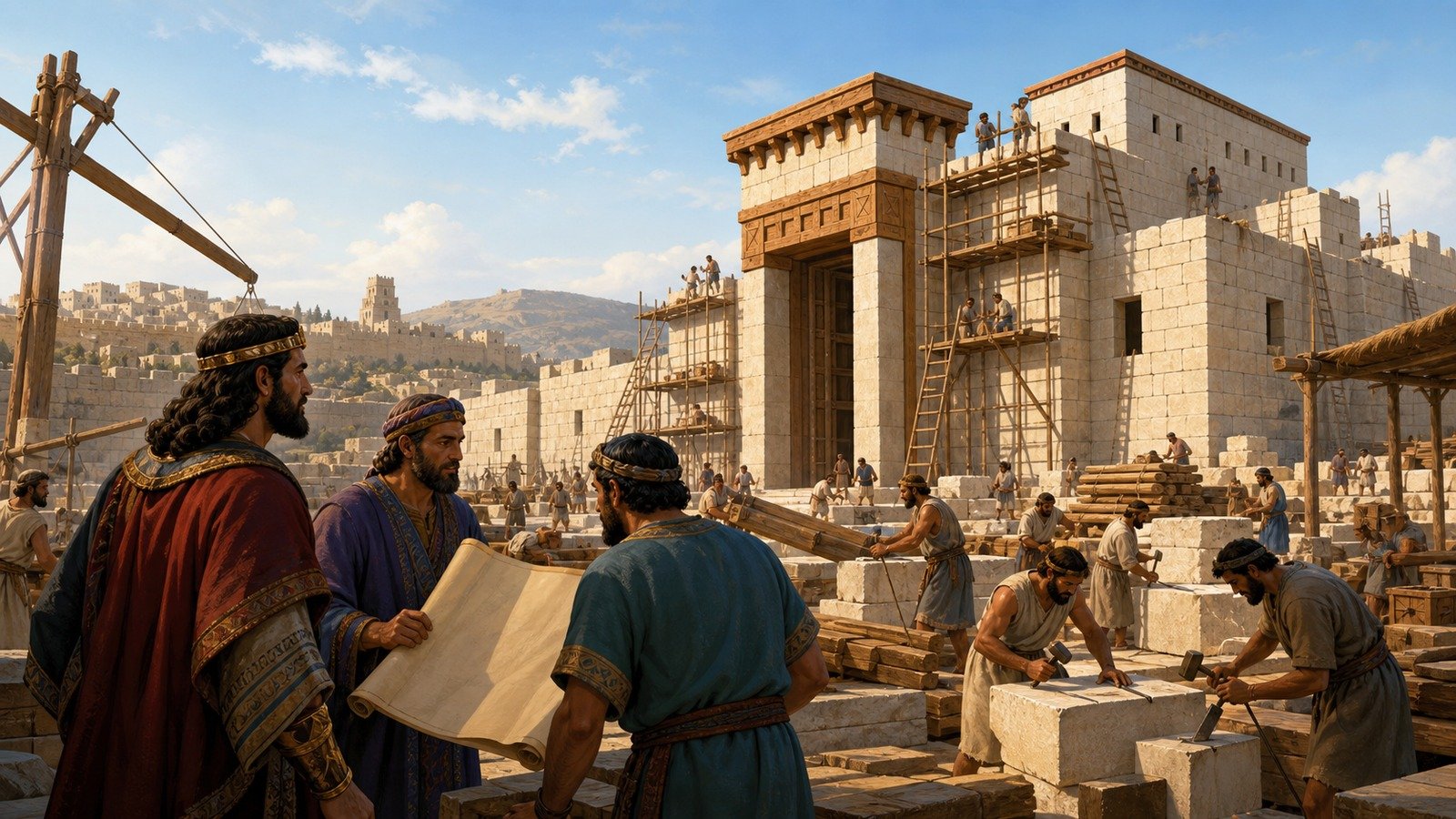
Construction begins in Solomon's fourth regnal year, 480 years after the Exodus by the text's own reckoning, using cedar from Hiram of Tyre and skilled labour; the Temple takes seven years to complete.
Further context
2 min readThe date given for the start is the single most important chronological cross-reference in the Old Testament: the four hundred and eightieth year after the Israelites came out of Egypt, in the fourth year of Solomon's reign. That fourth year can be fixed near 967 BC from Assyrian records, which is what produces an Exodus around 1446 BC on a literal reading of the figure, and it is the basis of the whole argument for the earlier of the two Exodus dates.
The arrangement with Tyre is a trade agreement between two states. Hiram supplies cedar and juniper from Lebanon, floated down the coast in rafts, and Solomon supplies wheat and pressed olive oil for the royal household, year after year. Phoenician craftsmen work alongside Israelite labourers, and a bronze worker from Tyre, also called Hiram and the son of a widow from Naphtali, casts all the bronze work.
The labour force is enormous and it is described in a way that has caused arguments ever since. Thirty thousand men are conscripted from all Israel, working in Lebanon in shifts of ten thousand a month, one month on and two at home. Seventy thousand carriers and eighty thousand stonecutters work in the hills, with three thousand three hundred foremen. A later summary insists that no Israelites were made slaves, only the descendants of the earlier populations of the land, while the conscription of thirty thousand Israelites sits a few sentences earlier, and both statements are left standing.
The building itself is not large. Sixty cubits long, twenty wide and thirty high, which is around twenty-seven metres by nine by thirteen. The plan follows the tent it replaces at double the scale: a porch, a main hall and an inner sanctuary, with the ark in the innermost room. Storerooms are built against the outside walls on three levels, and the building is surrounded by courtyards where the crowds actually stood. It is not an auditorium, and nobody worshipped inside it.
The layout of a porch, a hall and an inner room is the standard temple plan of the region, and comparable structures have been excavated at Ain Dara and Tell Tayinat in northern Syria, one of which has a strikingly similar arrangement including flanking chambers.
Everything inside is overlaid with gold: the inner sanctuary, the altar, the floor. Two cherubim of olive wood, each five metres tall, stand in the innermost room with their wings touching in the middle and reaching the walls on either side.
One detail is often missed. In building the temple, only blocks dressed at the quarry were used, and no hammer, chisel or any other iron tool was heard at the temple site while it was being built. The stones arrived finished.
Two comparisons put the timescale in perspective. The palace complex built immediately afterwards takes thirteen years, nearly twice as long, and is considerably larger, which the writers report without comment and which readers have been drawing conclusions from ever since. And the whole project runs on a treaty rather than on conquest: cedar bought with wheat and oil, Phoenician engineering hired rather than captured, and a foreign bronzeworker in charge of the metal.
It takes seven years.