

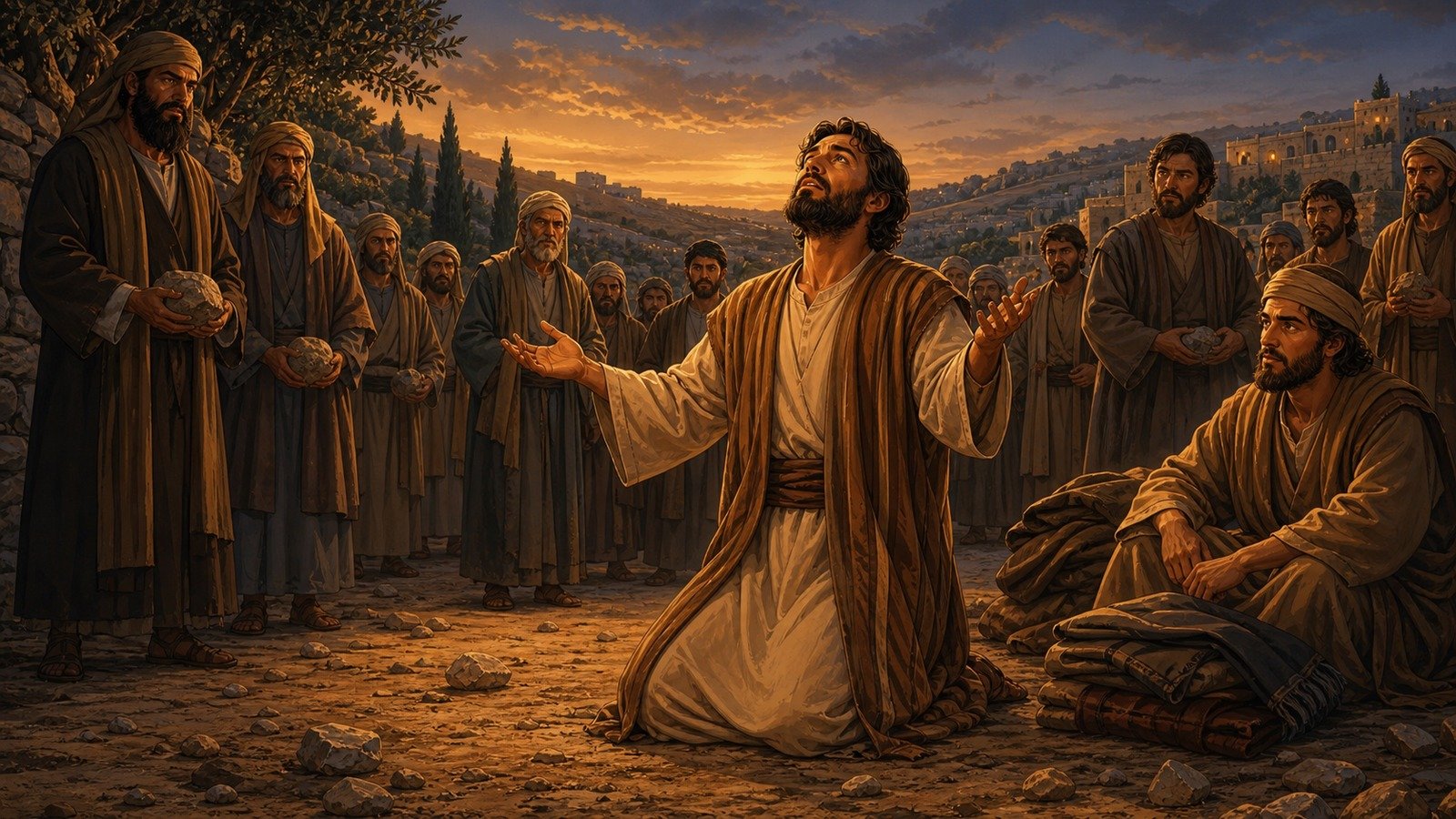
Enraged by Stephen's speech, the Sanhedrin drags him out of the city and stones him; he dies asking forgiveness for his killers, echoing Jesus' own words on the cross, while a young man named Saul looks after the coats of those throwing the stones and approves of his death.
Further context
2 min readWhen the members of the Sanhedrin heard this, they were furious and gnashed their teeth at him.
Stephen, full of the Holy Spirit, looks up to heaven and says: look, I see heaven open and the Son of Man standing at the right hand of God.
Two things in that sentence do the damage. Son of Man is the title Jesus had used of himself at his own hearing before the same body, quoting Daniel, and it had produced the charge of blasphemy. And standing is not the usual posture; every other reference has the figure seated at the right hand. Readers have proposed that he stands as a witness for the defence, or to welcome him, and the word is left without explanation.
At this they cover their ears, and yelling at the top of their voices they all rush at him, drag him out of the city and begin to stone him.
The proceedings collapse into a lynching at that point. Whether the council had authority to execute is doubtful, and this looks less like a sentence carried out than a room losing control. Stoning was the prescribed penalty for blasphemy, and the law required the witnesses to throw the first stones, which is why the next detail is there.
Meanwhile the witnesses laid their coats at the feet of a young man named Saul.
That is his first appearance. Within a few years he is travelling to Damascus with warrants to arrest believers, and after that he is the man who wrote a third of the New Testament and carried the message across the empire. He refers to this episode himself in a speech decades later, saying that when the blood of Stephen was shed he stood there giving his approval and guarding the clothes of those who were killing him.
While they were stoning him, Stephen prayed: Lord Jesus, receive my spirit. Then he fell on his knees and cried out, Lord, do not hold this sin against them. When he had said this, he fell asleep.
Both sentences are versions of things said from the cross.
And Saul approved of their killing him.
What follows immediately is a general persecution that scatters the church out of Jerusalem into Judea and Samaria, which is precisely the direction the commission had named, achieved by the last means anyone would have chosen.
Stephen is the first Christian killed for the faith, and the Greek word for witness, martys, begins its long journey towards the English martyr from about this point.
His speech and death also mark the moment the movement stops being containable inside Jerusalem. The persecution that follows scatters believers through Judea and Samaria, and those who scattered preached wherever they went, which is how the message reached Samaria, then the coastal cities, then Antioch, where the followers were first called Christians.
The man guarding the coats becomes the most travelled preacher of the next thirty years.
Devout men buried him and mourned deeply for him, which under the circumstances took some courage of its own.