

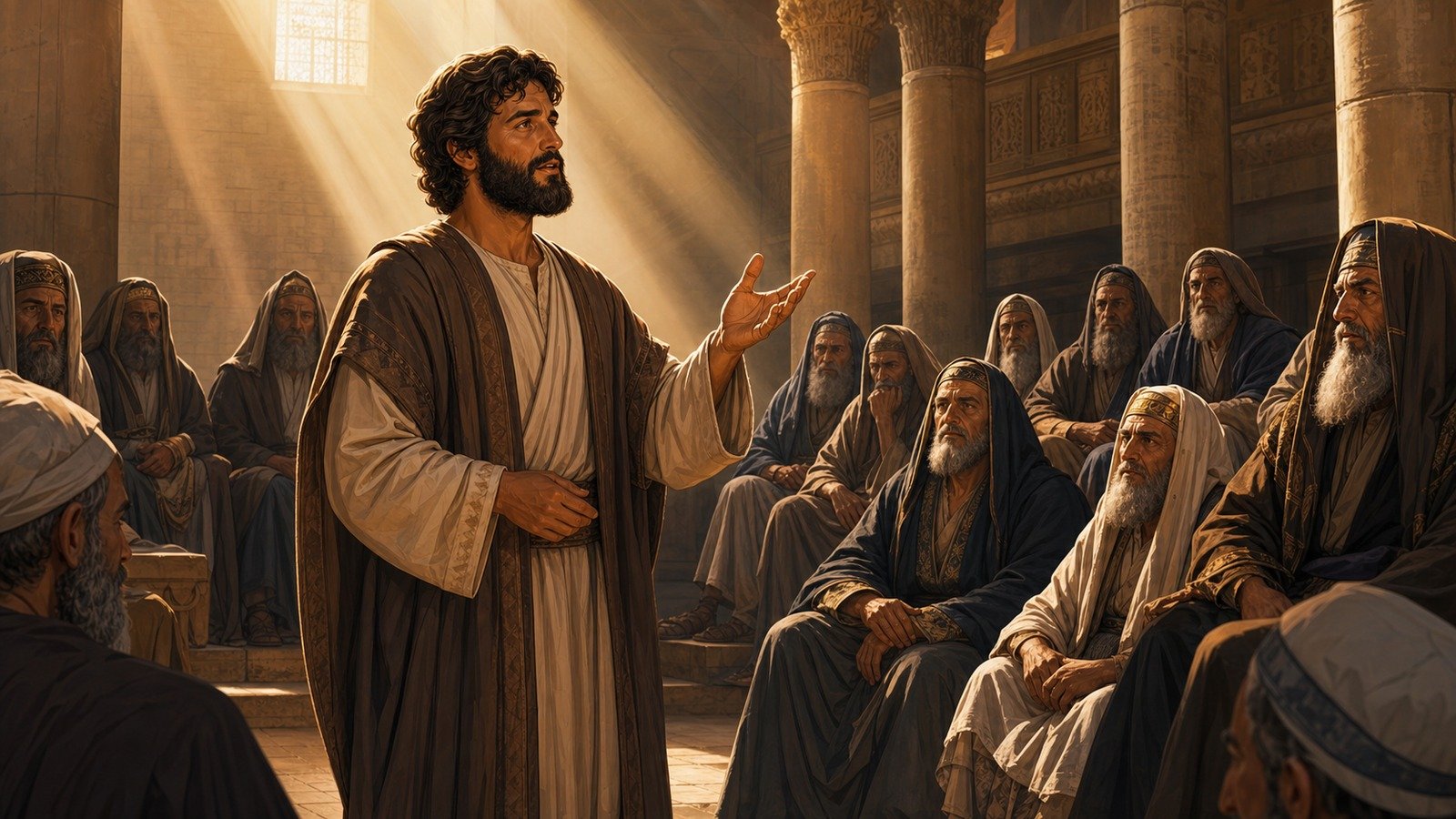
Rather than answering the charges directly, Stephen retells Israel's history from Abraham to Solomon, arguing that Israel has repeatedly resisted God's messengers, and closes by accusing his own judges of the same pattern, "you always resist the Holy Spirit."
Further context
2 min readAsked whether the charges are true, Stephen answers with a history lesson, and it is the longest speech in the record of the early church.
The strategy looks evasive and is not. He is accused of speaking against the temple and against Moses, so he retells Israel's story in a way that answers both charges by changing the ground under them.
He begins with Abraham, and the first thing he establishes is a location: the God of glory appeared to our father Abraham while he was still in Mesopotamia, before he lived in Harran. Not in the land, and certainly not in a building.
Then Joseph, sold into Egypt by the patriarchs out of jealousy, and God was with him there. Then Moses, who takes up a third of the speech and is presented with a particular emphasis. He tried to help his own people and was rejected: who made you ruler and judge over us? He met God at a burning bush in the desert of Sinai, on ground called holy, which was in Midian, outside the land altogether. He was sent back to the people who had rejected him.
Our ancestors refused to obey him. Instead, they rejected him and in their hearts turned back to Egypt.
That is the thread, and by this point everyone listening can see where it is going.
On the temple, his argument is careful. The tabernacle was made according to the pattern God showed Moses, and it was portable. David asked to build a dwelling, and Solomon built the house. Then a quotation from Isaiah: the Most High does not live in houses made by human hands. Heaven is my throne, and the earth is my footstool. What kind of house will you build for me?
Nothing there attacks the temple, and none of it is new; it is a prophet's own line, quoted accurately.
Then, without transition, the speech turns and becomes an accusation.
You stiff-necked people! Your hearts and ears are still uncircumcised. You are just like your ancestors: you always resist the Holy Spirit! Was there ever a prophet your ancestors did not persecute? They even killed those who predicted the coming of the Righteous One. And now you have betrayed and murdered him, you who have received the law that was given through angels but have not obeyed it.
The charge against him was that he spoke against the law. His last sentence accuses the court of not keeping it.
The speech contains several details that differ from the Hebrew text of the Old Testament and match the Greek translation used in the diaspora, including the number of Jacob's family who went down to Egypt. That is exactly what would be expected from a Greek-speaking Jew arguing before a Jerusalem court, and it is a small mark of authenticity rather than of carelessness.
It is also the longest single block of material in the record of the early church, given by a man who appears in only two chapters and is dead by the end of them.