

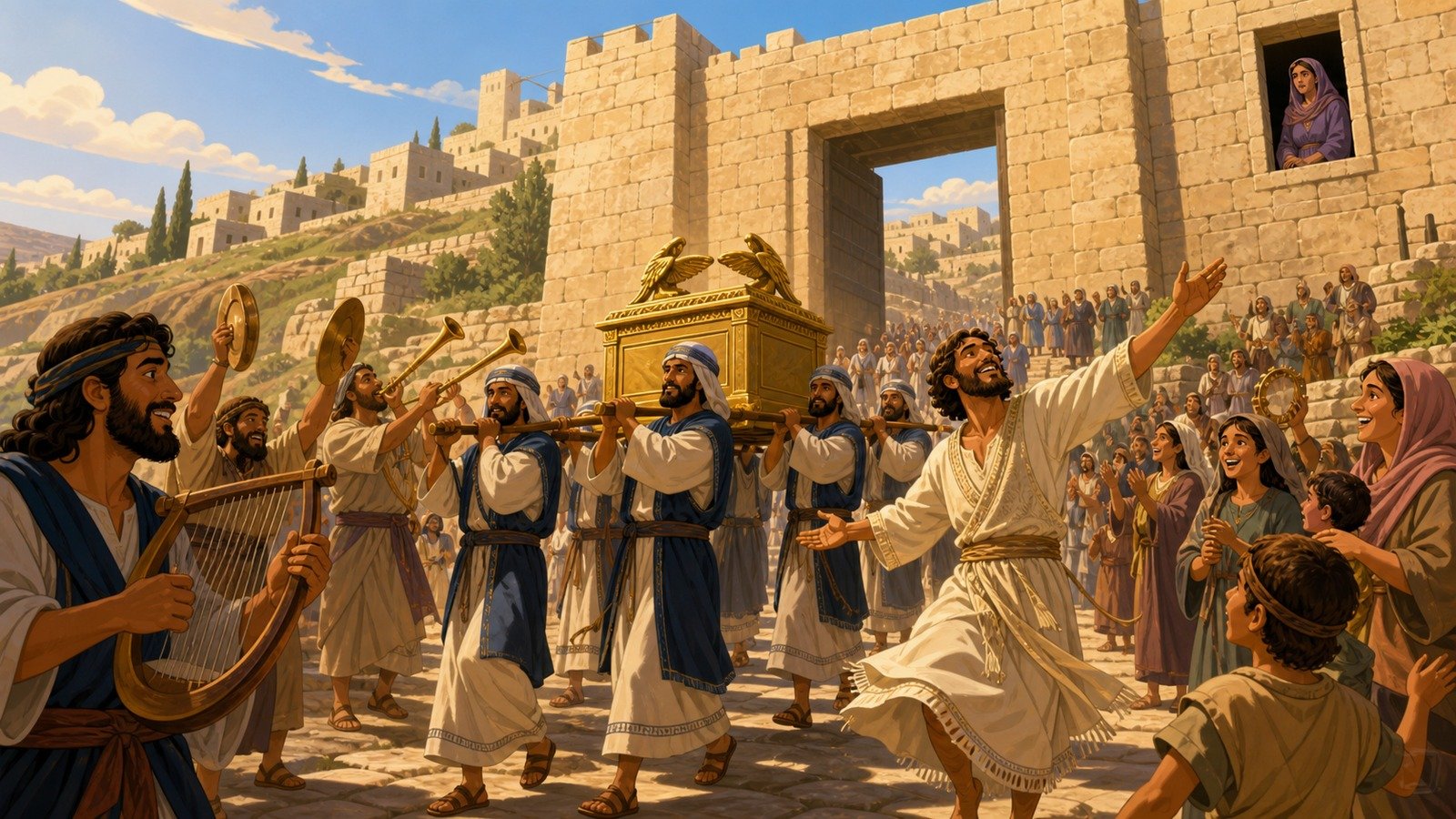
David brings the ark of the covenant to Jerusalem amid celebration, though the first attempt ends in Uzzah's death for touching it improperly; on the second, successful attempt David dances before the ark, drawing his wife Michal's contempt.
Further context
2 min readThe ark has been in a private house at Kiriath Jearim for something like seventy years, since the Philistines sent it back on a cart. Bringing it to the new capital is the move that makes Jerusalem the religious centre as well as the political one, and David goes about it with thirty thousand men and a great deal of enthusiasm.
He also goes about it wrong. The ark is put on a new cart, which is exactly how the Philistines had returned it, and is precisely not how it was supposed to be moved. The instructions were explicit: poles through rings, carried on the shoulders of Levites, never touched. What is being copied here is Philistine practice.
The oxen stumble at a threshing floor and Uzzah reaches out and takes hold of the ark to steady it, and he dies there beside it.
David's reaction is anger and then fear, and both are recorded. He is angry because the LORD's wrath had broken out against Uzzah, and afraid enough to say, how can the ark of the LORD ever come to me? He leaves it at the house of Obed-Edom the Gittite for three months, and that household is blessed, which is what finally persuades him to try again.
The second attempt is done properly, with the ark carried and with sacrifices offered after the first six steps, and this is where the well-known scene occurs. David, wearing a linen ephod, dances before the LORD with all his might, and the whole house of Israel brings the ark up with shouts and the sound of trumpets.
Michal, Saul's daughter, watches from a window and despises him in her heart. When he comes home she meets him with sarcasm: how the king of Israel has distinguished himself today, going around half-naked in full view of the slave girls of his servants as any vulgar fellow would.
His answer is brutal and precise: it was before the LORD, who chose me rather than your father or anyone from his house when he appointed me ruler over the LORD's people Israel. I will celebrate before the LORD. I will become even more undignified than this, and I will be humiliated in my own eyes. But by these slave girls you spoke of, I will be held in honour.
The exchange is not really about dancing. She is the last of Saul's house and she is watching the man who replaced it celebrate, and he answers by naming exactly that.
The three months at the house of Obed-Edom are worth noticing for who he was. He is called a Gittite, which most naturally means a man from Gath, so the ark spends a season in the household of a Philistine or a man of Philistine descent, and that household prospers. The object that had killed a man for touching it, and had wrecked a temple in Ashdod, sits quietly in a foreigner's house for three months and is a blessing to it.
The closing line has been read as a judgement and is more likely a simple statement of a marriage that ended that day: Michal daughter of Saul had no children to the day of her death. A child of hers would have united the two houses. There is not one.