

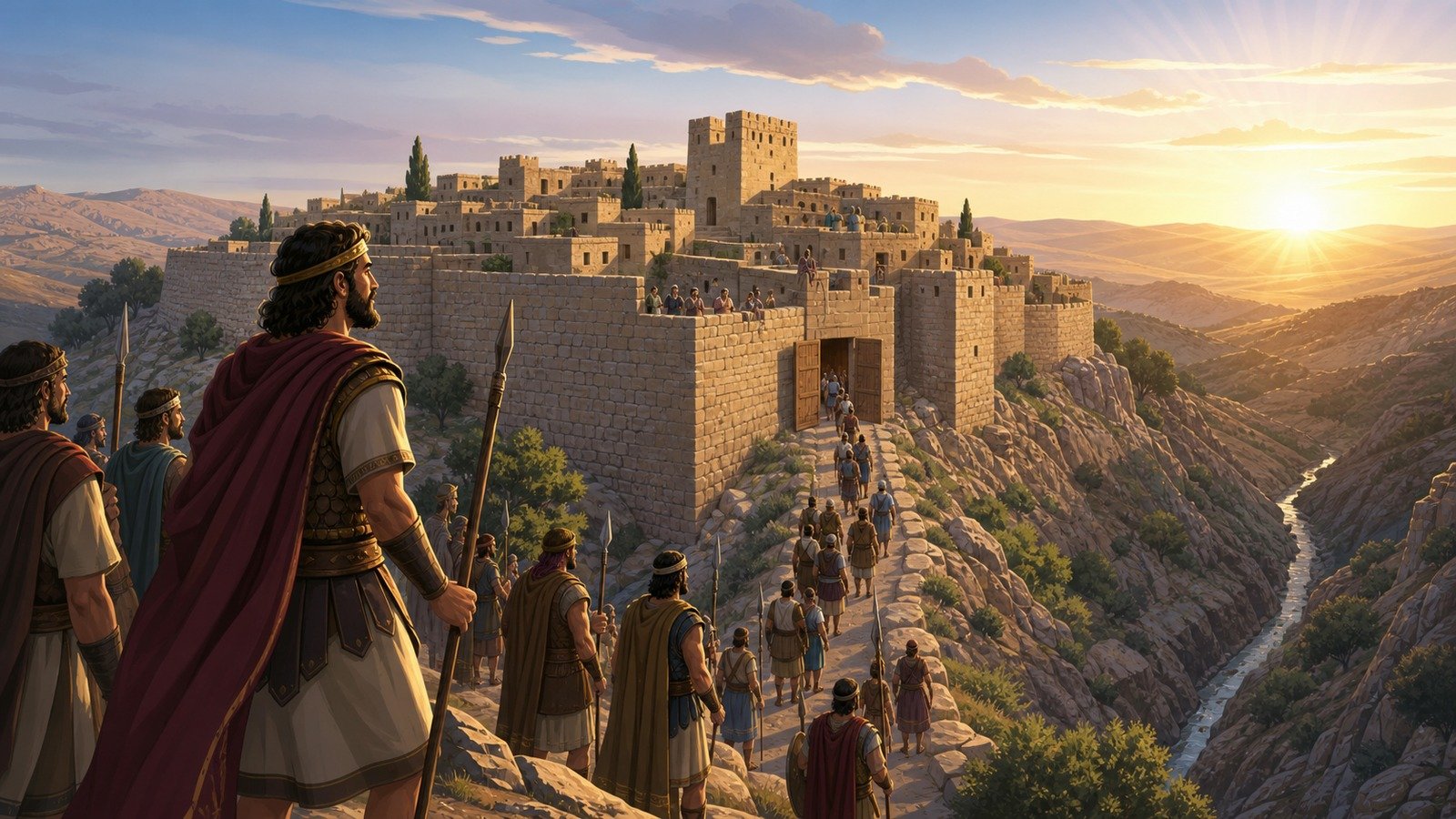
David captures the Jebusite stronghold of Jerusalem, previously thought impregnable, and makes it his new capital, strategically neutral between the northern and southern tribes.
Further context
2 min readJerusalem at this point is not an Israelite town and never has been. It is held by the Jebusites, sits on the boundary between Judah in the south and Benjamin in the north, and had resisted capture through the entire period of the judges. That is precisely why it is chosen.
A newly unified kingdom needs a capital, and using Hebron would have made the north feel conquered by Judah, while any northern town would have alienated the south. Taking a city that belongs to neither and making it the king's personal possession solves the problem. It is called the City of David from then on, which is a statement about ownership.
The Jebusites are contemptuous. Even the blind and the lame can ward you off, they say, on the assumption that the fortifications on the ridge above the Kidron valley made an assault impossible. The site is naturally strong on three sides, and its water supply came from the Gihon spring outside the walls.
The capture turns on that water supply. David offers command of the army to whoever leads the assault and says the way in is by the tsinnor, a word that appears only twice in the Hebrew Bible and whose meaning is uncertain. It has been translated as water shaft, gutter, or grappling hook. Excavations on the eastern slope have found a complex of rock-cut tunnels and shafts connecting the spring to the interior of the city, known as Warren's Shaft after the engineer who explored it in 1867, and a massive fortified tower over the spring itself. Whether any of those was passable by a climbing man in the eleventh century BC is disputed, and the identification remains a reasonable guess rather than a demonstration.
Joab goes up first and gets his command.
One line in the aftermath is easy to read past and it is the theological summary of the whole reign: he became more and more powerful, because the LORD God Almighty was with him. That formula recurs at every stage of his rise, from the sheepfold to the throne, and it is the writers' answer to a question the surrounding chapters raise repeatedly, which is how a fugitive with six hundred debtors ended up running an empire.
Building follows immediately: David occupies the fortress, builds up the area around it starting from the terraces inward, and becomes more and more powerful. Hiram king of Tyre sends cedar logs, carpenters and stonemasons, and a palace is built. That is the first appearance of a relationship with the Phoenician coast that will supply the materials and craftsmen for the temple a generation later.
A list of children born in Jerusalem is given, and one name in it is Solomon.
The city he takes is small. The ridge it sits on encloses something on the order of five hectares, which would hold perhaps two thousand people. Everything that Jerusalem becomes over the following three thousand years starts from a fortified village on a spur above a spring, chosen because it belonged to nobody.