

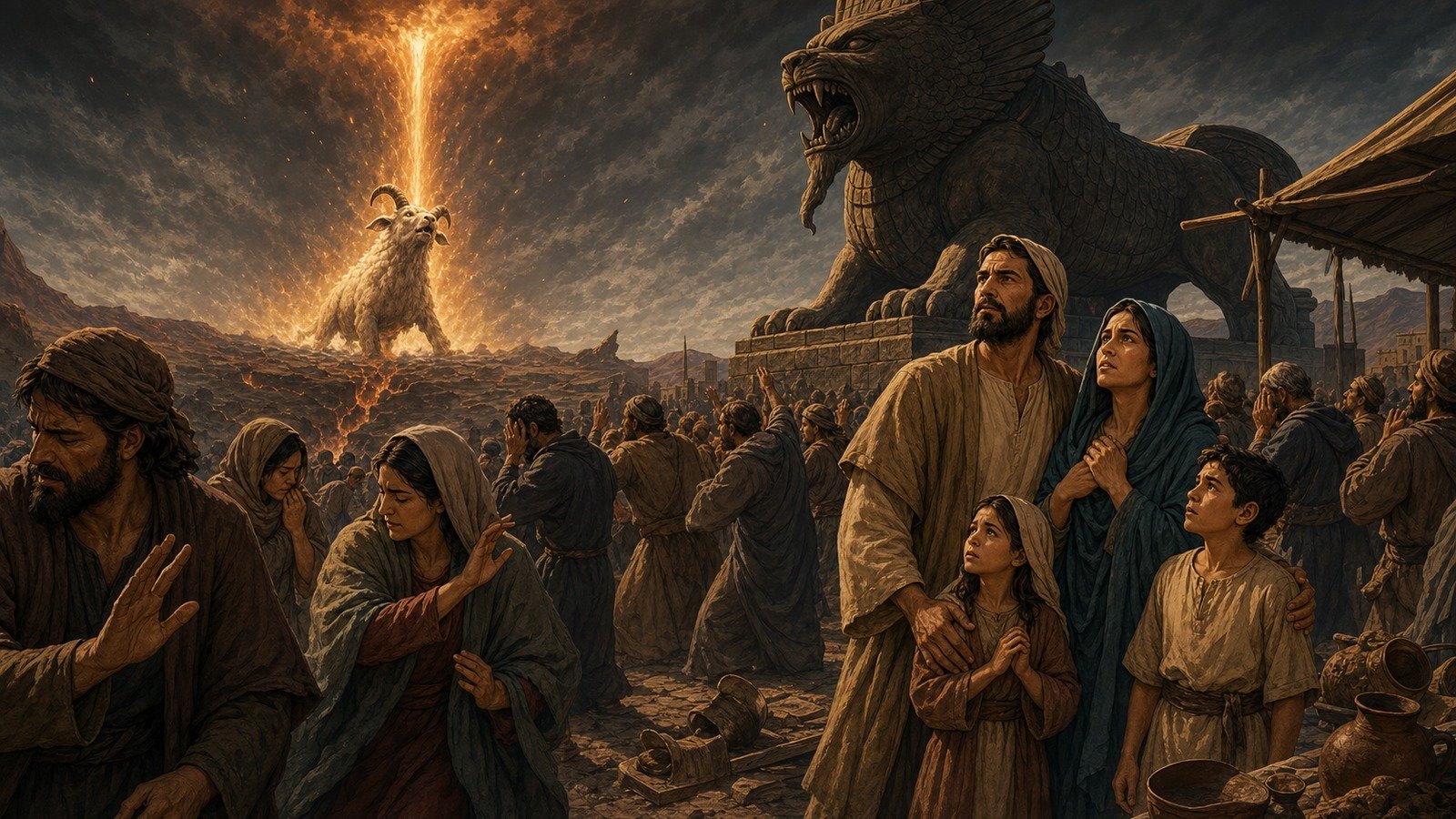
A second beast emerges, performing deceptive signs and forcing everyone to receive a mark, without which no one can buy or sell; the passage closes with the famously cryptic instruction to calculate the beast's number, "666."
Further context
2 min readA second beast comes up out of the earth. It has two horns like a lamb but speaks like a dragon.
Its role is entirely secondary and it is described precisely: it exercises all the authority of the first beast on its behalf, and makes the earth and its inhabitants worship the first beast. Later in the book it is given a different title, the false prophet.
It performs great signs, even causing fire to come down from heaven in full view of the people, and by these signs it deceives them. It orders them to set up an image in honour of the first beast, and is given power to give breath to the image so that it can speak and cause all who refuse to worship it to be killed.
The machinery being described is recognisable. The imperial cult in Asia was run by provincial officials and local elites, not by Rome directly; temples were built by the cities competing for the honour, statues were erected, and priesthoods were a route to status. Ancient writers describe temple mechanisms that made statues appear to speak, and the technology existed.
Then the economic clause, which is what most readers remember. It forces all people, great and small, rich and poor, free and slave, to receive a mark on their right hands or on their foreheads, so that they could not buy or sell unless they had the mark, which is the name of the beast or the number of its name.
The mark is set against the seal placed on the foreheads of God's servants earlier, and the two are opposites: both mark ownership.
This calls for wisdom. Let the person who has insight calculate the number of the beast, for it is the number of a man. That number is 666.
Hebrew and Greek used letters as numerals, so every name had a numerical value, and the practice of calculating them was common enough to appear as graffiti at Pompeii. The oldest and most widely accepted solution is that Nero Caesar, written in Hebrew letters, totals 666. It is supported by a variant reading of 616 in some manuscripts, which is what the same name yields with the Latin spelling.
Whether that exhausts it is another matter, and the book's own instruction is to calculate.
Calculating the numerical value of a name was called gematria in Hebrew and isopsephia in Greek, and it was a common enough pastime to appear scratched on walls: one Pompeian graffito reads, I love her whose number is 545.
What the mark on the hand and forehead alludes to is the instruction in the law to bind God's commands as a sign on the hand and on the forehead, which produced the small boxes worn at prayer. The imitation is exact and deliberate.
Six hundred and sixty-six has attracted more speculation than any other number in the Bible, and almost every generation has found a contemporary figure whose name fits. That the calculations always work is a comment on the method.