

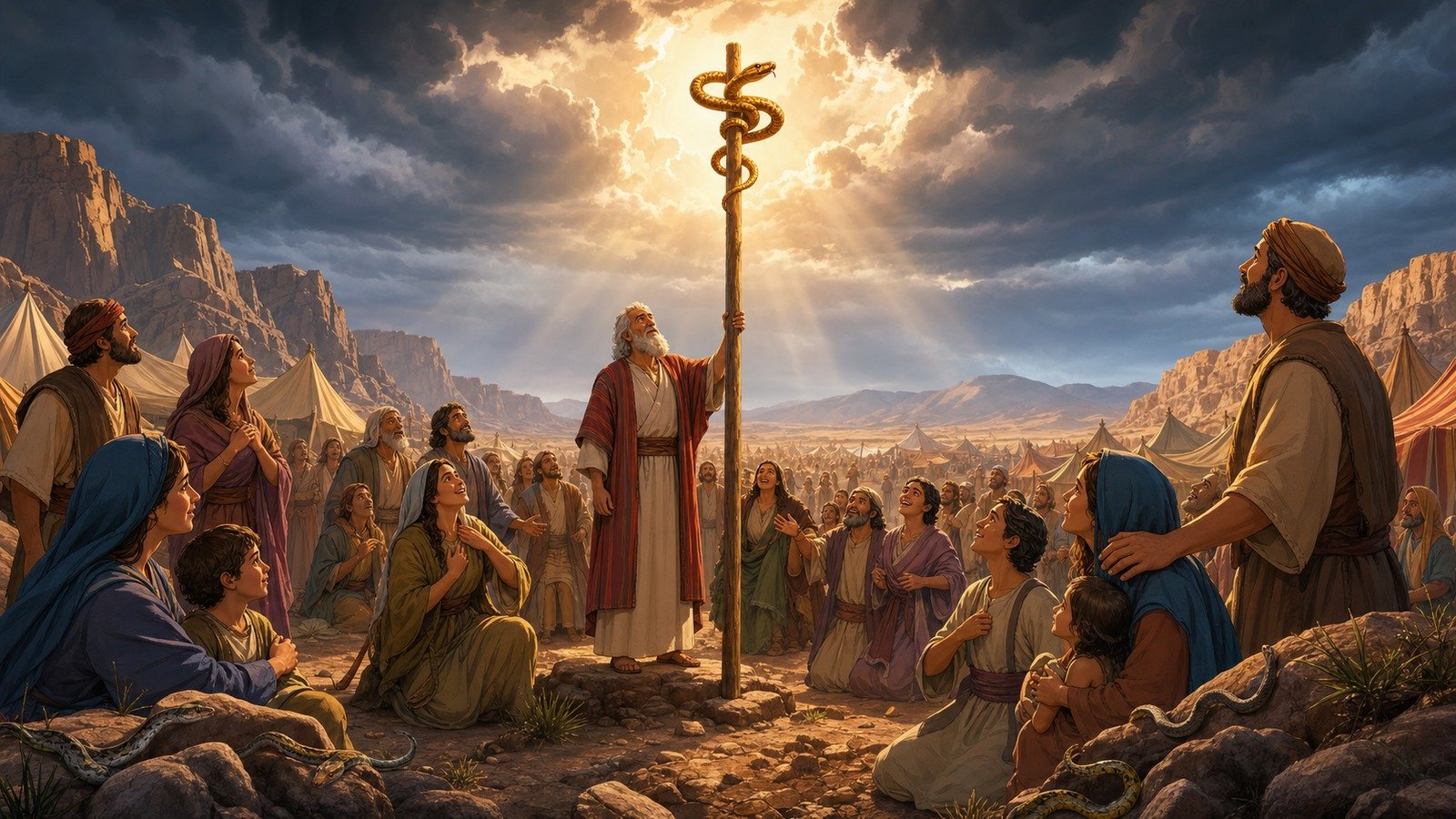
Israel again complains, and venomous snakes attack the camp. God instructs Moses to mount a bronze snake on a pole so that anyone bitten who looks at it lives, a healing sign Jesus later applies to himself.
Further context
2 min readEdom's refusal forces Israel on a long detour south, and the effect of it is summarised in one clause: the people grew impatient on the way. They are walking away from the land in order to go round a territory that would not let them through.
The complaint is the familiar one with a new edge. Why have you brought us up out of Egypt to die in the wilderness? There is no bread! There is no water! And we detest this miserable food! The last two statements contradict each other. There is food, it is the manna, and they are complaining about it in the same breath as claiming there is none.
Venomous snakes come among the people and many die. The Hebrew calls them burning ones (seraphim), which is usually taken as a description of what the venom feels like, and the same word is used of the winged figures in Isaiah's vision of the temple.
The people come to Moses with a straightforward confession: we sinned when we spoke against the LORD and against you. Pray that the LORD will take the snakes away from us. He prays.
The snakes are not taken away. That is the feature of this episode most often missed. What is provided instead is a remedy inside the danger. He is told to make a snake and put it up on a pole, and anyone who is bitten can look at it and live. He makes one of bronze, and the Hebrew keeps the sound of it: the snake is a nachash and the metal is nechoshet.
The arrangement is deliberately awkward. An image is made, on instruction, in a community that has been given a commandment against images, and what is lifted up for the afflicted to look at is a representation of the thing that is killing them. Nobody is cured by an ointment or a prayer or an antidote. They are told to look at the problem.
The object survived, and its later history is on record. Some seven centuries afterwards a reforming king of Judah had it broken into pieces, because people had been burning incense to it, and by then it had acquired a name of its own. A remedy given by God had become an idol, and the same books that record the rescue record the demolition.
The route being taken is the reason for the mood. Having been refused passage through Edom, they are walking south along the Arabah towards the Gulf of Aqaba in order to go round it, which means several weeks of moving directly away from the country they are trying to enter, through some of the driest terrain in the region. The complaint about there being no water is, on that road, largely accurate.
Jesus took the image up in a night-time conversation with a Pharisee: just as Moses lifted up the snake in the wilderness, so the Son of Man must be lifted up, that everyone who believes may have eternal life in him. The verb used there for lifting up carries both crucifixion and exaltation, and the comparison is not to a healing but to something being raised on a pole in front of people who are dying.