

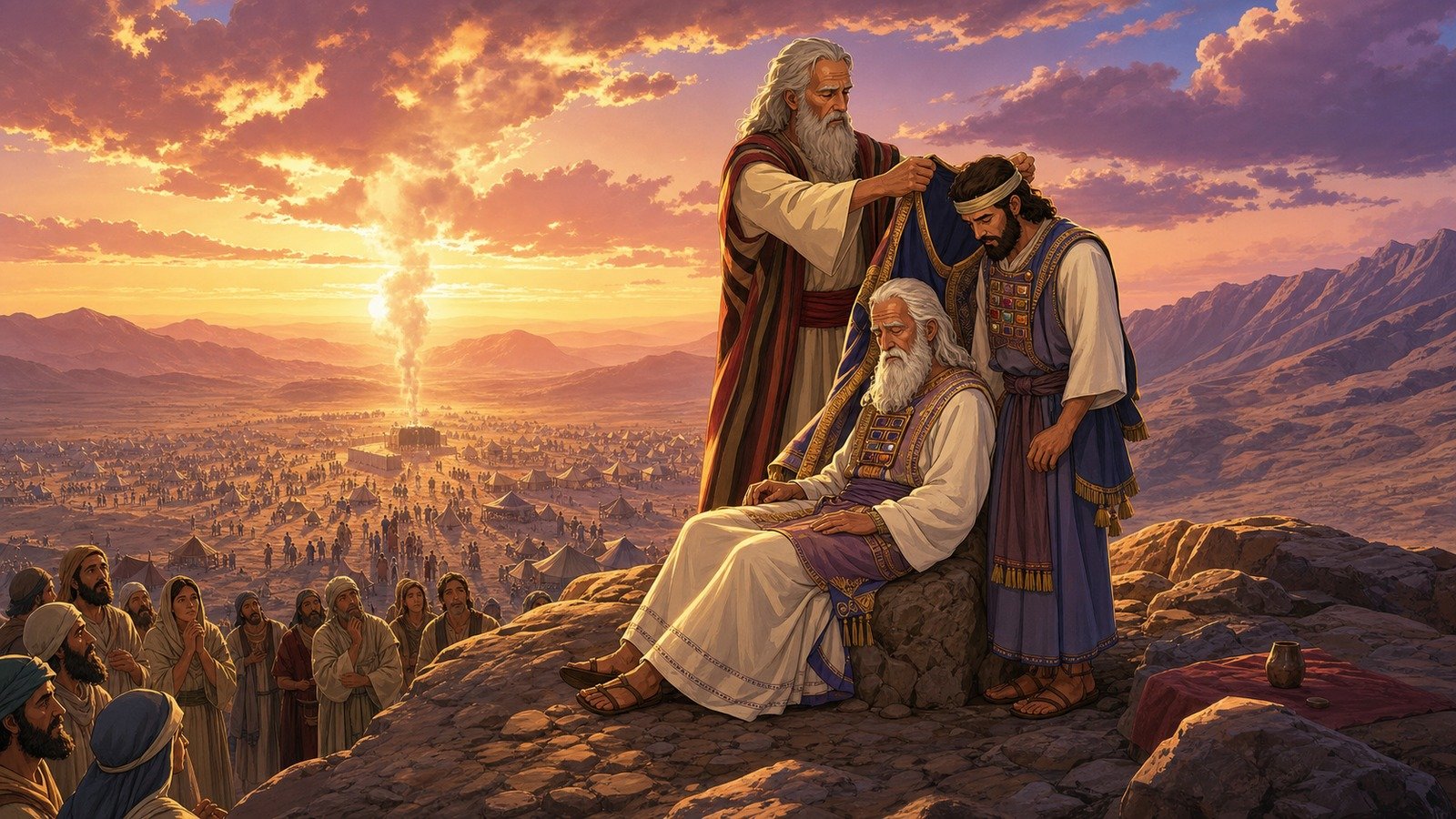
Aaron dies on Mount Hor at 123, and the priesthood passes to his son Eleazar, marking the end of the first high priestly generation before Israel enters Canaan.
Further context
2 min readThe immediate background is a diplomatic failure. Messengers were sent to the king of Edom asking permission to pass along the King's Highway, promising not to enter fields or vineyards or drink from any well, and offering to pay for any water taken. The appeal was made on grounds of kinship, addressing the Edomites as brothers, since they descend from Esau. Edom refused and came out with a large army, and Israel turned away.
They travel instead to Mount Hor on the Edomite border. Aaron is told he will not enter the land, for the same reason given to his brother at the waters of Meribah.
Three of them go up the mountain in the sight of the whole community: Moses, Aaron and Aaron's son Eleazar. There Moses removes his brother's priestly garments and puts them on the son, and Aaron dies on the mountain top.
The transfer of the garments is the point of the scene. The robes, the ephod, the breastpiece with its twelve stones and the turban with its gold plate are the office rather than the man's property, and they pass to the next holder while the nation watches from below. The priesthood does not lapse at a death, and the succession is made visible in the most public way available. Moses comes down with a man wearing what his brother wore.
Aaron is a hundred and twenty-three, and his death is dated to the first day of the fifth month of the fortieth year after the departure from Egypt, which is one of the very few precisely dated moments in the whole wilderness period. The house of Israel mourns for thirty days.
One discrepancy should be noted rather than passed over. A later summary states that he died and was buried at Moserah, not at Mount Hor. Proposals for reconciling the two include treating Moserah as the district the mountain stands in, or as the camp the ascent was made from. The location of Mount Hor itself is uncertain; a peak near Petra has carried the tradition since antiquity, and a hill closer to Kadesh has also been proposed.
The refusal by Edom is worth registering because of who Edom was. These were the descendants of Esau, and the appeal was made explicitly on that basis, addressing them as brothers and rehearsing the shared family history. What they refuse is passage on a public road, with payment offered for water. The relationship between the two peoples stays hostile for the next eight centuries, and prophets keep returning to it.
His record is mixed and nothing is done to tidy it. He made the golden calf and offered an excuse for it that convinced nobody. He joined his sister in challenging his brother's standing and escaped the consequence she received. He also stood between the living and the dead with a censer while a plague ran through the camp, held the office for forty years, and buried two sons killed at the altar without a word of complaint.
He dies within sight of a country he is not allowed to enter, and his son walks back down the mountain wearing his clothes.