

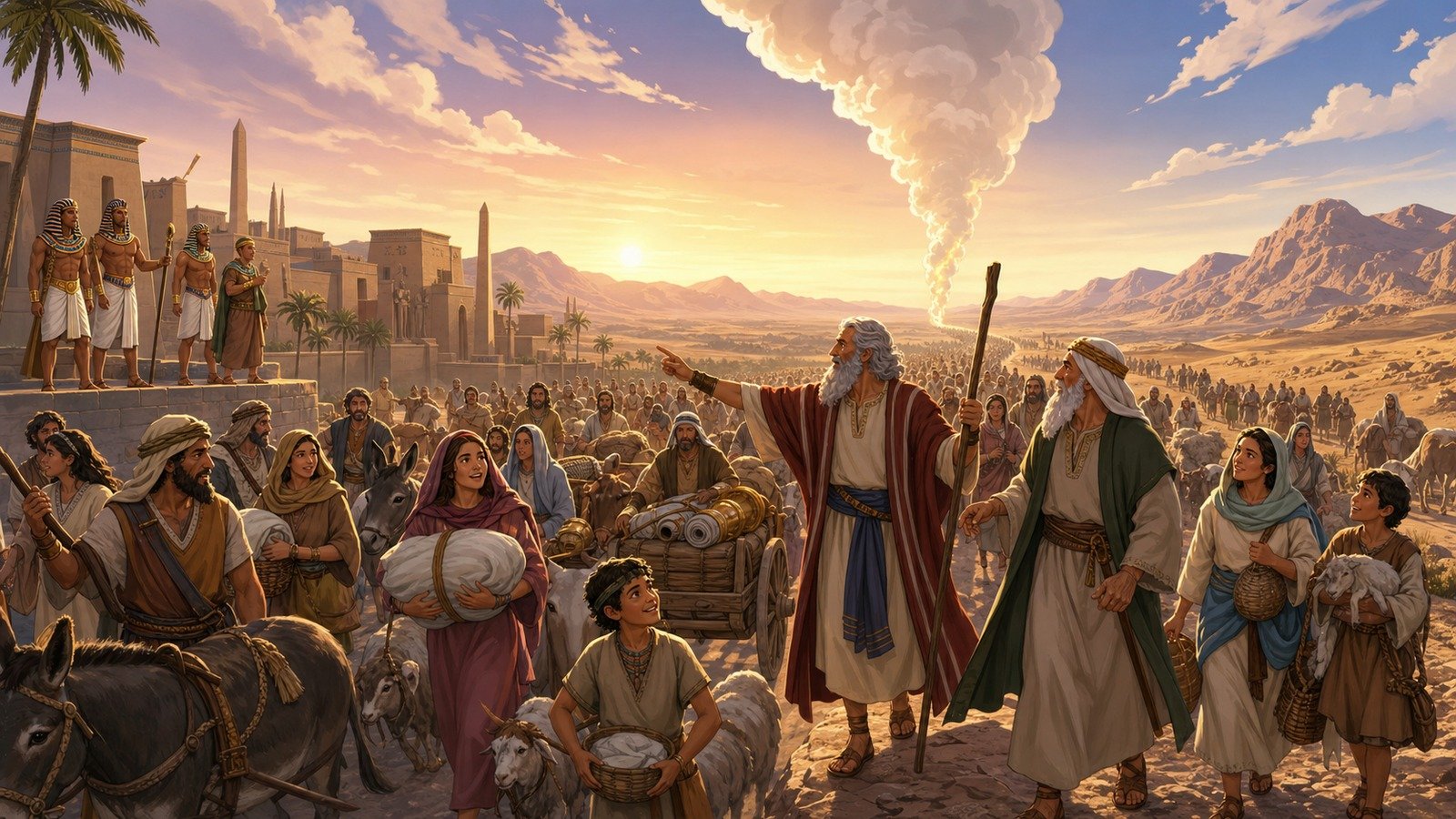
Pharaoh finally lets Israel go; around 600,000 men plus women and children leave Egypt after 430 years, taking unleavened dough and Egyptian plunder with them. God leads them by pillar of cloud by day and fire by night.
Further context
3 min readPharaoh summons Moses and Aaron during the night and gives way completely. Up, leave my people, you and the Israelites. Go, worship the LORD as you have requested. Take your flocks and herds, as you have said, and go. Those last words are the ones he has resisted through ten rounds, and he adds a request of his own: and also bless me.
The Egyptians urge the people to hurry, saying otherwise they will all die, and the Israelites leave with their dough before it is leavened, carrying kneading troughs wrapped in clothing. They ask their neighbours for articles of silver and gold and for clothing and are given them, which is presented as the settlement of an unpaid account after generations of forced labour.
Two figures here are the most discussed in the whole book. The first is the duration: at the end of four hundred and thirty years, to the very day, all the LORD's divisions left Egypt. The second is the size: about six hundred thousand men on foot, besides women and children, together with many other people who went up with them, a mixed group never identified further.
Six hundred thousand adult men implies a total population around two million, and several difficulties attach to that, all of them arithmetical rather than sceptical. A column that size would stretch for many days' march. The Sinai peninsula has no capacity to support it. The figure exceeds most estimates of Egypt's entire population at the time. And a later census counts the firstborn males of Israel at 22,273, which would mean roughly one firstborn son for every twenty-seven men, which is impossible.
One proposal addresses all of those at once. The Hebrew word translated thousand (eleph) also means a clan or a military unit, and it is used in that sense elsewhere. Reading the census figures as a number of units with a number of men produces a fighting force in the low thousands and a total population of perhaps twenty to thirty thousand. The counter-argument is that the totals in the census chapters are added up as straightforward thousands, which the proposal has to explain. No reconstruction is free of difficulty.
The institutions that carry the memory forward are set out at the same time: the consecration of every firstborn male, seven days of unleavened bread, and a requirement to explain the observance to children who ask what it means.
The route is deliberately indirect. They are not led on the road through Philistine country, though that was shorter, because if they faced war they might change their minds and return to Egypt. That road, which the Egyptians called the Way of Horus, was fortified with garrisons, which is exactly what an escaping labour force could not pass.
The plundering of the Egyptians has troubled readers for a long time and the framing given to it is worth stating precisely. It is not theft and it is not conquest. The Israelites ask and the Egyptians give, and what changes hands is described as favour rather than spoil. Four centuries of unpaid labour building store cities is the background, and the same principle turns up later in Israelite law, which requires that a released servant not be sent away empty-handed but supplied liberally from the flock, the threshing floor and the winepress.
And Moses takes the bones of Joseph, keeping an oath sworn four centuries earlier by a man who never saw the country he was asking to be buried in.