

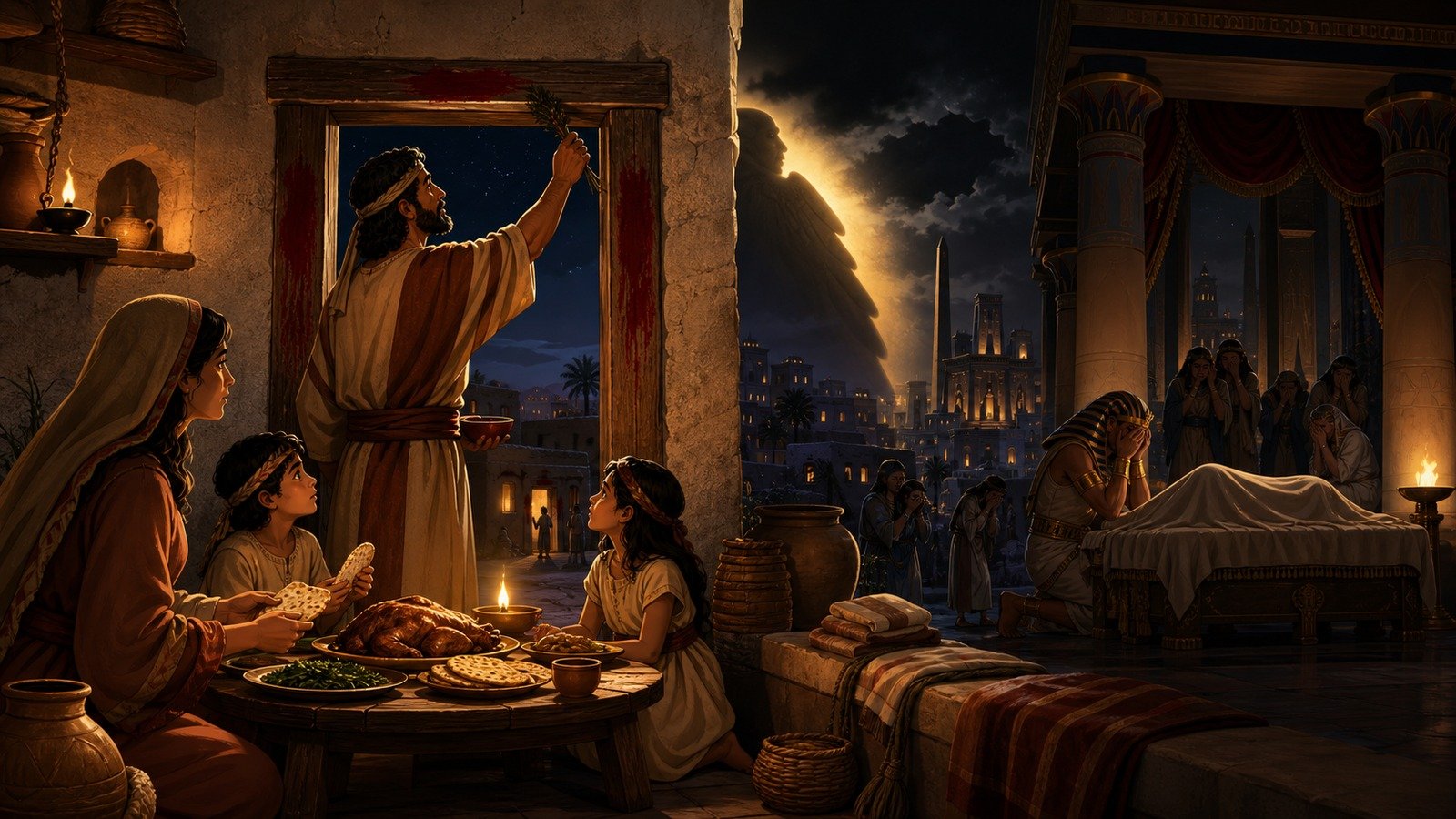
Israel is instructed to sacrifice a lamb and mark their doorframes with its blood so the final plague, the death of every Egyptian firstborn, passes over their houses. Every firstborn son of Egypt, including Pharaoh's, dies that night, finally breaking Pharaoh's resistance.
Further context
2 min readThe confrontation between Moses and Pharaoh stops, and instructions for a meal are given instead, beginning with a reset of the calendar: this month is to be for you the first month, the first month of your year. A nation that does not yet exist is handed a new starting point for counting time.
The instructions are detailed. On the tenth day of the month each household takes a lamb, a year-old male without defect, from the sheep or the goats. Small households join with their neighbours, and the animal is measured against how much each person will eat. It is kept until the fourteenth day and slaughtered at twilight. Some of the blood is put on the two doorposts and the lintel of the house where it is eaten. The meat is roasted over fire, not eaten raw or boiled, and served with bitter herbs and bread made without yeast. Nothing is left until morning. It is eaten with the cloak tucked into the belt, sandals on the feet and a staff in the hand, which is travelling dress, and it is eaten in haste.
The name is explained on the spot. When the judgement passes through Egypt, the blood on the houses will be a sign, and God says he will pass over them. The Hebrew pesach stands behind both the verb and the name of the festival.
One feature separates this from the other nine disasters. Every earlier judgement fell on Egypt and passed over Israel automatically, with Goshen exempted because of where the people happened to live. This one requires an act. The blood has to be applied to the doorframe of each individual house, and the protection attaches to the house rather than to anyone's ancestry. A provision a few sentences later makes the implication explicit by allowing a foreigner living among them to keep the Passover on the same terms as anyone born in the land.
The event itself takes three sentences. At midnight the LORD struck down all the firstborn in Egypt, from the firstborn of Pharaoh, who sat on the throne, to the firstborn of the prisoner in the dungeon, and the firstborn of all the livestock as well. Pharaoh and his officials and all the Egyptians got up during the night, and there was loud wailing in Egypt, for there was not a house without someone dead. The reach of that sentence from throne room to dungeon is the point: this one falls on everyone regardless of rank.
The meal became the central annual observance of Jewish life and is still kept. It is also the most heavily used piece of the Hebrew scriptures in the New Testament. Paul states directly that Christ, the Passover lamb, has been sacrificed. John the Baptist introduces Jesus as the Lamb of God who takes away the sin of the world. John's Gospel places the crucifixion at the hour the Passover lambs were being killed, and quotes the regulation that none of the lamb's bones may be broken. The Last Supper takes place within the Passover season, which is why the accounts of that evening are saturated with the vocabulary of this night.