

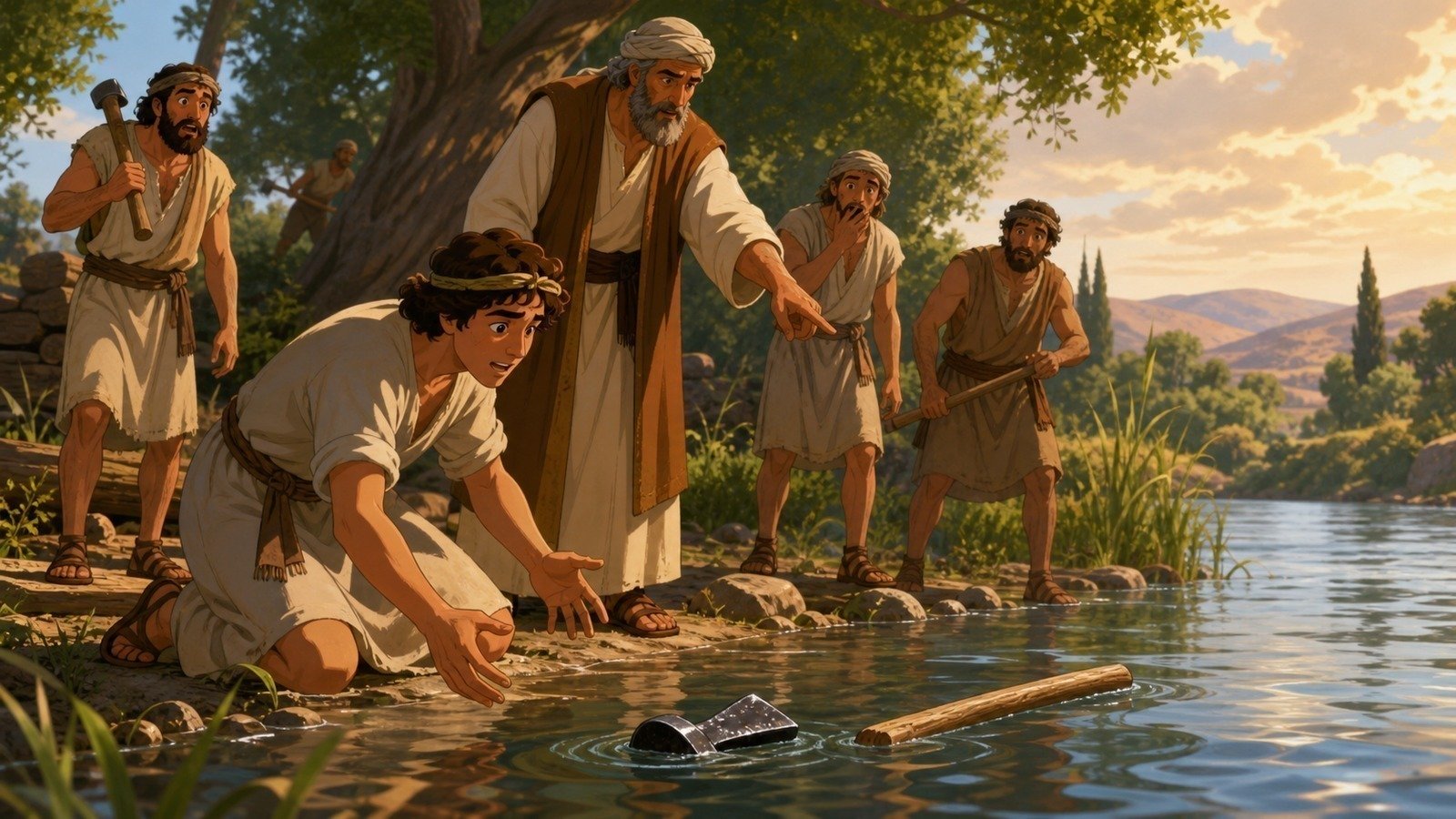
A young prophet loses a borrowed iron axehead in the Jordan while cutting timber; Elisha throws in a stick, and the iron floats to the surface, a small miracle addressing a real financial anxiety over a borrowed tool.
Further context
3 min readThe company of prophets tells Elisha that the place where they meet with him is too small, and proposes going down to the Jordan to cut logs and build somewhere bigger. He agrees, and one of them asks him to come along, which he does.
They are felling trees at the river when an iron axhead flies off its handle and goes into the water, and the man who was using it cries out that it was borrowed.
That is the whole problem, and it is only a problem because of what iron cost. Ironworking had been a Philistine monopoly in the previous era and the metal was still expensive in the ninth century BC. A working axe was a substantial capital item, and a man in a community poor enough that its members lived on charity and one of their widows was facing debt slavery could not replace one. Borrowing tools was normal, and losing a borrowed tool was a debt he had no way to pay.
Elisha asks where it fell, is shown the spot, cuts a stick, throws it in, and the iron floats. He tells the man to lift it out, and the man reaches out his hand and takes it.
Two features of this are worth noticing because they are characteristic of everything recorded about him.
The first is the scale. Nothing national is at stake, nobody is dying, and no king is involved. A workman has lost a tool he borrowed and is embarrassed and frightened about it, and the man who had chariots of fire around him on a hillside cuts a stick and deals with it.
The second is the method. A stick thrown into water is the same order of gesture as salt thrown into a spring, flour thrown into a poisoned stew and a garment laid on a dead child. Nothing about the object matters. The wood does not float the iron; a piece of wood the size of a stick could not lift an axhead. What is described is an ordinary action performed at a stated moment with an outcome that does not follow from it.
The episode also shows what the company of prophets actually was. It is a residential group large enough to have outgrown its accommodation, poor enough to build its own premises and to borrow the tools to do it, and attached to a man they call master and consult about the building work. It is the closest thing the northern kingdom has to a religious institution outside the shrines at Bethel and Dan, and it is a work party on a riverbank.
Iron in that period was expensive enough that a working head was a serious asset, and the man's cry, oh my lord, it was borrowed, is the point of the episode. He had taken on a debt he could not clear, and debt in Israel ended with people being sold.
The Jordan at that stretch is muddy and fast, and an axhead sunk in it is gone. Elisha asks where it fell, cuts a stick and throws it in, and tells the man to lift it out himself.
Almost every Elisha episode is like this in scale. A borrowed tool, a poisoned pot, a widow's jars, a boy who collapsed in a field. He works among ordinary people with ordinary problems, and the contrast with Elijah, who dealt almost entirely with kings, appears to be deliberate.