

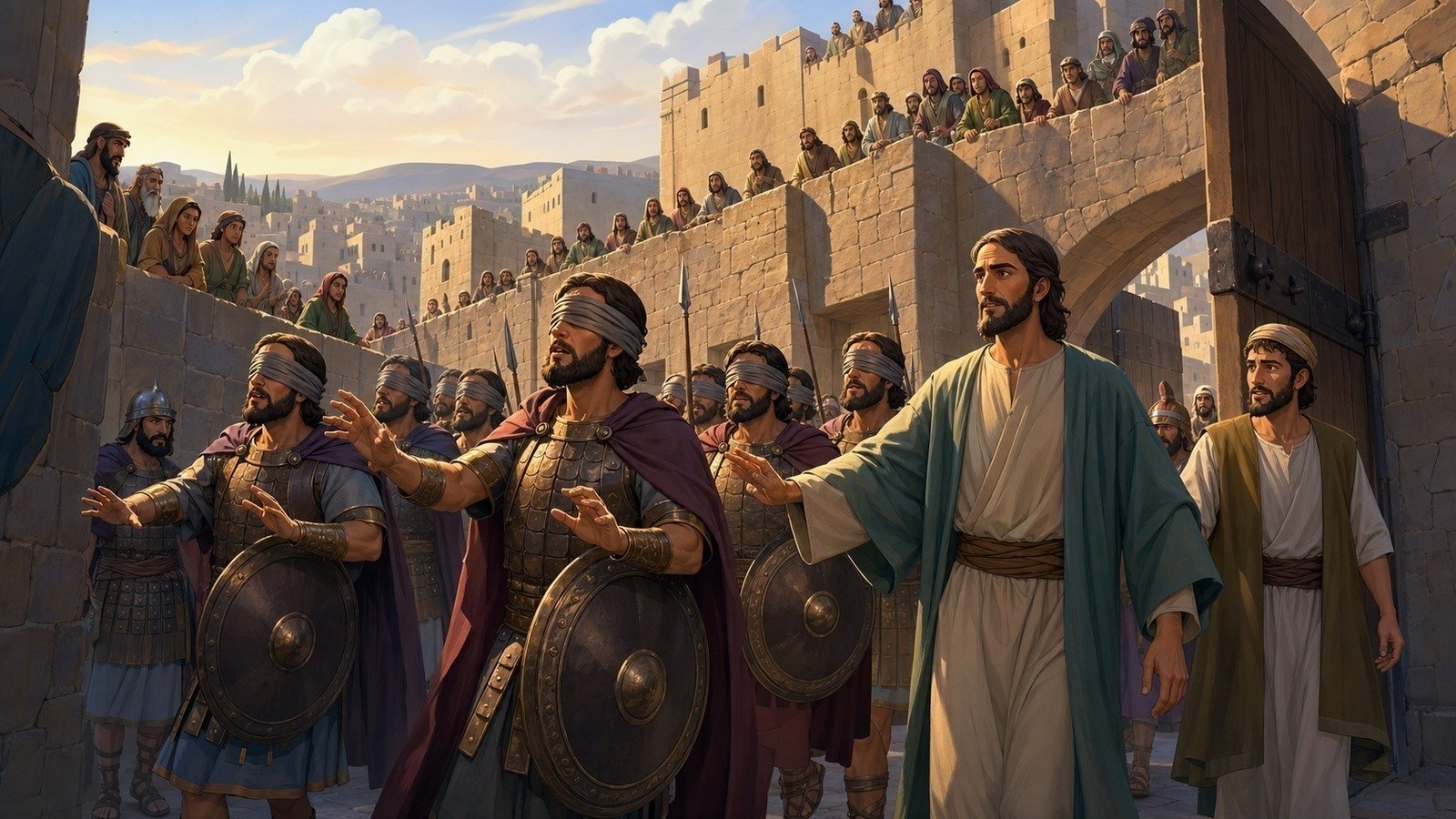
Elisha repeatedly reveals Aramean military plans to Israel's king, and when an Aramean force is sent to capture him, he strikes them with temporary blindness and leads them into Samaria itself before having them fed and released.
Further context
3 min readThe king of Aram is at war with Israel and cannot understand why every ambush he sets is empty when he gets there. He plans a raid, and the Israelite king is warned and avoids the place, not once or twice but repeatedly.
He assumes there is a traitor and calls in his officers to identify him, and one of them tells him the truth: none of us, my lord the king, but Elisha, the prophet who is in Israel, tells the king of Israel the very words you speak in your bedroom. Whether that reputation was earned by anything as specific as it sounds is beside the point; it is what an Aramean staff officer believed.
The response is a special operation. Horses, chariots and a strong force are sent by night to Dothan to surround the town and seize one man.
The servant gets up early, goes out and finds the town encircled, and asks what they are going to do. The answer he gets is arithmetic he cannot check: do not be afraid, those who are with us are more than those who are with them. Then a prayer, and the servant sees the hills full of horses and chariots of fire.
What follows is the least expected thing in the episode. Elisha prays that the Aramean force be struck with blindness, then walks out to them and tells them this is not the road and not the city, and offers to lead them to the man they are looking for. He walks an entire army fifteen kilometres to Samaria, into the middle of the Israelite capital, and then prays that their eyes be opened.
The king of Israel, seeing a blind enemy army standing in his own streets, asks twice whether he should kill them, calling the prophet my father.
The chariots of fire the servant is shown are the same image his master had used when Elijah was taken, and it is the second time the phrase appears. Whatever it describes, it is invisible until somebody's eyes are opened, and the servant had been standing in the middle of it.
The refusal and the instruction that follows are the point of the whole episode: do not kill them. Would you kill those you have captured with your own sword or bow? Set food and water before them so that they may eat and drink and then go back to their master.
A great feast is prepared, they eat and drink, and they are sent home. And the raiding parties from Aram stopped raiding Israel's territory.
That is a prophet with an enemy army helpless in his own capital, refusing an execution and ordering dinner, and reporting afterwards that it ended the raids more effectively than the fighting had.
The Aramean king's frustration is described in a way that gives the whole episode its comedy: he calls in his officers and demands to know which of them is informing for the king of Israel, and one of them tells him that Elisha, the prophet who is in Israel, tells the king of Israel the very words you speak in your bedroom.
His response is to send horses and chariots and a strong force by night to surround Dothan and arrest one man.
Elisha's servant gets up in the morning, sees the army round the town and panics. The prayer that follows is not for rescue: open his eyes, LORD, so that he may see. And the hills are full of horses and chariots of fire.
Then the reverse prayer, striking the army with blindness, and Elisha leads them personally into Samaria before their eyes are opened.