

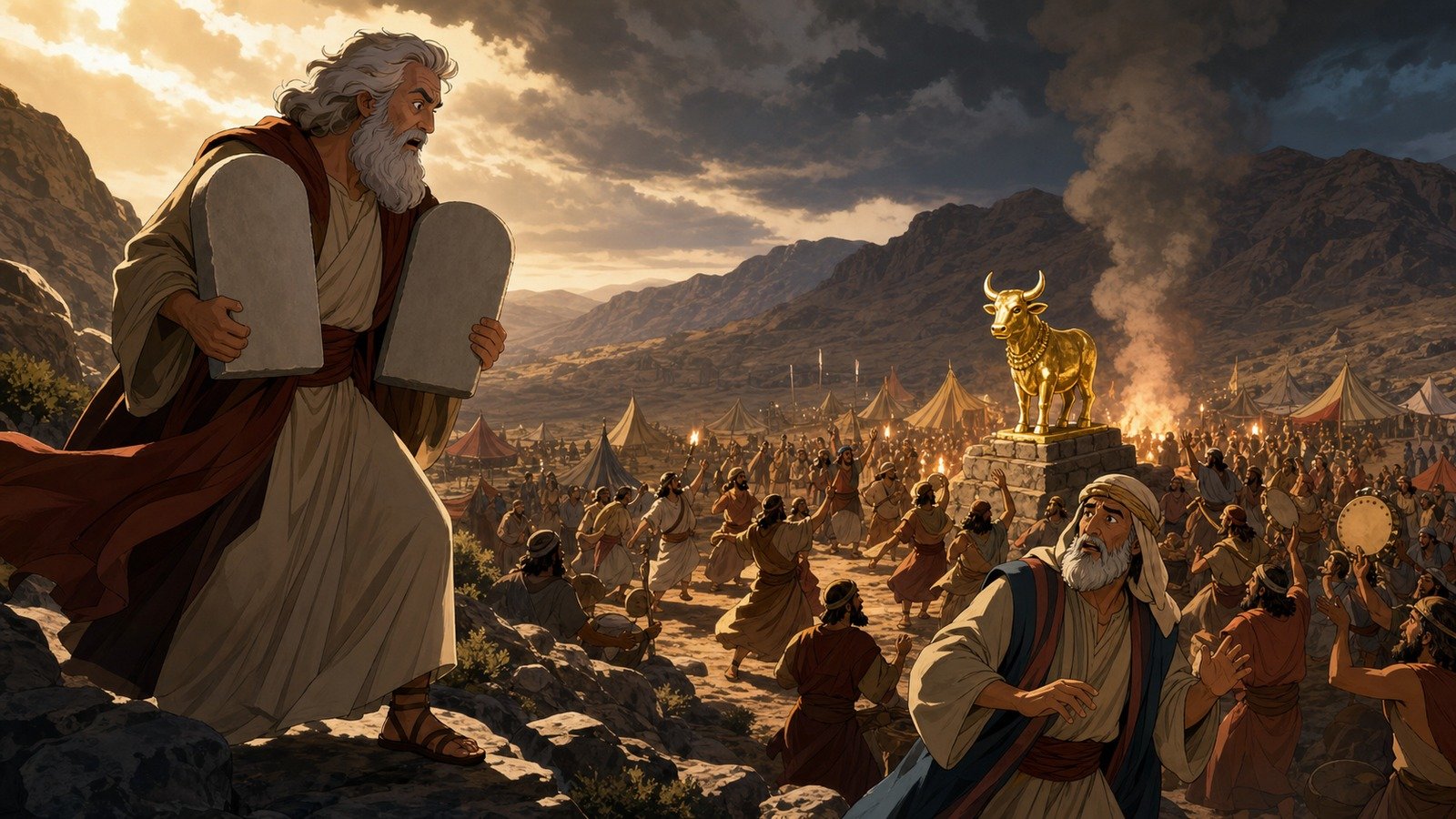
While Moses is on the mountain, Israel persuades Aaron to cast a golden calf and worships it. Moses breaks the tablets in anger on seeing it, and judgement falls on the ringleaders.
Further context
2 min readMoses has been on the mountain for forty days, and the people lose patience. Their words to Aaron are dismissive of the man they are waiting for: as for this fellow Moses who brought us up out of Egypt, we do not know what has happened to him.
Aaron asks for their gold earrings, melts them down and makes an image of a calf. The announcement made over it decides what the offence actually was: these are your gods, Israel, who brought you up out of Egypt. He then builds an altar in front of it and proclaims a festival to the LORD, using the name given at the burning bush.
That combination matters. This is not straightforwardly a switch to a foreign deity. It is an attempt to represent the God who brought them out of Egypt in a visible form, in direct breach of a commandment against images that had been spoken aloud to the whole community a few weeks earlier. A young bull was a standard pedestal or symbol of divine strength in Canaanite and Egyptian iconography, and they are reaching for the visual vocabulary they know.
Moses is told to go down, and the people are called stiff-necked, and then: now leave me alone so that my anger may burn against them and that I may destroy them. Then I will make you into a great nation. The offer made to him is the offer once made to Abraham.
He refuses it and argues on three grounds, none of which concerns Israel's merits. The Egyptians will say God brought them out to kill them in the mountains. God swore by his own name to Abraham, Isaac and Israel. And the promise was of descendants as numerous as the stars and a land given for ever. Then the LORD relented.
Coming down, he hears the noise, sees the calf and the dancing, and throws the tablets down at the foot of the mountain, breaking them. He burns the calf, grinds it to powder, scatters it on water and makes the Israelites drink it.
Aaron's explanation is one of the least convincing sentences anywhere: I threw it into the fire, and out came this calf. His own earlier statement that he asked for the gold and shaped it with a tool sits three sentences above it.
Moses stands at the entrance to the camp and calls for those on the LORD's side. The Levites rally to him, and about three thousand die that day. The following morning he goes back up and offers something extraordinary: please forgive their sin, but if not, then blot me out of the book you have written.
Aaron's position afterwards is the hardest thing here to account for. He made the idol, built the altar and announced the festival, and he is not deposed, not punished and not replaced. Within a few chapters he is consecrated as high priest and his sons after him, which is the arrangement the seven chapters of instructions had already specified before any of this happened. No explanation and no apology for that sequence is offered anywhere, and Moses' intercession for his brother is mentioned only much later, where he says God was angry enough with Aaron to destroy him.